Design Issues of Distributed System (original) (raw)
Last Updated : 16 Apr, 2026
A distributed system consists of multiple independent computers that work together over a network to perform tasks or provide services as a single system. These computers are located in different places but coordinate using software-based communication.
- Computers are connected through a network and communicate with each other, while each machine still works independently.
- They share resources and data across the system to collectively achieve a common goal efficiently.
**Example: web applications, online games, and cloud computing.
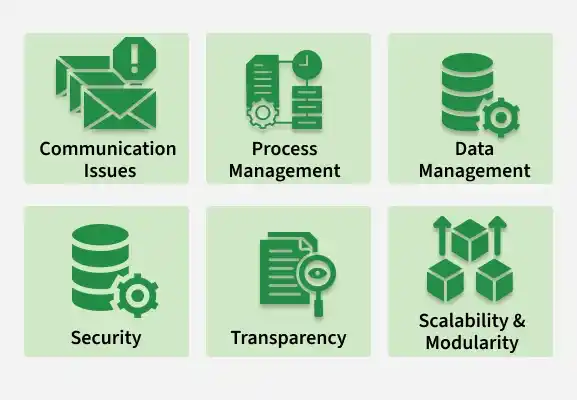
Major Design issues of Distributed Systems.
The following are some of the major design issues of distributed systems.
1. Communication Issues
This issue arises due to network latency and unreliable connections between distributed components.
- **Message Passing: It is a communication method where processes exchange information by sending messages over a network.
- **Communication Latency and Bandwidth: Both latency and bandwidth affect the performance and efficiency of the system.
- **Communication Protocols: These define rules for data exchange between nodes, ensuring reliable and secure transmission.
2. Process Management
This involves creating, scheduling, coordinating, and terminating processes across multiple machines.
- **Process Coordination: It manages the interaction and synchronization of processes across nodes.
- **Process Migration: This involves moving a running process from one node to another to balance load.
- **Thread Management: It controls the execution, scheduling, and termination of threads in the processes.
3. Data Management
This focuses on storing, accessing, and maintaining the consistency of data distributed across different nodes.
- **Data Storage: It manages data across multiple nodes, ensuring efficient access, scalability, and redundancy.
- **Data Access: Efficient access mechanisms ensure quick retrieval, even in systems with large datasets and multiple users.
- **Consistency and Replication: Consistency ensures that all data copies are identical across nodes. Replication improves access speed and fault tolerance.
- **Data Integrity: This ensures data accuracy and consistency throughout its lifecycle, preventing corruption or loss.
4. Fault Tolerance and Reliability
This ensures that the system continues to operate correctly even when some components fail.
- **Failure Detection: It identifies when a node or link fails, allowing the system to take corrective actions.
- **Redundancy and Recovery: Redundancy duplicates critical components across nodes, while recovery mechanisms restore normal operations after failures.
- **Consensus: Consensus ensures distributed nodes agree on decisions, even with failures.
5. Security
Security addresses protecting distributed systems from unauthorized access, data breaches, and malicious attacks.
- **Authentication and Authorization: Authentication verifies the identity of users or systems, while authorization controls access to resources.
- **Cryptography: It secures communication and data using encryption, decryption and cryptographic keys.
- **Data Privacy: Protects personal and sensitive information from unauthorized access and exposure.
6. Scalability and Modularity
Enables the system to grow and evolve without significant performance degradation.
- **Scalable Architectures: Allows the system to handle workloads by adding resources likeserver or storage and maintaining performance as demand increases.
- **Modular Design: Breaks the system into smaller, independent components that can be developed, deployed and scaled separately.
- **Elasticity: Enables a system to dynamically allocate and deallocate resources based on demand.
7. Synchronization and Coordination
Manages the correct ordering and timing of operations among distributed processes.
- **Clock Synchronization: Ensures all nodes in a distributed system share a consistent time, crucial for coordinating tasks and time-sensitive operations.
- **Leader Election: It selects a node to coordinate actions and manage resources, ensuring consistency and preventing conflicts in decentralized systems.
- **Mutual Exclusion: Prevents multiple processes from accessing the same resource simultaneously.
8. Transparency
Hides the complexity of the distributed system from users and applications.
- **Access Transparency: It hides differences in data representation and storage, allowing users to interact with resources uniformly across systems.
- **Location Transparency: It makes the physical location of resources invisible, enabling users to access them without knowing where they are stored.
- **Replication Transparency: It hides the replication of data across multiple nodes, allowing users to access it as if there were a single copy.
9. Performance
This focuses on optimizing response time, throughput, and efficient resource utilization.
- **Load Balancing: It distributes workloads across multiple nodes to optimize resource use, prevent overload and improve system performance.
- **Caching and Cache Management: Caching stores frequently accessed data for faster retrieval, while cache management ensures data is up-to-date.
- **Latency and Throughput: Latency is the delay in data transfer, while throughput measures the data processed per unit of time.
10. Debugging and Monitoring
This involves detecting, diagnosing, and resolving issues across distributed components.
- **Debugging Distributed Systems: This involves identifying and fixing errors across multiple nodes.
- **Event Monitoring: It tracks and records system events across nodes, helping detect issues early and ensuring stability for debugging and optimization.
- **Distributed Tracing: Distributed tracing tracks requests across system components, providing a visual timeline to identify performance issues.
11. Real-Time Systems
This requires strict timing guarantees to ensure responses occur within defined time constraints.
- **Real-Time Scheduling: This assigns tasks within strict timing constraints, ensuring timely execution in mission-critical systems.
- **Quality of Service (QoS): QoS guarantees performance characteristics like bandwidth, latency and reliability, prioritizing critical tasks and ensuring optimal performance in real-time applications.