Authentication vs Authorization in LLD System Design (original) (raw)
Last Updated : 8 Aug, 2025
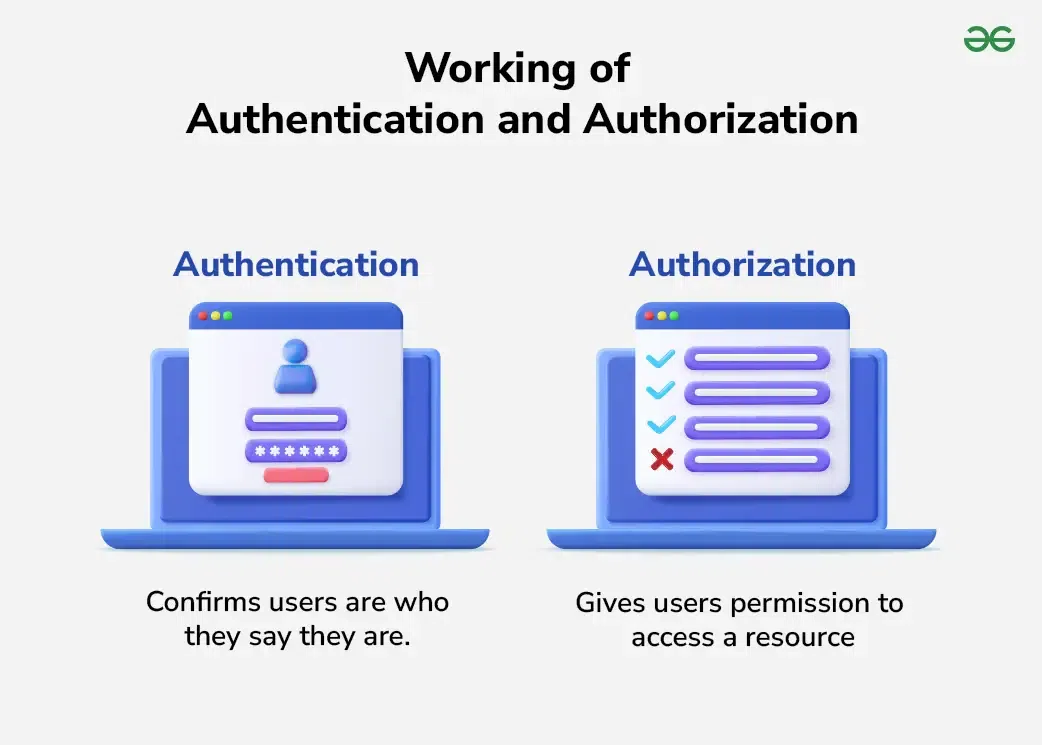
Two fundamental ideas in system design, particularly in low-level design (LLD), are authentication and authorization.
- **Authentication confirms a person's identity.
- **Authorization establishes what resources or actions a user is permitted to access.
Authentication Methods
- **Password-based Authentication
- **Description: The most common form of authentication, in this users provide a unique password to verify their identity.
- **Considerations: Passwords should be complex, stored securely, and users should be encouraged to use unique passwords.
- **Multi-Factor Authentication (MFA)
- **Description: Requires users to provide multiple forms of identification, such as a password and a temporary code is sent to their mobile device.
- **Advantages: Enhances security by adding an extra layer of verification, even if one factor is compromised.
- **Biometric Authentication
- **Description: Involves using unique physical or behavioral characteristics for identification, like fingerprints, facial recognition, or voice recognition.
- **Considerations: Biometric data should be securely stored and processed to prevent unauthorized access.
- **Token-based Authentication
- **Description: Users are given a physical or digital token (like a security key or smart card) for authentication.
- **Advantages: Provides an additional physical element that needs to be present for authentication.
- **OAuth Connect
- **Description: Protocols used for authentication and authorization in the context of web applications and APIs.
- **Use Cases: Commonly used for delegated authorization, allowing third-party applications to access user data.
Ensuring that only authorized individuals or entities have access to particular resources, functionality, or information is an essential component of security.
- **Role-Based Access Control (RBAC):
- Assigning roles to users or groups, letting them access only what their role requires.
- **Example: HR personnel can access HR data but not finance information.
- **Security Assertion Markup Language (SAML):
- Using an XML-based protocol for Single Sign-On, allowing admins to control resource access.
- **Example: Access permissions are communicated through digitally signed documents.
- **OpenID Authorization:
- Checking a user's identity through OpenID standards, ensuring consistency across systems.
- **Example: Standardised authorization based on authentication from an authorization server.
- **OAuth Authorization:
- It allows secure access within applications using permission tokens.
- **Example: Users grant access to their information to certain apps without sharing their password.
- **Device Permissions:
- Granting access based on the device trying to connect to a resource.
- **Example: Only approved devices can establish a connection.
Differences between Authentication and Authorization
| Aspect | Authentication | Authorization |
|---|---|---|
| Definition | Verifies the user's identity. | Determines the user's access to resources or actions. |
| Focus | "Who are you?" | "What are you allowed to do?" |
| Process | Typically involves usernames, passwords, or biometrics. | Involves checking permissions or roles assigned to the user. |
| Order | Happens before Authorization. | Happens after Authentication. |
| Scope | Ensures the user is genuine. | Ensures the user has access rights. |
| Implementation | Login pages, OTP, fingerprint scans. | Role-based access control (RBAC), policy checks. |
| Example | Entering a password to log into an account. | Checking if the logged-in user can view or edit a file. |
| Security Purpose | Protects against unauthorized user access. | Protects against unauthorized actions by authenticated users. |