EventDriven Architecture Patterns in Cloud Native Applications (original) (raw)
Last Updated : 4 May, 2026
Event-driven architecture (EDA) enables cloud applications to respond to events in real time, making them more scalable and responsive. Instead of direct requests, systems communicate asynchronously by producing and consuming events, which helps efficiently handle high traffic and dynamic workloads.
- Event producers generate events when actions occur (like user actions or system updates), while event channels such as message queues or streams carry these events between services.
- Event consumers listen to these events and react by processing data, updating systems, or triggering required actions.
**Example: In a ride-sharing app, when a user books a ride, an event is created. This event is sent through a message queue, and different services like driver matching, notifications, and billing react to it independently without waiting for each other.
Event-Driven Architecture Patterns for Cloud-Native Applications
Event-driven architecture (EDA) patterns for cloud-native applications are design paradigms that enable services to communicate and react to events asynchronously.
- These patterns facilitate the development of scalable, resilient, and loosely-coupled systems by defining how events are produced, transmitted, and consumed across distributed services.
- Key patterns include Publish-Subscribe, Message Queues, Event Sourcing, CQRS, Sagas, and Choreography, each addressing specific needs such as scalability, reliability, and responsiveness in cloud-native environments
Event-Delivery Patterns for Cloud Native Applications
Event-Delivery Patterns in cloud-native applications define how events are transmitted from producers to consumers, ensuring reliable and efficient communication across distributed systems.
1. Publish-Subscribe (Pub-Sub)
Publish-Subscribe (Pub-Sub) is a messaging pattern where events are sent to a common topic, and multiple services can receive them. Publishers and subscribers do not directly interact, which keeps the system loosely coupled. This makes it highly useful in cloud-native applications for handling dynamic and scalable workloads.
- Services are decoupled because they publish and subscribe to events independently, allowing new services to be added without changing existing components.
- Event-driven systems like Kafka or AWS SNS improve scalability and flexibility by efficiently handling large volumes of events and supporting easy expansion.
**Example: In an e-commerce system, when a user places an order, an event is published. Services like payment, inventory, and notifications subscribe to this event and process it independently.
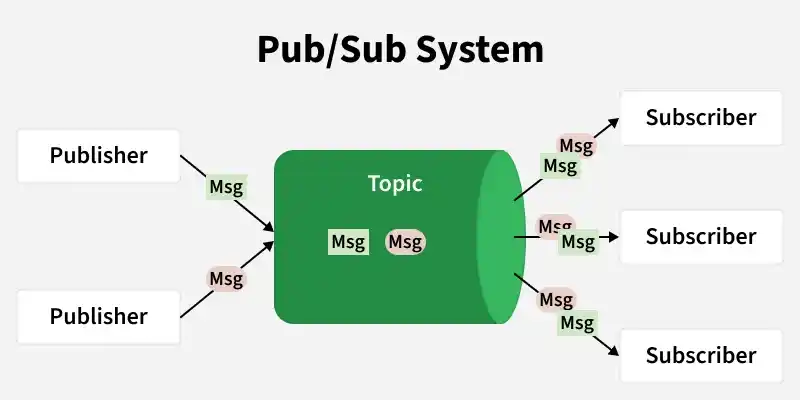
Pub/Sub System
The diagram illustrates the Pub-Sub pattern, where events are published by publishers and received by multiple subscribers. This decoupled communication pattern enhances flexibility in application architecture.
2. Message Queue
A message queue temporarily stores messages so that different services can process them later. Consumers pick messages from the queue and handle them asynchronously, which helps in smooth communication between services.
- Ensures messages are not lost and can be processed later, even if a service is temporarily unavailable
- Allows multiple consumers to process messages and distributes load evenly without blocking producers
**Example: In an order processing system, when a user places an order, it is added to a queue. Services like payment and shipping pick messages from the queue and process them independently, ensuring smooth operation even during high traffic or service downtime.
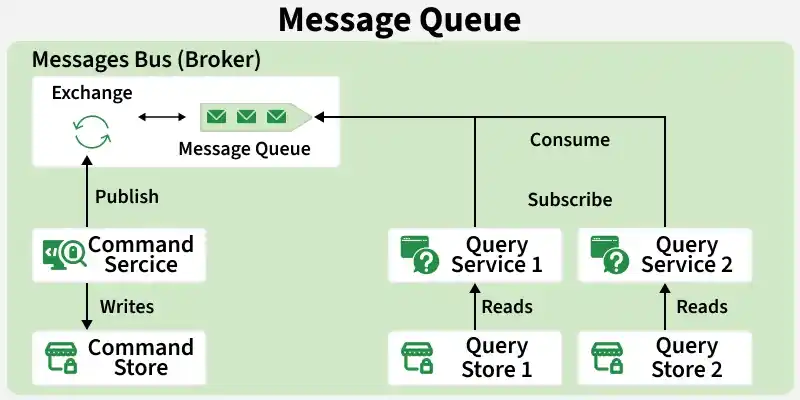
The diagram depicts a Message Queue pattern where messages are queued and delivered to consumers. This asynchronous approach ensures scalability and reliability in event processing.
State Management Patterns for Cloud Native Applications
State Management Patterns in cloud-native applications focus on how state is stored, managed, and updated in distributed systems. Here’s an overview of key state management patterns:
1. Event Sourcing
Event sourcing stores all changes as a sequence of events instead of just keeping the latest state. The current state of the system can be rebuilt anytime by replaying these events. This approach is useful in systems where tracking history and changes is important.
- Keeps a full record of all changes, which helps in auditing, debugging, and tracking data over time
- Allows replaying events to rebuild state, fix issues, or generate reports based on past data
**Example: In an e-commerce system, every update to an order (created, paid, shipped) is stored as an event. If needed, the system can replay these events to rebuild the exact order state or analyze past changes.
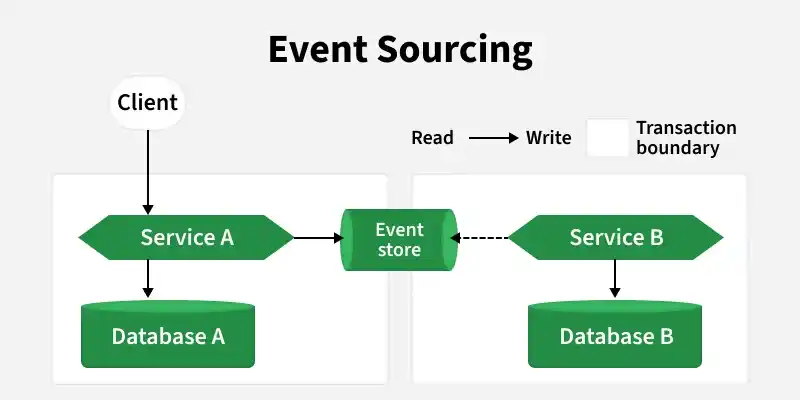
Event Sourcing
The diagram showcases Event Sourcing, where events are stored and used to reconstruct the application's state. It provides a historical view of all actions, facilitating data consistency.
2. CQRS (Command Query Responsibility Segregation)
CQRS (Command Query Responsibility Segregation) separates operations that change data from those that read data. Commands are used to update the system, while queries are used to fetch information. This separation helps improve performance and flexibility in modern systems.
- Read and write operations can be scaled independently to handle different workloads efficiently
- Different rules and controls can be applied to commands and queries based on their purpose
**Example: In an e-commerce system, placing an order uses commands to update data, while browsing products or checking order status uses queries. This allows the system to handle high read traffic without affecting write operations.
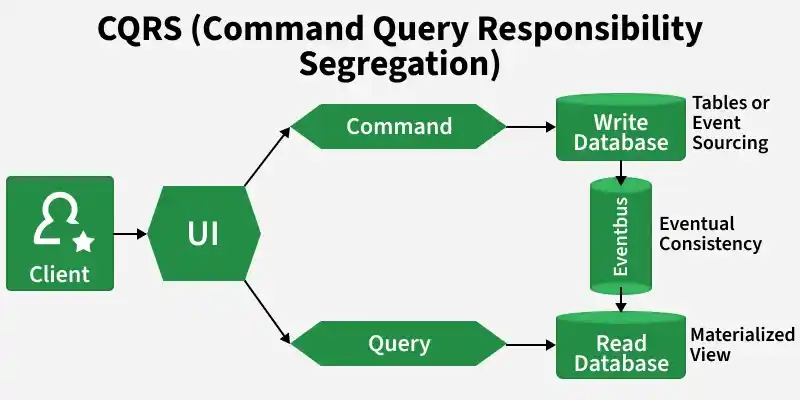
CQRS
The diagram illustrates CQRS, which divides command and query responsibilities. This separation optimizes performance and scalability by enabling independent scaling of components.
Orchestration Patterns for Cloud Native Applications
Orchestration patterns in event-driven architecture define how events are coordinated and managed across multiple services in cloud-native applications. Below is an overview of key orchestration patterns:
1. Saga
Saga is a pattern used to manage long-running transactions by breaking them into smaller steps. Each step is handled by a different service, and if something fails, previous steps can be undone using compensating actions. This helps maintain consistency across distributed systems.
- Manages workflows across multiple services without needing a single global transaction
- Handles failures by rolling back completed steps, keeping the system consistent
**Example: In a travel booking system, booking a flight, hotel, and cab are separate steps. If the hotel booking fails, the system cancels the already booked flight to maintain consistency.
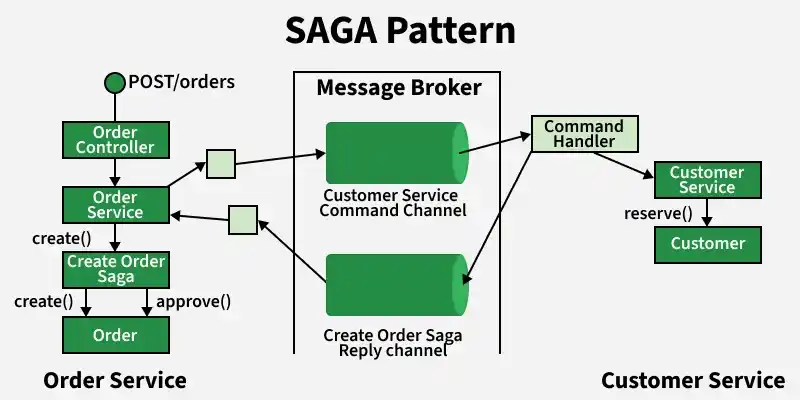
SAGA
The diagram presents a Saga pattern, showcasing a sequence of events and actions across microservices. Sagas enable distributed transaction management for data consistency.
2. Choreography
Choreography is a pattern where microservices work independently by reacting to events, without any central controller. Each service listens for events it is interested in and performs its own actions. This makes the system more flexible and loosely coupled.
- Services work independently without a central orchestrator, making the system more flexible
- Services can be updated or changed easily as long as they follow the same event structure
**Example: In a supply chain system, when inventory is updated, an event is generated. Services like shipping, billing, and notifications listen to this event and react on their own without any central coordination.
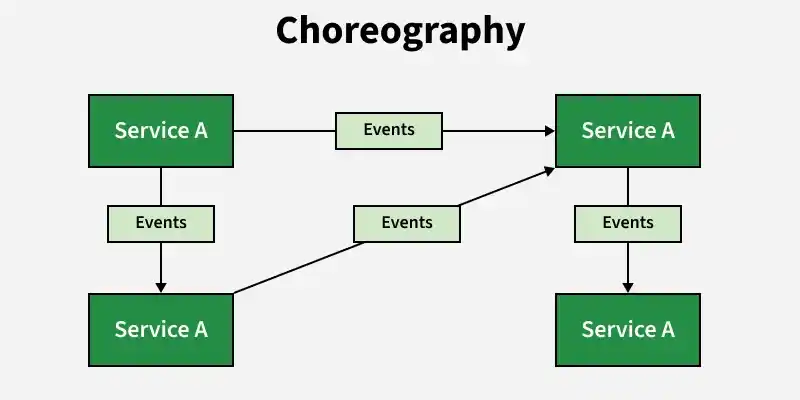
Choreography
The diagram demonstrates Choreography, where microservices communicate through events without central coordination. This approach offers flexibility and autonomous service evolution.
Importance
Event-driven architecture (EDA) is crucial in cloud-native applications for several reasons:
- **Scalability: EDA allows systems to handle varying loads efficiently by processing events asynchronously and distributing them across multiple services or instances, improving overall scalability.
- **Responsiveness: It enables real-time data processing and immediate reaction to changes, which is essential for applications requiring prompt updates and interactions.
- **Loose Coupling: By decoupling components through event streams, EDA fosters greater modularity and flexibility, allowing services to evolve independently without impacting other parts of the system.
- **Fault Tolerance: EDA enhances resilience by isolating failures to specific services or events, preventing system-wide disruptions and improving overall reliability.
- **Dynamic Scaling: Cloud-native environments benefit from EDA's ability to dynamically scale services up or down in response to the volume and frequency of events, optimizing resource usage and cost efficiency.
Technologies
There are several technologies that support Event-Driven Architecture in Cloud Native Applications:
- **Apache Kafka: A distributed streaming platform that provides high-throughput, low-latency event streaming. It is ideal for handling large volumes of events and ensuring reliable delivery across cloud-native applications.
- **RabbitMQ: A message broker that supports various messaging protocols and ensures reliable delivery of messages between services. It’s useful for implementing message queues and Pub-Sub systems.
- **AWS Lambda: A serverless computing service that can execute code in response to events, such as changes to data or messages in a queue. It enables scalable and cost-effective event-driven processing.
- **Kubernetes: Manages containerized applications and orchestrates microservices, providing the infrastructure needed to deploy and scale event-driven applications effectively in a cloud environment.
Challenges
The challenges and considerations for event-driven architecture in cloud-native applications:
- **Event Ordering and Consistency: Events might arrive out of order or be duplicated. Implement idempotency and order management mechanisms.
- **Debugging and Troubleshooting: Asynchronous systems complicate issue resolution. Use comprehensive logging, monitoring, and distributed tracing.
- **Scalability and Performance: Handling high volumes of events requires scalable infrastructure. Use efficient event streaming platforms and manage resources effectively.
- **Data Management and Storage: Storing large volumes of events can be resource-intensive. Implement efficient storage solutions and manage data retention.
- **Handling Failure and Reliability: Ensure the system can recover from failures. Use retry logic and dead letter queues for failed messages.