Observer Design Pattern (original) (raw)
Last Updated : 7 Jun, 2026
Observer Design Pattern is a behavioral pattern that creates a one-to-many relationship between a subject and its observers. When the subject's state changes, all dependent observers are notified and updated automatically, ensuring synchronized communication.
- Enables automatic updates to multiple objects when one object changes, useful for event-driven or publish-subscribe systems.
- Promotes loose coupling between the subject and its observers, improving flexibility and maintainability.
**Example: A YouTube channel (Subject) notifies all its subscribers (Observers) whenever a new video is uploaded.
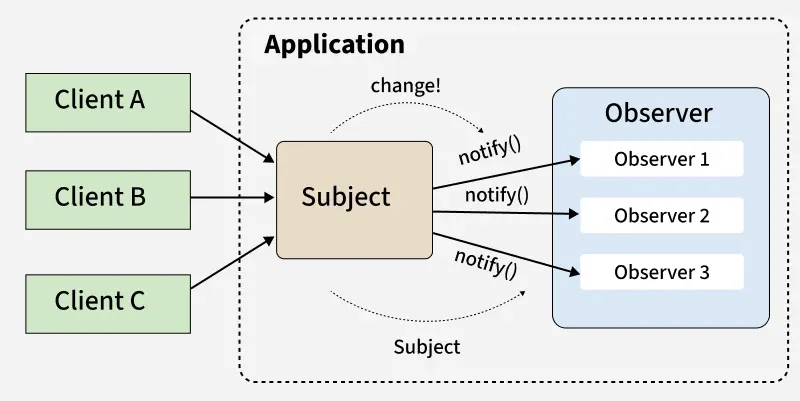
Observer Design Pattern
In the Diagram
- Clients (A, B, C) interact with the Subject, and when its state changes, it triggers a notification.
- The Subject sends notify() updates to all registered Observers (Observer 1, 2, 3).
- Observers automatically receive updates and react, without the Subject knowing their specific details (loose coupling).
**Note: Subjects are the objects that maintain and notify observers about changes in their state, while Observers are the entities that react to those changes.
Real-Life Applications
The Observer pattern is widely used in applications where changes in one object need to be automatically reflected in multiple others:
- **Social Media Notifications: Users (observers) receive updates when someone they follow (subject) posts new content.
- **Stock Market Apps: Investors get real-time updates when stock prices (subjects) change.
- **Event Listeners in GUIs: UI components respond to user actions like clicks or keyboard input.
- **Weather Monitoring Systems: Multiple displays update automatically when central weather data changes.
Components
The main components of Observer Design Pattern are:
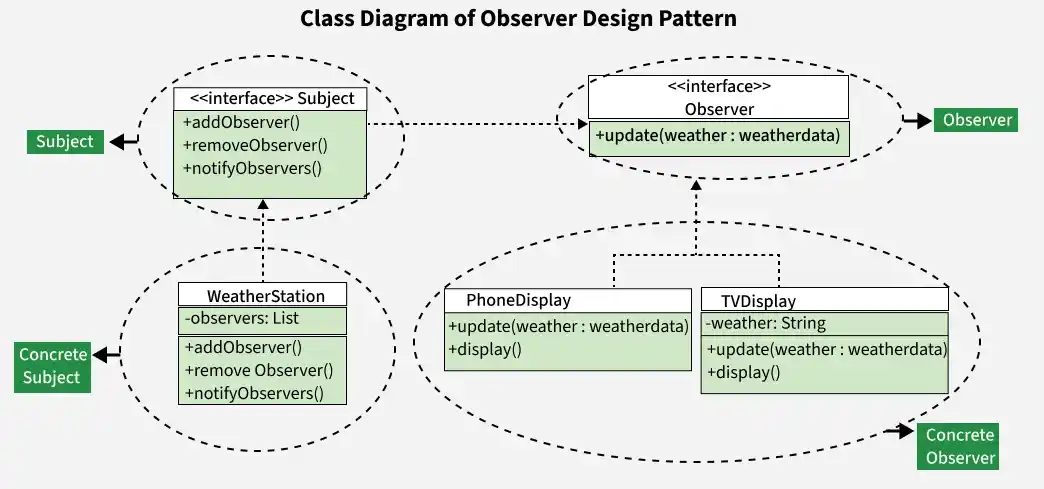
Class Diagram
- **Subject: Maintains a list of observers, provides methods to add/remove them, and notifies them of state changes.
- **Observer: Defines an interface with an update() method to ensure all observers receive updates consistently.
- **ConcreteSubject: A specific subject that holds actual data. On state change, it notifies registered observers (e.g., a weather station).
- **ConcreteObserver: Implements the observer interface and reacts to subject updates (e.g., a weather app showing weather updates).
Working
The Observer Pattern works by establishing a subscription mechanism between a subject and its observers so that changes in one object are automatically reflected in others.
- Observers subscribe to the subject to receive updates.
- The subject maintains a list of registered observers.
- When the subject’s state changes, it notifies all observers.
- Observers react to the update according to their own behavior.
Uses
The Observer Pattern is used when multiple objects need to be notified automatically about changes in another object’s state.
- To implement event handling systems such as GUI listeners.
- To maintain consistency between related objects without tight coupling.
- To support publish–subscribe mechanisms.
Implementation Example
Problem statement
Imagine a weather monitoring system where multiple display devices like phone and TV need to show updated weather information. Whenever the weather changes, all devices should receive updates automatically without being tightly connected to the weather system.
The Observer pattern solves this by allowing devices (observers) to register with a WeatherStation (subject). When the weather changes using setWeather(), it notifies all observers, and they update their display accordingly.
**1. Subject
- The "Subject" interface outlines the operations a subject (like "WeatherStation") should support.
- "addObserver" and "removeObserver" are for managing the list of observers.
- "notifyObservers" is for informing observers about changes. C++ `
class Observer; // Forward declaration
class Subject { public: virtual void addObserver(Observer* observer) = 0; virtual void removeObserver(Observer* observer) = 0; virtual void notifyObservers() = 0; virtual ~Subject() = default; };
Java
public interface Subject { void addObserver(Observer observer); void removeObserver(Observer observer); void notifyObservers(); }
Python
from abc import ABC, abstractmethod
class Subject(ABC): @abstractmethod def add_observer(self, observer): pass
@abstractmethod
def remove_observer(self, observer):
    pass

@abstractmethod
def notify_observers(self):
    pass
JavaScript
class Subject { addObserver(observer) { // Implementation }
removeObserver(observer) {
    // Implementation
}

notifyObservers() {
    // Implementation
}
}
`
**2. Observer
- The "
Observer"interface defines a contract for objects that want to be notified about changes in the subject ("WeatherStation"in this case). - It includes a method "
update"that concrete observers must implement to receive and handle updates. C++ `
#include
class Observer { public: virtual void update(const std::string& weather) = 0; virtual ~Observer() = default; };
Java
public interface Observer { void update(String weather); }
Python
from abc import ABC, abstractmethod
class Observer(ABC): @abstractmethod def update(self, weather: str): pass
JavaScript
class Observer { update(weather) { // Implementation here } }
`
**3. ConcreteSubject(WeatherStation)
- "WeatherStation" is the concrete subject implementing the "Subject" interface.
- It maintains a list of observers ("observers") and provides methods to manage this list.
- "notifyObservers" iterates through the observers and calls their "update" method, passing the current weather.
- "setWeather" method updates the weather and notifies observers of the change. C++ `
#include #include #include
class Observer { public: virtual void update(const std::string& weather) = 0; };
class Subject { public: virtual void addObserver(Observer* observer) = 0; virtual void removeObserver(Observer* observer) = 0; virtual void notifyObservers() = 0; };
class WeatherStation : public Subject { private: std::vector<Observer*> observers; std::string weather;
public: void addObserver(Observer* observer) override { observers.push_back(observer); }
void removeObserver(Observer* observer) override {
    observers.erase(std::remove(observers.begin(), observers.end(), observer), observers.end());
}

void notifyObservers() override {
    for (Observer* observer : observers) {
        observer->update(weather);
    }
}

void setWeather(const std::string& newWeather) {
    this->weather = newWeather;
    notifyObservers();
}
};
Java
import java.util.ArrayList; import java.util.List;
// Observer interface interface Observer { void update(String weather); }
// Subject interface interface Subject { void addObserver(Observer observer); void removeObserver(Observer observer); void notifyObservers(); }
// Concrete Subject class WeatherStation implements Subject { private List observers = new ArrayList<>(); private String weather = "";
@Override
public void addObserver(Observer observer) {
    observers.add(observer);
}

@Override
public void removeObserver(Observer observer) {
    observers.remove(observer);
}

@Override
public void notifyObservers() {
    for (Observer observer : observers) {
        observer.update(weather);
    }
}

public void setWeather(String newWeather) {
    this.weather = newWeather;
    notifyObservers();
}
}
Python
from abc import ABC, abstractmethod from typing import List
class Observer(ABC): @abstractmethod def update(self, weather: str): pass
class Subject(ABC): @abstractmethod def add_observer(self, observer: Observer): pass
@abstractmethod
def remove_observer(self, observer: Observer):
    pass

@abstractmethod
def notify_observers(self):
    pass
class WeatherStation(Subject): def init(self): self.observers: List[Observer] = [] self.weather = ""
def add_observer(self, observer: Observer):
    self.observers.append(observer)

def remove_observer(self, observer: Observer):
    if observer in self.observers:
        self.observers.remove(observer)

def notify_observers(self):
    for observer in self.observers:
        observer.update(self.weather)

def set_weather(self, new_weather: str):
    self.weather = new_weather
    self.notify_observers()
JavaScript
class Observer { update(weather) { throw new Error('Method update() must be implemented.'); } }
class Subject { addObserver(observer) { throw new Error('Method addObserver() must be implemented.'); } removeObserver(observer) { throw new Error('Method removeObserver() must be implemented.'); } notifyObservers() { throw new Error('Method notifyObservers() must be implemented.'); } }
class WeatherStation extends Subject { constructor() { super(); this.observers = []; this.weather = ""; } addObserver(observer) { this.observers.push(observer); } removeObserver(observer) { this.observers = this.observers.filter(obs => obs !== observer); } notifyObservers() { this.observers.forEach(observer => observer.update(this.weather)); } setWeather(newWeather) { this.weather = newWeather; this.notifyObservers(); } }
`
**4. ConcreteObserver(PhoneDisplay)
- "PhoneDisplay" is a concrete observer implementing the "Observer" interface.
- It has a private field weather to store the latest weather.
- The "update" method sets the new weather and calls the "display" method.
- "display" prints the updated weather to the console. C++ `
class PhoneDisplay : public Observer { private: string weather;
public: void update(string weather) override { this->weather = weather; display(); }
private: void display() { cout << "Phone Display: Weather updated - " << weather << endl; } };
Java
import java.util.Observer; import java.util.Observable;
public class PhoneDisplay implements Observer { private String weather;
@Override
public void update(Observable o, Object arg) {
    if (arg instanceof String) {
        this.weather = (String) arg;
        display();
    }
}

private void display() {
    System.out.println("Phone Display: Weather updated - " + weather);
}
}
Python
from abc import ABC, abstractmethod
class Observer(ABC): @abstractmethod def update(self, weather): pass
class PhoneDisplay(Observer): def init(self): self.weather = ""
def update(self, weather):
    self.weather = weather
    self.display()

def display(self):
    print(f'Phone Display: Weather updated - {self.weather}')
` JavaScript ``
class Observer { update(weather) { throw new Error('Method not implemented.'); } }
class PhoneDisplay extends Observer { constructor() { super(); this.weather = ""; }
update(weather) {
    this.weather = weather;
    this.display();
}

display() {
    console.log(`Phone Display: Weather updated - ${this.weather}`);
}
}
``
**5. ConcreteObserver(TVDisplay)
- "TVDisplay" is another concrete observer similar to "PhoneDisplay".
- It also implements the "Observer" interface, with a similar structure to "PhoneDisplay". C++ `
class TVDisplay : public Observer { private: string weather;
public: void update(string weather) override { this->weather = weather; display(); }
private: void display() { cout << "TV Display: Weather updated - " << weather << endl; } };
Java
class TVDisplay implements Observer { private String weather;
@Override
public void update(String weather) {
    this.weather = weather;
    display();
}

private void display() {
    System.out.println("TV Display: Weather updated - " + weather);
}
}
Python
class TVDisplay: def init(self): self.weather = ""
def update(self, weather):
    self.weather = weather
    self.display()

def display(self):
    print(f'TV Display: Weather updated - {self.weather}')
` JavaScript ``
class TVDisplay { constructor() { this.weather = ""; }
update(weather) {
    this.weather = weather;
    this.display();
}

display() {
    console.log(`TV Display: Weather updated - ${this.weather}`);
}
}
``
6. Usage
- In "WeatherApp", a "WeatherStation" is created.
- Two observers ("PhoneDisplay" and "TVDisplay") are registered with the weather station using "addObserver".
- The "setWeather" method simulates a weather change to "Sunny," triggering the "update" method in both observers.
- The output shows how both concrete observers display the updated weather information. C++ `
#include #include using namespace std;
class Observer { public: virtual void update(string weather) = 0; };
class PhoneDisplay : public Observer { public: void update(string weather) override { cout << "Phone Display: " << weather << endl; } };
class TVDisplay : public Observer { public: void update(string weather) override { cout << "TV Display: " << weather << endl; } };
class WeatherStation { private: vector<Observer*> observers; string weather; public: void addObserver(Observer* observer) { observers.push_back(observer); } void setWeather(string newWeather) { weather = newWeather; notifyObservers(); } void notifyObservers() { for (Observer* observer : observers) { observer->update(weather); } } };
int main() { WeatherStation weatherStation;
Observer* phoneDisplay = new PhoneDisplay();
Observer* tvDisplay = new TVDisplay();

weatherStation.addObserver(phoneDisplay);
weatherStation.addObserver(tvDisplay);

// Simulating weather change
weatherStation.setWeather("Sunny");

delete phoneDisplay;
delete tvDisplay;
return 0;
}
Java
public class WeatherApp { public static void main(String[] args) { WeatherStation weatherStation = new WeatherStation();
    Observer phoneDisplay = new PhoneDisplay();
    Observer tvDisplay = new TVDisplay();

    weatherStation.addObserver(phoneDisplay);
    weatherStation.addObserver(tvDisplay);

    // Simulating weather change
    weatherStation.setWeather("Sunny");

}
}
Python
from abc import ABC, abstractmethod
class Observer(ABC): @abstractmethod def update(self, weather): pass
class PhoneDisplay(Observer): def update(self, weather): print(f'Phone Display: Weather updated - {weather}')
class TVDisplay(Observer): def update(self, weather): print(f'TV Display: Weather updated - {weather}')
class WeatherStation: def init(self): self.observers = [] self.weather = ""
def add_observer(self, observer):
    self.observers.append(observer)

def set_weather(self, weather):
    self.weather = weather
    self.notify_observers()

def notify_observers(self):
    for observer in self.observers:
        observer.update(self.weather)
Main execution
weather_station = WeatherStation()
phone_display = PhoneDisplay() tv_display = TVDisplay()
weather_station.add_observer(phone_display) weather_station.add_observer(tv_display)
Simulating weather change
weather_station.set_weather('Sunny')
Output:
Phone Display: Weather updated - Sunny
TV Display: Weather updated - Sunny
` JavaScript ``
class Observer { update(weather) { throw new Error('Method not implemented.'); } }
class PhoneDisplay extends Observer {
update(weather) {
console.log(Phone Display: Weather updated - ${weather});
}
}
class TVDisplay extends Observer {
update(weather) {
console.log(TV Display: Weather updated - ${weather});
}
}
class WeatherStation { constructor() { this.observers = []; this.weather = ""; }
addObserver(observer) {
    this.observers.push(observer);
}

setWeather(weather) {
    this.weather = weather;
    this.notifyObservers();
}

notifyObservers() {
    this.observers.forEach(observer => observer.update(this.weather));
}
}
// Main execution const weatherStation = new WeatherStation();
const phoneDisplay = new PhoneDisplay(); const tvDisplay = new TVDisplay();
weatherStation.addObserver(phoneDisplay); weatherStation.addObserver(tvDisplay);
// Simulating weather change weatherStation.setWeather('Sunny');
// Output: // Phone Display: Weather updated - Sunny // TV Display: Weather updated - Sunny
``
Complete code for the above example
The complete code for the above example is:
C++ `
#include #include #include // for std::remove #include using namespace std;
// Observer Interface class Observer { public: virtual void update(const string& weather) = 0; virtual ~Observer() {} };
// Subject Interface class Subject { public: virtual void addObserver(Observer* observer) = 0; virtual void removeObserver(Observer* observer) = 0; virtual void notifyObservers() = 0; virtual ~Subject() {} };
// ConcreteSubject Class class WeatherStation : public Subject { private: vector<Observer*> observers; // list of observers string weather;
public: void addObserver(Observer* observer) override { observers.push_back(observer); }
void removeObserver(Observer* observer) override {
    observers.erase(remove(observers.begin(), observers.end(), observer), observers.end());
}

void notifyObservers() override {
    for (Observer* observer : observers) {
        observer->update(weather);
    }
}

void setWeather(const string& newWeather) {
    weather = newWeather;
    notifyObservers();
}
};
// ConcreteObserver Class: PhoneDisplay class PhoneDisplay : public Observer { private: string weather;
void display() {
    cout << "Phone Display: Weather updated - " << weather << endl;
}
public: void update(const string& weather) override { this->weather = weather; display(); } };
// ConcreteObserver Class: TVDisplay class TVDisplay : public Observer { private: string weather;
void display() {
    cout << "TV Display: Weather updated - " << weather << endl;
}
public: void update(const string& weather) override { this->weather = weather; display(); } };
// Usage / Demo int main() { WeatherStation weatherStation;
PhoneDisplay phoneDisplay;
TVDisplay tvDisplay;

// Register observers
weatherStation.addObserver(&phoneDisplay);
weatherStation.addObserver(&tvDisplay);

// Simulating weather changes
weatherStation.setWeather("Sunny");
weatherStation.setWeather("Rainy");
weatherStation.setWeather("Cloudy");

// Remove one observer
weatherStation.removeObserver(&tvDisplay);

// Notify remaining observer
weatherStation.setWeather("Windy");

return 0;
}
Java
import java.util.ArrayList; import java.util.List;
// Observer Interface interface Observer { void update(String weather); }
// Subject Interface interface Subject { void addObserver(Observer observer); void removeObserver(Observer observer); void notifyObservers(); }
// ConcreteSubject Class class WeatherStation implements Subject { private List observers = new ArrayList<>(); private String weather;
@Override
public void addObserver(Observer observer) {
    observers.add(observer);
}

@Override
public void removeObserver(Observer observer) {
    observers.remove(observer);
}

@Override
public void notifyObservers() {
    for (Observer observer : observers) {
        observer.update(weather);
    }
}

public void setWeather(String newWeather) {
    this.weather = newWeather;
    notifyObservers();
}
}
// ConcreteObserver Class class PhoneDisplay implements Observer { private String weather;
@Override
public void update(String weather) {
    this.weather = weather;
    display();
}

private void display() {
    System.out.println("Phone Display: Weather updated - " + weather);
}
}
// ConcreteObserver Class class TVDisplay implements Observer { private String weather;
@Override
public void update(String weather) {
    this.weather = weather;
    display();
}

private void display() {
    System.out.println("TV Display: Weather updated - " + weather);
}
}
// Usage Class public class WeatherApp { public static void main(String[] args) { WeatherStation weatherStation = new WeatherStation();
    Observer phoneDisplay = new PhoneDisplay();
    Observer tvDisplay = new TVDisplay();

    // Register observers
    weatherStation.addObserver(phoneDisplay);
    weatherStation.addObserver(tvDisplay);

    // Simulating weather changes
    weatherStation.setWeather("Sunny");
    weatherStation.setWeather("Rainy");
    weatherStation.setWeather("Cloudy");

    // Remove one observer
    weatherStation.removeObserver(tvDisplay);

    // Notify remaining observer
    weatherStation.setWeather("Windy");
}
}
Python
from abc import ABC, abstractmethod from typing import List
Observer Interface
class Observer(ABC): @abstractmethod def update(self, weather: str): pass
Subject Interface
class Subject(ABC): @abstractmethod def add_observer(self, observer: Observer): pass
@abstractmethod
def remove_observer(self, observer: Observer):
    pass

@abstractmethod
def notify_observers(self):
    pass
ConcreteSubject Class
class WeatherStation(Subject): def init(self): self.observers: List[Observer] = [] self.weather = ""
def add_observer(self, observer: Observer):
    self.observers.append(observer)

def remove_observer(self, observer: Observer):
    self.observers.remove(observer)

def notify_observers(self):
    for observer in self.observers:
        observer.update(self.weather)

def set_weather(self, new_weather: str):
    self.weather = new_weather
    self.notify_observers()
ConcreteObserver Class
class PhoneDisplay(Observer): def init(self): self.weather = ""
def update(self, weather: str):
    self.weather = weather
    self.display()

def display(self):
    print(f'Phone Display: Weather updated - {self.weather}')
ConcreteObserver Class
class TVDisplay(Observer): def init(self): self.weather = ""
def update(self, weather: str):
    self.weather = weather
    self.display()

def display(self):
    print(f'TV Display: Weather updated - {self.weather}')
Usage
if name == 'main': weather_station = WeatherStation()
phone_display = PhoneDisplay()
tv_display = TVDisplay()

weather_station.add_observer(phone_display)
weather_station.add_observer(tv_display)

# Simulating weather change
weather_station.set_weather('Sunny')
# Output:
# Phone Display: Weather updated - Sunny
# TV Display: Weather updated - Sunny
` JavaScript ``
// Observer Interface class Observer { update(weather) { throw new Error('Method not implemented.'); } }
// Subject Interface class Subject { addObserver(observer) { throw new Error('Method not implemented.'); }
removeObserver(observer) {
    throw new Error('Method not implemented.');
}

notifyObservers() {
    throw new Error('Method not implemented.');
}
}
// ConcreteSubject Class class WeatherStation extends Subject { constructor() { super(); this.observers = []; this.weather = ""; }
addObserver(observer) {
    this.observers.push(observer);
}

removeObserver(observer) {
    this.observers = this.observers.filter(obs => obs !== observer);
}

notifyObservers() {
    this.observers.forEach(observer => observer.update(this.weather));
}

setWeather(newWeather) {
    this.weather = newWeather;
    this.notifyObservers();
}
}
// ConcreteObserver Class class PhoneDisplay extends Observer { constructor() { super(); this.weather = ""; }
update(weather) {
    this.weather = weather;
    this.display();
}

display() {
    console.log(`Phone Display: Weather updated - ${this.weather}`);
}
}
// ConcreteObserver Class class TVDisplay extends Observer { constructor() { super(); this.weather = ""; }
update(weather) {
    this.weather = weather;
    this.display();
}

display() {
    console.log(`TV Display: Weather updated - ${this.weather}`);
}
}
// Usage const weatherStation = new WeatherStation();
const phoneDisplay = new PhoneDisplay(); const tvDisplay = new TVDisplay();
weatherStation.addObserver(phoneDisplay); weatherStation.addObserver(tvDisplay);
// Simulating weather change weatherStation.setWeather('Sunny'); // Output: // Phone Display: Weather updated - Sunny // TV Display: Weather updated - Sunny
``
Output
Phone Display: Weather updated - Sunny TV Display: Weather updated - Sunny Phone Display: Weather updated - Rainy TV Display: Weather updated - Rainy Phone Display: Weather updated - Cloudy TV Display...
Advantages
The Observer Pattern improves flexibility and communication between objects.
- Provides loose coupling between subject and observers.
- Allows easy addition or removal of observers at runtime.
- Ensures automatic and consistent updates to all dependents.
Disadvantages
Despite its benefits, the Observer Pattern has some drawbacks.
- Can lead to performance issues if there are many observers.
- Debugging becomes harder due to indirect communication.
- Observers may receive unnecessary updates if not managed carefully.