Sidecar Design Pattern for Microservices (original) (raw)
Last Updated : 29 May, 2026
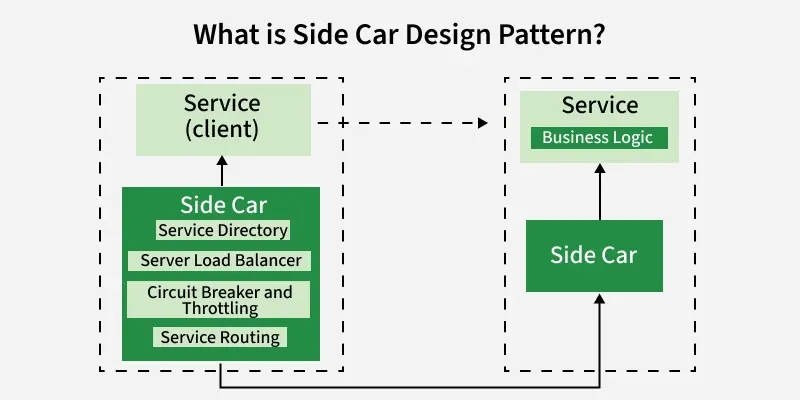
The Sidecar Pattern is a microservices design pattern where a helper container or process runs alongside the main application container. It extends the application’s functionality by handling supporting tasks separately from the core business logic.
- The sidecar container manages tasks such as logging, monitoring, security, and service communication. This allows the main application to focus only on its primary functionality.
- Since both containers run in the same environment, they can communicate efficiently and work together. This improves modularity, scalability, and maintainability in distributed systems.
**Example: In Kubernetes, a logging sidecar container can collect and forward logs generated by the main application container.
Benefits of Using the Sidecar Pattern
The Sidecar Pattern offers several benefits in microservices architectures:
- **Modularity and Encapsulation: By moving secondary tasks to sidecar containers, microservices can focus only on core business logic. This improves code organization and makes services easier to develop, test, and maintain.
- **Scalability: Sidecar containers can be scaled independently from the main application containers. This enables better resource utilization and allows handling increased workloads without affecting primary services.
- **Flexibility and Extensibility: New functionalities can be added through separate sidecar containers without changing the main microservices. This provides flexibility and makes the system adaptable to changing requirements.
- **Isolation of Concerns: Functions like logging, monitoring, and security are isolated into dedicated sidecar containers. This improves maintainability, troubleshooting, and fault isolation within the system.
- **Dynamic Configuration and Orchestration: Sidecar containers can be dynamically configured and managed using platforms like Kubernetes or Docker Swarm. This simplifies deployment, scaling, and management in distributed environments.
Components of Sidecar Design Pattern for Microservices
The Sidecar Pattern for microservices typically consists of the following key components:
- **Primary Application Container: This container hosts the main business logic of the microservice and handles incoming requests. It focuses only on the core functionality of the application.
- **Sidecar Container: The sidecar container runs alongside the primary container and provides supporting services such as logging, monitoring, security, and communication proxies. This keeps secondary tasks separate from the main application.
- **Inter-Container Communication: Communication mechanisms allow the primary container and sidecar container to exchange data efficiently. This can be achieved using local networking, shared storage, or IPC mechanisms.
- **Configuration and Coordination: Configuration and coordination mechanisms ensure both containers remain properly synchronized and updated. They help manage service discovery, configuration changes, and communication settings.
- **Observability and Monitoring: The sidecar often includes monitoring and observability tools like log collectors, metrics collectors, and tracing agents. These help track performance, health, and application behavior for troubleshooting and optimization.
- **Lifecycle Management: Lifecycle management ensures both the main container and sidecar container are properly started, stopped, and managed. Tools like Kubernetes help coordinate and automate these operations.
Challenges
Below are the challenges of Sidecar Design Pattern:
- **Increased Resource Consumption: Running additional sidecar containers with each microservice increases the usage of CPU, memory, and network resources. This can raise infrastructure costs in large-scale systems.
- **Complexity in Orchestration: Managing multiple containers for a single microservice makes deployment, configuration, and lifecycle management more complex. Advanced orchestration tools like Kubernetes are often required.
- **Synchronization and Coordination: Keeping the primary container and sidecar container synchronized can be difficult, especially during updates, scaling, or configuration changes in dynamic environments.
- **Overhead in Inter-container Communication: Communication between the application container and sidecar container can add extra latency and performance overhead, particularly in high-throughput systems.
- **Debugging and Troubleshooting: Identifying and resolving issues across multiple containers is more challenging compared to traditional architectures. Specialized monitoring and debugging tools are often needed.
Implementation of Sidecar Design Pattern
Implementing the Sidecar Design Pattern involves several steps:
The Sidecar Design Pattern is implemented by deploying supporting services alongside the main application to handle cross-cutting concerns.
Step 1: Identify Secondary Functionalities
Identify functionalities that support the application but are not part of core business logic.
- Includes logging, monitoring, security, service discovery, and communication proxies.
- Helps keep the main application focused and lightweight.
Step 2: Design Sidecar Containers
Design sidecar containers to encapsulate the identified secondary responsibilities.
- Each sidecar is self-contained and handles a single concern.
- Can be reused across multiple services.
Step 3: Define Inter-container Communication
Define how the main application and sidecar containers will communicate.
- Use local networking, shared volumes, or IPC mechanisms.
- Ensure low-latency and reliable communication.
Step 4: Implement Sidecar Containers
Develop and package sidecar logic as independent container images.
- Sidecars are deployed alongside the primary application container.
- Run within the same execution environment for close interaction.
Step 5: Configure and Coordinate Sidecar Containers
Configure sidecars so they work in coordination with the main application.
- Manage configuration updates and service discovery.
- Use container platform APIs or configuration tools.
Step 6: Handle Lifecycle Management
Ensure both the application and sidecar containers share a synchronized lifecycle.
- Start, stop, and restart together.
- Use orchestration tools or lifecycle hooks.
Step 7: Integrate Observability and Monitoring
Integrate monitoring and observability tools within sidecar containers.
- Collect logs, metrics, and traces.
- Improve visibility into application health and performance.
Different Deployment Strategies for Sidecar Instances
There are several deployment strategies for Sidecar instances in microservices architectures, each offering different trade-offs in terms of scalability, reliability, resource utilization, and operational complexity. Some common deployment strategies include:
1. Collocated Deployment
In this strategy, the Sidecar runs within the same container as the primary microservice.
- Shares the same resources and lifecycle as the application.
- Simplifies deployment but limits flexibility and independent scaling.
2. Separate Container Deployment
The Sidecar is deployed as a separate container alongside the microservice within the same pod or host.
- Allows independent scaling, management, and resource isolation.
- Provides greater flexibility but increases orchestration complexity.
3. DaemonSet Deployment
In Kubernetes, Sidecars are deployed on every node using a DaemonSet.
- Ensures consistent services like logging or monitoring across all nodes.
- May cause resource overhead on nodes running many microservices.
4. Proxy-based Deployment
Sidecars act as network proxies, commonly used in service mesh architectures.
- Handles traffic routing, load balancing, security, and observability.
- Enables advanced traffic management but adds configuration complexity.
**Choosing the Right Deployment Strategy
The deployment strategy should align with architectural and operational requirements.
- Depends on scalability goals, resource usage, and platform capabilities.
- Organizations may combine strategies based on service needs.
Use Cases of Sidecar Design Pattern for Microservices
The Sidecar Design Pattern for microservices finds application in various use cases across different industries. Some common use cases include
- **Logging and Monitoring: Sidecar containers collect logs and metrics from microservices and send them to centralized monitoring systems. This improves observability, troubleshooting, and performance tracking.
- **Security and Authentication: Sidecars can manage authentication, authorization, encryption, and security policies for service communication. This improves security and simplifies compliance management.
- **Service Discovery and Registration: Sidecar instances help services register themselves and discover other services dynamically. This supports efficient communication and load balancing in distributed systems.
- **Traffic Splitting and Canary Deployment: Sidecar proxies can control traffic routing for canary releases or gradual feature rollouts. This reduces deployment risk and ensures smoother updates.