Horizontal and Vertical Scaling | System Design (original) (raw)
Last Updated : 30 Apr, 2026
In system design, scaling is important for managing increased loads. Horizontal scaling and vertical scaling are two different approaches to scaling a system, both of which can be used to improve the performance and capacity of the system.
- Adding more servers or instances to distribute load and handle high traffic efficiently.
- Upgrading a single server’s CPU, RAM, or storage to increase its capacity.
**Example: A large e-commerce platform may use horizontal scaling by adding more servers during high traffic events like sales, while a small application may use vertical scaling by upgrading the server’s RAM or CPU.
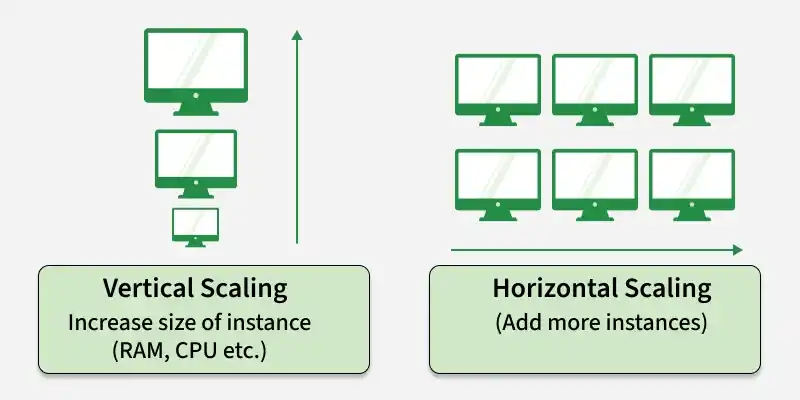
Vertical and Horizontal Scaling
Need of Scaling
We need scaling to handle increasing load and improve performance, while resilience is achieved through fault tolerance, redundancy, and recovery mechanisms.
- We need scaling to handle increasing system load efficiently and provide a smooth and reliable user experience.
- Handle increased user load and traffic without slowing down or crashing the system during peak usage.
- Ensure high availability and reliability so the system remains accessible even during failures or heavy demand.
- Maintain performance and response time by distributing workload and avoiding bottlenecks.
- Support growing data and storage needs as the application expands over time.
The following are two ways to do scaling.
Vertical Scaling
Vertical scaling, also known as scaling up, refers to the process of increasing the capacity or capabilities of an individual hardware or software component within a system.
- We upgrade the same system rather than adding more systems. Add more power to your machine by adding better processors, increasing RAM, or other power-increasing adjustments.
- Simple to implement and useful for monolithic and small scale applications.
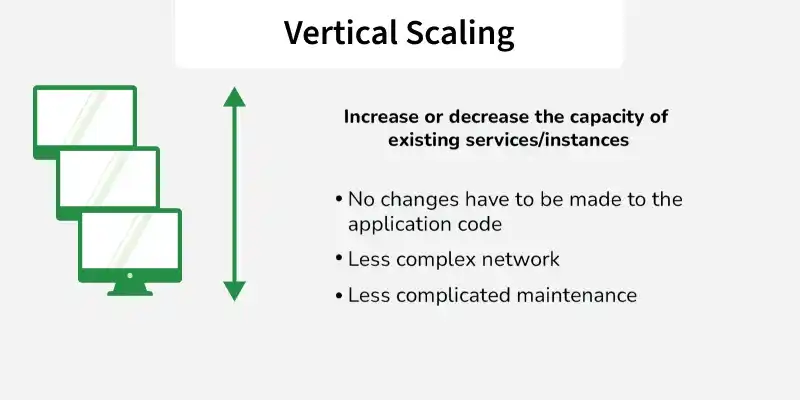
Vertical Scaling
Examples
The following examples illustrate how vertical scaling improves system capacity by upgrading the resources of a single server.
- Upgrading a MySQL server from 16 GB RAM to 64 GB to handle more queries.
- Moving a website hosted on a 2-core VM to an 8-core, higher-RAM VM to improve performance.
- E-commerce platform running on a single large AWS EC2 instance with increased resources (CPU, RAM, disk).
Advantages
Vertical scaling offers several benefits, especially for applications that need quick performance improvements with minimal architectural changes.
- **Increased capacity: A server's performance and ability to manage incoming requests can both be enhanced by upgrading its hardware.
- **Easier management: Upgrading a single node is usually the focus of vertical scaling, which might be simpler than maintaining several nodes.
Disadvantages
Despite its benefits, vertical scaling has certain limitations that can affect system growth and reliability.
- Vertical scaling is constrained by the hardware's physical limitations. Horizontal scaling also has practical limits such as network overhead, coordination complexity, and consistency constraints.
- One server still receives all incoming requests thus increasing the possibility of downtime in the event of a server failure.
- Scaling up often requires restarting or replacing the machine, causing downtime.
Horizontal Scaling
Horizontal scaling, also known as scaling out, refers to the process of increasing the capacity or performance of a system by adding more machines or servers to distribute the workload across a larger number of individual units.
- There is no need to change the capacity of the server or replace the server.
- Adding more servers usually avoids full downtime, but may involve delays due to deployment, warm-up time, or traffic rebalancing.
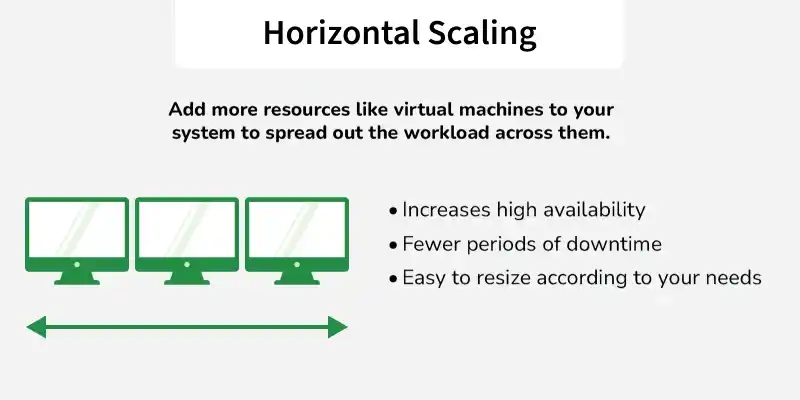
Horizontal Scaling
Examples
Horizontal scaling is widely used in real-world systems to handle high traffic and ensure availability.
- A website like GeeksforGeeks adds more web servers behind a load balancer to handle traffic spikes.
- Netflix scales different microservices independently — e.g., multiple instances of the streaming service across regions.
- Amazon Auto Scaling spins up more EC2 instances during peak shopping hours (e.g., Black Friday).
- Akamai or Cloudflare uses servers distributed globally to serve content closer to users.
Advantages
Horizontal scaling improves system capacity and reliability by distributing workload across multiple machines.
- **Increased capacity: More nodes or instances can handle a larger number of incoming requests.
- **Improved performance: By distributing the load over several nodes or instances, it is less likely that any one server will get overloaded.
- **Increased fault tolerance: Incoming requests can be sent to another node in the event of a node failure, lowering the possibility of downtime.
Disadvantages
Despite its benefits, horizontal scaling introduces complexity in system design and management.
- Requires complex architecture (load balancers, distributed databases, etc.).
- Difficult to maintain strong consistency across distributed nodes. Requires synchronization, messaging, or replication between nodes.
- More machines = more networking, power, and maintenance.
- Needs orchestration tools (e.g., Kubernetes, Ansible) to manage many servers.
Differences between Horizontal and Vertical Scaling
This section highlights the key differences between scaling by adding more machines versus upgrading a single machine.
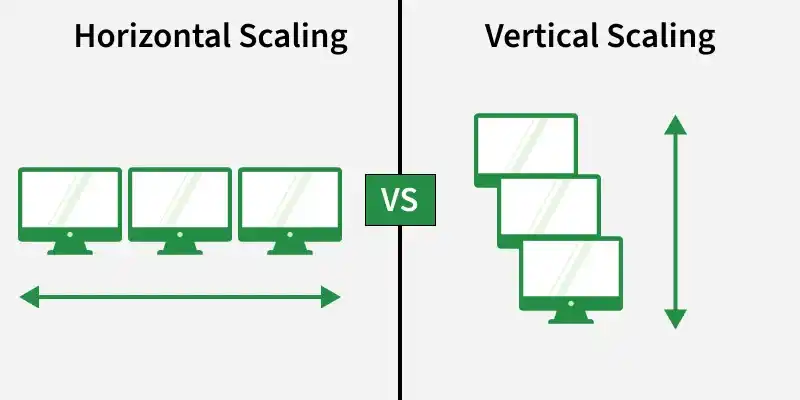
Horizontal Vs vertical Scaling
We have understood the meaning of both the major categories of scaling an application. We also have discussed some pros and cons of each one of them. do a quick comparison of these two approaches based on these pros and cons.
| **Horizontal Scaling | **Vertical Scaling |
|---|---|
| Adds more machines or servers to distribute the workload. | Increases CPU, RAM, or storage of a single machine. |
| More cost-effective for large-scale systems. | Simpler initially but can become expensive over time. |
| Highly flexible because new servers can be added easily. | Limited flexibility due to hardware limits. |
| Better fault tolerance since workload is spread across multiple machines. | Lower fault tolerance because it depends on one machine. |
| Improves performance by distributing traffic across servers. | Performance improves only up to hardware capacity. |
| Less risk of single point of failure. | Higher risk of single point of failure. |
| More complex to manage because it involves distributed systems. | Easier to manage since it uses a single machine. |
| Suitable for applications requiring massive scalability. | Suitable for applications with moderate scalability needs. |
| Requires load balancing to distribute traffic across servers. | Load balancing is usually not required. |
| Relies on network communication between multiple machines. | Mostly uses communication within a single machine. |
Choosing Between Horizontal and Vertical Scaling
There will be always some trade-offs so it may be a little bit trickier for developers to decide which one is better for an application.
- Firstly, you should identify your requirements, business goals, and areas where we would like to add value.
- Then make important design decisions by questioning ourselves, developing prototypes, and refining the design.
- Most of the time in big organizations engineers take some good qualities of vertical scaling and some good qualities of horizontal scaling.
- They follow a hybrid approach of combining the speed and consistency of vertical scaling, with the resilience and infinite scalability of horizontal scaling.