System Design of Uber App | Uber System Architecture (original) (raw)
Last Updated : 6 Apr, 2026
Getting hassle-free transportation services like Uber or Ola is easy for users, but building such large-scale applications is highly complex. These systems require robust architecture and coordination of multiple components to deliver reliable services worldwide.
- Involves complex system architecture and distributed components
- Requires high scalability and real-time processing
- Handles global users with reliability and performance
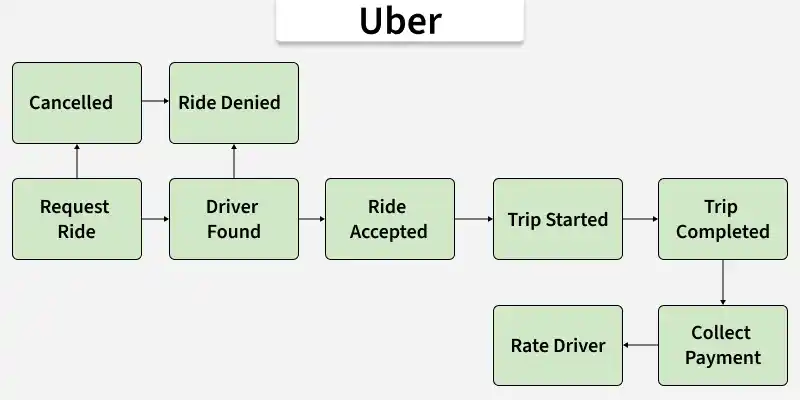
Uber
1. System Requirements
This section outlines what the cab booking system should do and the qualities it must have.
1. Functional requirements
These are the core features the system must provide to users.
- Users should be able to see all the cabs available with minimum price and ETA
- Users should be able to book a cab for their destination
- Users should be able to see the location of the driver
- Users should be able to cancel their ride whenever they want
2. Non-Functional requirements
These define the performance, reliability, and scalability expectations of the system.
- High Availability
- High Reliability
- Highly Scalable
- Low Latency
2. Capacity Estimation
Lets assume we have 5 million active users on our application with 200,000 drivers and on an average there are 1 million rides daily. If a user performs 5 actions on an average then we need to handle 5 million requests daily
- **Requests per Second: ~58 RPS (5 million requests/day)
- **Daily Storage Needed: ~2.32 GB (assuming 500 bytes per message)
3. Low-Level Design
We all are familiar with Uber services. A user can request a ride through the application and within a few minutes, a driver arrives nearby his/her location to take them to their destination.
- Earlier Uber was built on the "monolithic" software architecture model.
- They had a backend service, a frontend service, and a single database.
- They used Python and its frameworks and SQLAlchemy as the ORM layer to the database.
- This architecture was fine for a small number of trips in a few cities but when the service started expanding in other cities Uber team started facing the issue with the application.
- After the year 2014 Uber team decided to switch to the "service-oriented architecture" and now Uber also handles food delivery and cargo.
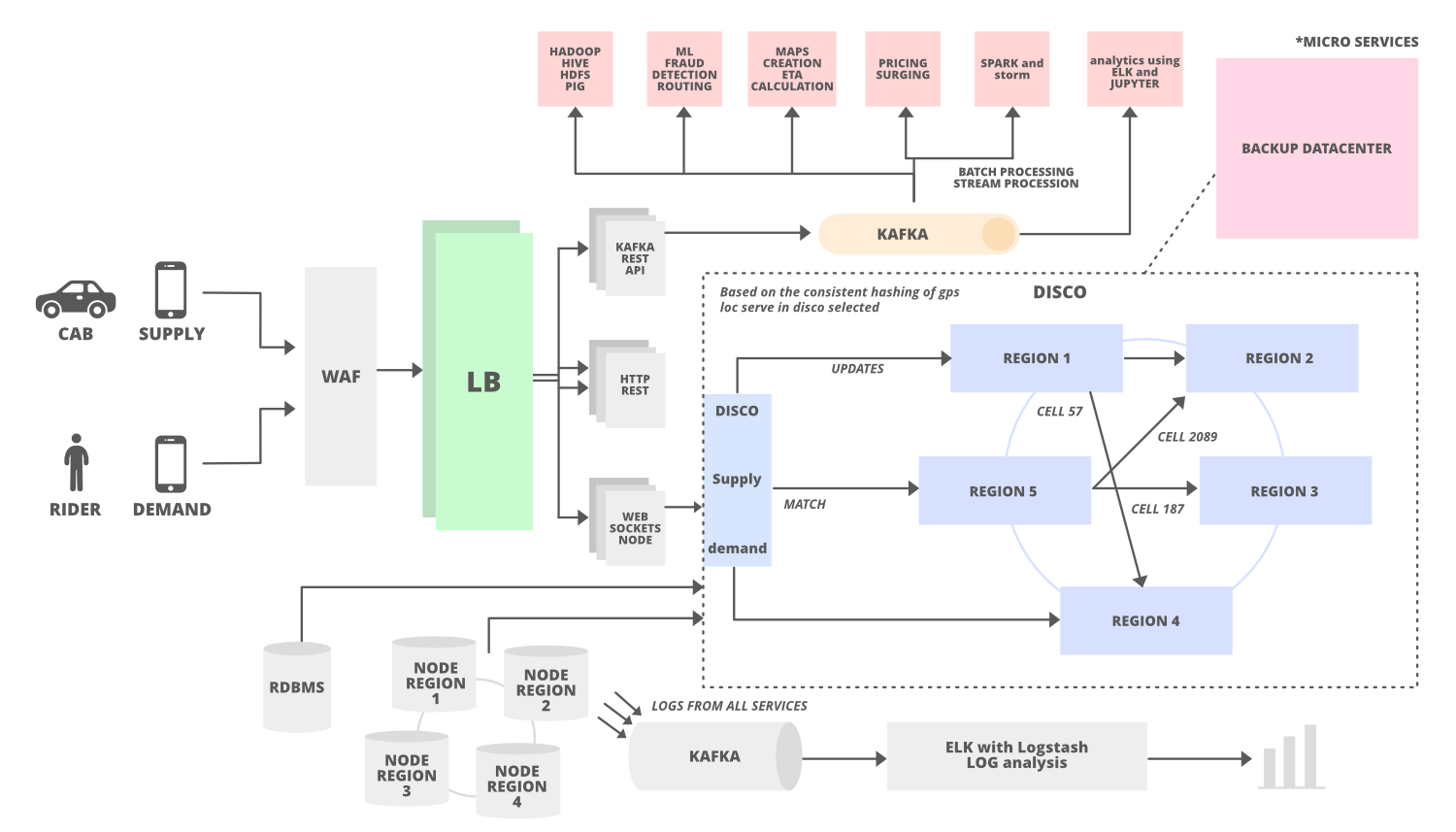
1. Challenges
One of the main tasks of Uber service is to match the rider with cabs which means we need two different services in our architecture i.e.
- Supply Service (for cabs)
- Demand Service (for riders)
Uber has a Dispatch system (Dispatch optimization/DISCO) in its architecture to match supply with demand. This dispatch system uses mobile phones and it takes the responsibility to match the drivers with riders (supply to demand).
2. Working
DISCO must have these goals...
- Reduce extra driving.
- Minimum waiting time
- Minimum overall ETA
The dispatch system completely works on maps and location data/GPS, so the first thing which is important is to model our maps and location data.
- Earth has a spherical shape so it's difficult to do summarization and approximation by using latitude and longitude. To solve this problem Uber uses the Google S2 library. This library divides the map data into tiny cells (for example 3km) and gives a unique ID to each cell. This is an easy way to spread data in the distributed system and store it easily.
- S2 library gives coverage for any given shape easily. Suppose you want to figure out all the supplies available within a 3km radius of a city.
- Using the S2 libraries you can draw a circle of 3km radius and it will filter out all the cells with IDs that lie in that particular circle.
- This way you can easily match the rider to the driver and you can easily find out the number of cars(supply) available in a particular region.
3. Supply Service And Working
This service tracks all active cabs using geolocation and updates the system in real-time.
- In our case, cabs are the supply services and they will be tracked by geolocation (latitude and longitude).
- All the active cabs keep on sending the location to the server once every 4 seconds through a web application firewall and load balancer.
- The accurate GPS location is sent to the data center through Kafka’s Rest APIs once it passes through the load balancer. Here we use Apache Kafka as the data hub.
- Once the latest location is updated by Kafka it slowly passes through the respective worker nodes' main memory.
- Also, a copy of the location (state machine/latest location of cabs) will be sent to the database and to the dispatch optimization to keep the latest location updated.
- We also need to track a few more things such as the number of seats, the presence of a car seat for children, the type of vehicle, can a wheelchair be fit, and allocation (for example, a cab may have four seats but two of those are occupied).
4. Demand Service And Working
This service handles rider requests and communicates user requirements to the supply side.
- Demand service receives the request of the cab through a web socket and it tracks the GPS location of the user. It also receives different kinds of requirements such as the number of seats, type of car, or pool car.
- Demand gives the location (cell ID) and user requirement to supply and make requests for the cabs.
5. Rider-to-Driver Matching in the Dispatch System
This system matches riders with the best available drivers efficiently using map cells and sharding.
- We have discussed that DISCO divides the map into tiny cells with a unique ID. This ID is used as a sharding key in DISCO. When supply receives the request from demand the location gets updated using the cell ID as a shard key.
- These tiny cells' responsibilities will be divided into different servers lying in multiple regions (consistent hashing).
- For example, we can allocate the responsibility of 12 tiny cells to 6 different servers (2 cells for each server) lying in 6 different regions.
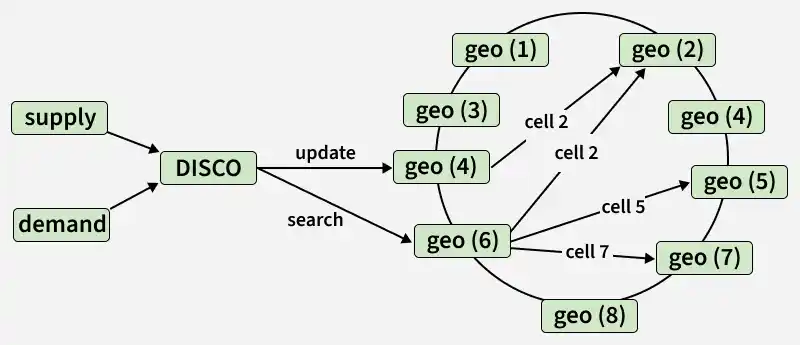
- Supply sends the request to the specific server based on the GPS location data. After that, the system draws the circle and filters out all the nearby cabs which meet the rider's requirements.
- After that, the list of the cab is sent to the ETA to calculate the distance between the rider and the cab, not geographically but by the road system.
- The sorted ETA is then sent back to the supply system to offer to a driver.
If we need to handle the traffic for the newly added city then we can increase the number of servers and allocate the responsibilities of newly added cities' cell IDs to these servers.
6. Scaling of Dispatch System
The dispatch system (including supply, demand, and web socket) is built on NodeJS. NodeJS is the asynchronous and event-based framework that allows you to send and receive messages through WebSockets whenever you want.
Uber uses an open-source _ringpop to make the application cooperative and scalable for heavy traffic. Ring pop has mainly three parts and it performs the below operation to scale the dispatch system.
- It maintains consistent hashing to assign the work across the workers. It helps in sharding the application in a way that’s scalable and fault-tolerant.
- Ringpop uses RPC (Remote Procedure Call) protocol to make calls from one server to another server.
- Ringpop also uses a SWIM membership protocol/gossip protocol that allows independent workers to discover each other's responsibilities. This way each server/node knows the responsibility and the work of other nodes.
- Ringpop detects the newly added nodes to the cluster and the node which is removed from the cluster. It distributes the loads evenly when a node is added or removed.
7. Understanding Map Regions in Uber
Before launching a new operation in a new area, Uber onboarded the new region to the map technology stack. In this map region, we define various subregions labeled with grades A, B, AB, and C.
- **Grade A: This subregion is responsible to cover the urban centers and commute areas. Around 90% of Uber traffic gets covered in this subregion, so it's important to build the highest quality map for subregion A.
- **Grade B: This subregion covers the rural and suburban areas which are less populated and less traveled by Uber customers.
- **Grade AB: A union of grade A and B subregions.
- **Grade C: Covers the set of highway corridors connecting various Uber Territories.
8. Map Construction in Uber
Uber uses a third-party map service provider to build the map in their application. Earlier Uber was using Mapbox services but later Uber switched to Google Maps API to track the location and calculate ETAs.
**1. Trace coverage
Trace coverage spot the missing road segments or incorrect road geometry.
- Trace coverage calculation is based on two inputs: map data under testing and historic GPS traces of all Uber rides taken over a certain period of time.
- It covers those GPS traces onto the map, comparing and matching them with road segments.
- If we find missing road segments (no road is shown) on GPS traces then we take some steps to fix the deficiency.
**2. Preferred access (pick-up) point accuracy
We get the pickup point in our application when we book the cab in Uber. Pick-up points are a really important metric in Uber, especially for large venues such as airports, college campuses, stadiums, factories, or companies. We calculate the distance between the actual location and all the pickup and drop-off points used by drivers.
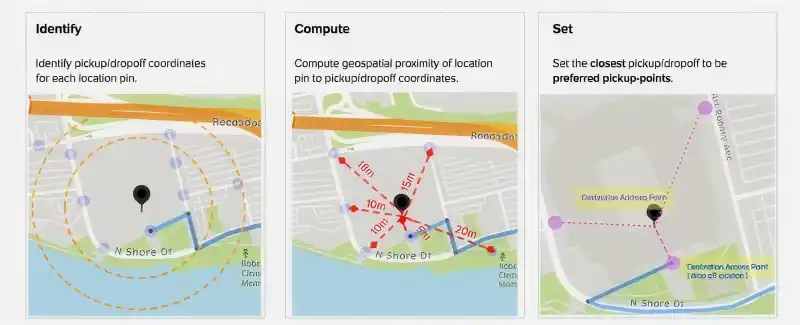
The process refines pickup and drop-off points in three steps: first identifying actual location pins, then calculating distances between them. Finally, it selects the closest points as the preferred pickup or drop-off locations for better accuracy.
- The shortest distance (closest pickup point) is then calculated and we set the pin to that location as a preferred access point on the map.
- When a rider requests the location indicated by the map pin, the map guides the driver to the preferred access point.
- The calculation continues with the latest actual pick-up and drop-off locations to ensure the freshness and accuracy of the suggested preferred access points.
- Uber uses machine learning and different algorithms to figure out the preferred access point.
9. Estimating Arrival Times (ETA)
ETA is an extremely important metric in Uber because it directly impacts ride-matching and earnings.
- ETA is calculated based on the road system (not geographically) and there are a lot of factors involved in computing the ETA (like heavy traffic or road construction).
- When a rider requests a cab from a location the app not only identifies the free/idle cabs but also includes the cabs which are about to finish a ride.
It may be possible that one of the cabs which are about to finish the ride is closer to the demand than the cab which is far away from the user. So many Uber cars on the road send GPS locations every 4 seconds, so to predict traffic we can use the driver's app’s GPS location data.
- We can represent the entire road network on a graph to calculate the ETAs. We can use AI-simulated algorithms or simple **Dijkstra's algorithm to find out the best route in this graph.
- In that graph, nodes represent intersections (available cabs), and edges represent road segments.
- We represent the road segment distance or the traveling time through the edge weight. We also represent and model some additional factors in our graph such as one-way streets, turn costs, turn restrictions, and speed limits.
Once the data structure is decided we can find the best route using Dijkstra’s search algorithm which is one of the best modern routing algorithms today. For faster performance, we also need to use OSRM (Open Source Routing Machine) which is based on contraction hierarchies.
4. High-Level Design
This section provides an overview of the system architecture, showing how components interact to fulfill user requirements.
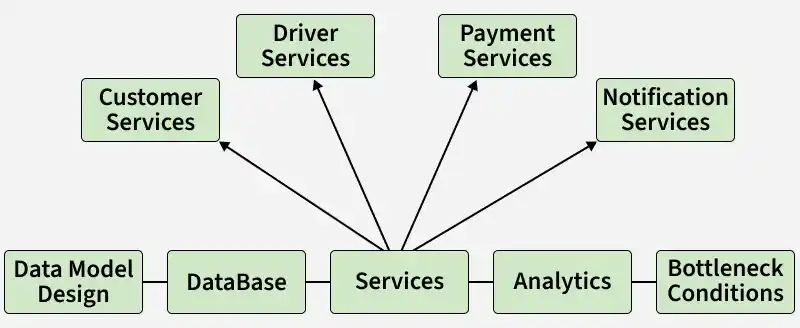
HLD
1. Data model design
This section defines how data is structured and stored for efficient access and scalability.
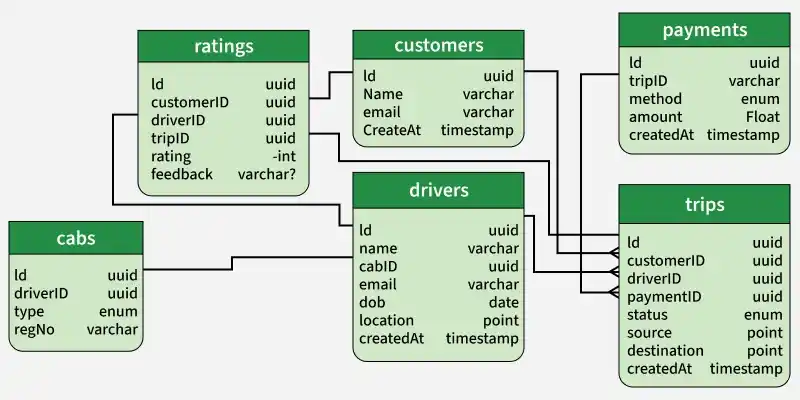
Data Model Design
2. Databases
Uber had to consider some of the requirements for the database for a better customer experience. These requirements are...
- The database should be horizontally scalable. You can linearly add capacity by adding more servers.
- It should be able to handle a lot of reads and writes because once every 4-second cabs will be sending the GPS location and that location will be updated in the database.
- The system should never give downtime for any operation. It should be highly available no matter what operation you perform (expanding storage, backup, when new nodes are added, etc).
Earlier Uber was using the RDBMS PostgreSQL database but due to scalability issues uber switched to various databases. Uber uses a NoSQL database (schemaless) built on top of the MySQL database.
- Redis for both caching and queuing. Some are behind Twemproxy (which provides scalability of the caching layer). Some are behind a custom clustering system.
- Uber uses Schemaless (built in-house on top of MySQL), Riak, and Cassandra. Schemaless is for long-term data storage. Riak and Cassandra meet high-availability, low-latency demands.
- MySQL database.
- Uber is building their own distributed column store that’s orchestrating a bunch of MySQL instances.
3. Services
This section explains the key services that make up the system and their responsibilities.
- **Customer Service: This service handles concerns related to customers such as customer information and authentication.
- **Driver Service: This service handles driver-related concerns such as authentication and driver information.
- **Payment Service: This service will be responsible for handling payments in our system.
- **Notification Service: This service will simply send push notifications to the users. It will be discussed in detail separately.
4. Analytics
To optimize the system, minimize the cost of the operation and for better customer experience uber does log collection and analysis. Uber uses different tools and frameworks for analytics. For log analysis, Uber uses multiple Kafka clusters.
Kafka takes historical data along with real-time data. Data is archived into Hadoop before it expires from Kafka. The data is also indexed into an Elastic search stack for searching and visualizations. Elastic search does some log analysis using Kibana/Graphana. Some of the analyses performed by Uber using different tools and frameworks are...
- Track HTTP APIs
- Manage profile
- Collect feedback and ratings
- Promotion and coupons etc
- Fraud detection
- Payment fraud
- Incentive abuse by a driver
- Compromised accounts by hackers. Uber uses historical data of the customer and some machine learning techniques to tackle this problem.
5. Handling The Data center Failure
Datacenter failure doesn't happen very often but Uber still maintains a backup data center to run the trip smoothly. This data center includes all the components but Uber never copies the existing data into the backup data center.
**Then how does Uber tackle the data center failure?
- It actually uses driver phones as a source of trip data to tackle the problem of data center failure.
- When The driver's phone app communicates with the dispatch system or the API call is happening between them, the dispatch system sends the encrypted state digest (to keep track of the latest information/data) to the driver's phone app.
- Every time this state digest will be received by the driver's phone app. In case of a data center failure, the backup data center (backup DISCO) doesn't know anything about the trip so it will ask for the state digest from the driver's phone app and it will update itself with the state digest information received by the driver's phone app. Untitled Diagram
5. Internal Team - Testing Suggestions
To ensure Uber’s complex system runs smoothly and reliably, the internal team must perform thorough testing across multiple areas:
1. Functional Testing
This ensures that all user-facing features and workflows function correctly.
- Verify all user flows like ride booking, driver tracking, cancellations, and payments.
- Test edge cases such as no cabs available or last-minute cancellations.
2. Load and Performance Testing
This measures how the system performs under high traffic and stress conditions.
- Simulate millions of daily requests to measure dispatch latency and Kafka throughput.
- Test database scalability for frequent GPS location updates and trip data.
3. Integration Testing
This validates that different services communicate and work together correctly.
- Validate communication between Supply, Demand, Dispatch, Payment, and Notification services.
- Test WebSocket connections for real-time driver and rider updates.
- Verify Kafka event streaming and data pipeline flows correctly.
4. Fault Tolerance and Recovery Testing
This ensures the system can handle failures and recover gracefully.
- Simulate data center failure to check backup data center recovery using state digests from driver phones.
- Test system behavior under network partitions and node failures.
- Ensure data consistency and recovery after failover.
5. Geospatial and Dispatch Logic Testing
This verifies the accuracy and efficiency of location-based algorithms and dispatch logic.
- Validate location mapping using S2 library cells for accurate supply-demand matching.
- Test dispatch optimization algorithms and ETA calculations using road network graphs and OSRM.
6. Security Testing
This ensures that user data and communications are protected from unauthorized access.
- Ensure secure authentication and authorization for drivers and riders.
- Test encryption of sensitive data, including state digests shared between apps and servers.
- Conduct penetration testing on APIs and WebSocket communication.
7. Analytics Pipeline Testing
This verifies that data processing and reporting pipelines work correctly.
- Verify Kafka data archiving, Hadoop storage, and ElasticSearch indexing.
- Test analytics dashboards for accurate real-time and historical insights.
8. Scalability Testing
This ensures the system can grow and handle increasing loads efficiently.
- Dynamically add or remove Ringpop nodes and ensure load is balanced correctly.
- Test consistent hashing and shard allocation for distributed dispatch