Circuit Breaker Pattern in Microservices (original) (raw)
Last Updated : 21 Jan, 2026
The Circuit Breaker pattern is like a safety switch for microservices. Suppose your online store depends on a payment service. If that service starts failing repeatedly, the circuit breaker “trips” and stops further calls for a while, preventing cascades and giving the service time to recover. let's understand circuit breaker pattern with this example:
- Your store makes a request to the payment service to process a payment. Everything works fine.
- Suddenly, the payment service has issues and fails three times in a row.
- The circuit breaker trips and enters an "open" state. Now, when your store tries to contact the payment service, it immediately gets an error response instead of trying to connect again.
- After a set time, the circuit breaker changes to a "half-open" state. It allows a few test requests to see if the payment service is back online.
- If those requests succeed, the circuit breaker resets to "closed," and everything goes back to normal. If they fail, it stays open longer, giving the payment service more time to recover.
Characteristics of Circuit Breaker Pattern
Below are some of the characteristics of Circuit Breaker Patterns in Microservices include:
- Improves fault tolerance by isolating failing dependencies.
- Monitors latency, error rate, and timeouts over a rolling window.
- Prevents cascades by temporarily stopping calls to an unhealthy service.
- Supports fallbacks (default responses, cached data, queueing) for graceful degradation.
- Auto-recovers by probing and resetting when the service stabilizes.
Working and Different States in Circuit Breaker Pattern
The Circuit Breaker pattern typically operates in three main states: Closed, Open, and Half-Open. Each state represents a different phase in the management of interactions between services. Here's an explanation of each state:
**Closed State
- In the Closed state, the circuit breaker operates normally, allowing requests to flow through between services.
- During this phase, the circuit breaker monitors the health of the downstream service by collecting and analyzing metrics such as response times, error rates, or timeouts.
**Open State
- When the monitored metrics breach predetermined thresholds, signaling potential issues with the downstream service, the circuit breaker transitions to the Open state.
- In the Open state, the circuit breaker immediately stops forwarding requests to the failing service, effectively isolating it.
- This helps prevent cascading failures and maintains system stability by ensuring that clients receive timely feedback, even when services encounter issues.
**Half-Open State
- After a specified timeout period in the Open state, transitions to Half-Open state.
- Allows a limited number of trial requests to pass through to the downstream service.
- Monitors responses to determine service recovery.
- If trial requests succeed, indicating service recovery, transitions back to Closed state.
- If trial requests fail, service issues persist.
- May transition back to Open state or remain in Half-Open state for further evaluation.
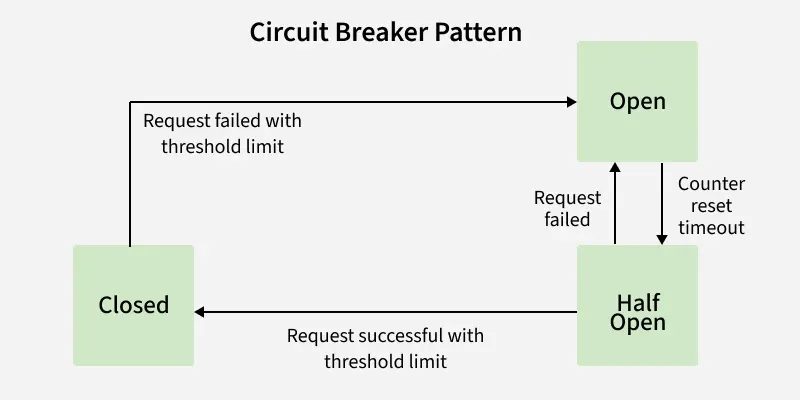
**Closed State to Open State:
- **Transition Trigger: Request failed with threshold limit.
- When the monitored metrics breach the predefined thresholds while the Circuit Breaker is in the Closed state, indicating potential issues with the downstream service, it transitions to the Open state. This means that the Circuit Breaker stops forwarding requests to the failing service(that is experiencing issues or failures)and provides fallback responses to callers.
**Half-Open State to Closed State:
- **Transition Trigger: Request successful with threshold value.
- After a specified timeout period in the Open state, the Circuit Breaker transitions to the Half-Open state. In the Half-Open state, a limited number of trial requests are allowed to pass through to the downstream service. If these trial requests are successful and the service appears to have recovered, the Circuit Breaker transitions back to the Closed state, allowing normal traffic to resume.
**Half-Open State to Open State:
- **Transition Trigger: Request failed.
- While in the Half-Open state, if the trial requests to the downstream service fail, indicating that the service is still experiencing issues, the Circuit Breaker transitions back to the Open state. This means that requests will again be blocked, and fallback responses will be provided until the service's health improves.
**Open State to Half-Open State:
- **Transition Trigger: Counter reset timeout.
- After a specified timeout period in the Open state, the Circuit Breaker transitions to the Half-Open state. This timeout period allows the Circuit Breaker to periodically reevaluate the health of the downstream service and determine if it has recovered.
Steps to Implement Circuit Breaker Pattern
Below are the steps to implement Circuit Breaker Pattern:
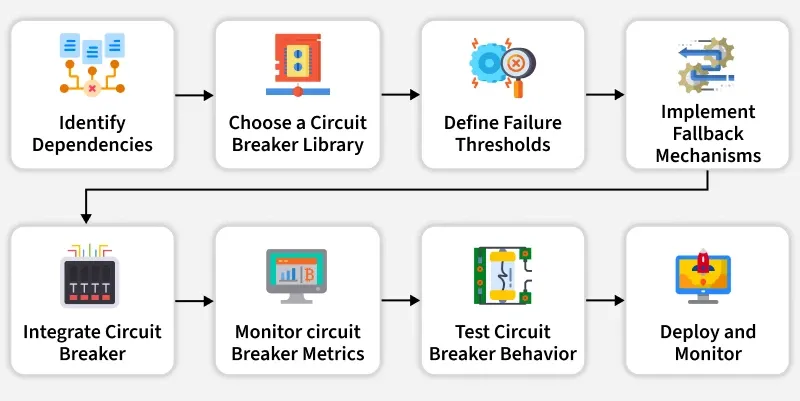
Step 1: Identify Dependencies
Going for the external services that will bring interactions and make the microservice functional in turn.
Step 2: Choose a Circuit Breaker Library:
Choose a circuit breaker library from these existing libraries, or create your own framework that you are familiar with, based on your programming language and platform.
Step 3: Integrate Circuit Breaker into Code:
Make sure to insert the selected circuit breaker library into your microservices code base.
Step 4: Define Failure Thresholds:
Set boundaries for faults and time-outs that turn the mechanism of the circuit breaker to open.
Step 5: Implement Fallback Mechanisms:
Include whenever the circuit has open or close requests, the fallback mechanism should be implemented.
Step 6: Monitor Circuit Breaker Metrics:
Use the statistics built into the circuit braker library to see the health an behavior of your services. Such evaluation measurements includes number of successful/unsuccessful requests, status of the circuit breaker, and error rates.
Step 7: Tune Configuration Parameters:
Tuning configuration parameters like timeouts, thresholds, and retry methods in accordance to behavior of your microservices and your application requirements.
Step 8: Test Circuit Breaker Behavior:
Perform live testing of your circuit breaker during different operating states including normal function, failure scenarios (high load), and fault condition.
Step 9: Deploy and Monitor:
Move/deploy your microservice with circuit breaker, into your production environment.
Use Cases of Circuit Breaker Pattern
Below are the use cases of circuit breaker pattern:
- When microservices are communicating with one over the network through the pattern of the Circuit breaker, the document helps to deal with the network failures and with unavailability of service or with slow responses.
- That, in doing so, it avoids collateral damage of failures by serving as a barrier between a final service and providing alternative options when failure occurs.
- That is, the microservices are the APIs or services which may be external or from other parties.
- This Circuit Breaker pattern can be included as a contingency to mitigate against failures in the integrations, enabling the whole system to stay functional even when the external parties are affected by unforeseen issues.
- Service instances could be split by circuit breakers together with load balancers in the same time to carry incoming traffic to various instance of that service.
- When a service failure occur, the circuit breakers redirect traffic from the failing instance to a healthy instance, meaning that requests are still processed in case of a further failures.
Challenges of Circuit Breaker Pattern in Microservices
Below are some challenges of circuit breaker pattern in microservices:
- Implementing a circuit breaker adds an extra layer of complexity to the system. Developers need to manage its states (open, closed, half-open) and ensure it integrates well with existing services.
- Properly tuning the parameters for timeout, failure thresholds, and recovery periods can be tricky. If these settings aren’t optimized, it could lead to either too many failed attempts or unnecessary service disruptions.
- Testing circuit breaker behavior can be challenging in a development environment. Simulating real-world failure scenarios and ensuring that the circuit breaker responds as expected requires careful planning.
- When multiple services use circuit breakers, understanding the interdependencies and potential points of failure can become complex. This can lead to confusion about which service is causing issues.
When to use Circuit Breaker Pattern
Use Circuit breaker pattern when:
- You rely on third-party services or APIs that are known to have failures, using a circuit breaker can help manage those outages without overwhelming your system.
- When dealing with services that can experience high response times, a circuit breaker can prevent excessive waiting and keep your application responsive by quickly returning fallback responses.
- For operations that consume significant resources (like database queries or external API calls), a circuit breaker can help avoid overloading the system when failures occur.
- In a microservices architecture, where services communicate frequently, a circuit breaker can protect each service from failures in others, maintaining overall system stability.
- If a service typically requires time to recover after a failure (like restarting or rebooting), implementing a circuit breaker can help prevent repeated attempts to connect during that recovery phase.
Below are some tools and frameworks for implementing circuit breaker:
- **Hystrix: Developed by Netflix, Hystrix is one of the most well-known libraries for implementing the Circuit Breaker pattern in Java applications. It provides features like fallback mechanisms, metrics, and monitoring, helping to manage service calls effectively.
- **Resilience4j: This lightweight, modular library for Java is designed to work seamlessly with Spring Boot and other frameworks. Resilience4j includes a circuit breaker, along with other resilience patterns like retries and rate limiting, allowing for fine-tuned control over service interactions.
- **Spring Cloud Circuit Breaker: This project provides an abstraction for circuit breakers in Spring applications. It allows you to use different circuit breaker implementations (like Hystrix or Resilience4j) interchangeably, making it easy to switch between them based on your needs.
- **Polly: For .NET applications, Polly is a popular library that supports the Circuit Breaker pattern and other resilience strategies, such as retries and timeouts. It provides a simple API for defining policies and applying them to service calls.
- **Istio: As a service mesh for Kubernetes, Istio offers built-in circuit breaker capabilities at the network level. It allows you to configure circuit breakers for service-to-service communication, providing resilience without needing to modify application code.