Microservice Architecture (original) (raw)
Last Updated : 1 Jun, 2026
Microservice Architecture is a software design approach where an application is divided into small, independent services that work together. Each service handles a specific business function and can be developed, deployed, and scaled independently.
- Breaks large applications into smaller services, making development, testing, and debugging easier.
- Improves scalability and maintainability, as each service can be updated or deployed without affecting the entire system.
**Example: An e-commerce application can use separate microservices for user authentication, product catalog, orders, and payments. Each service operates independently while communicating through APIs to provide a complete shopping experience.
Breaking Down an Application into Modules
An organization requires an Employee and Customer Management System to efficiently manage employee and customer information. The application is designed to support essential operations such as adding, updating, and deleting records. This helps streamline business processes and improve the management of organizational data.
- _Add employees/customers
- _Delete employees/customers
- _Update employees/customers
And you started developing the application. So in the beginning, you try to find out the main components. So the main components/modules for this requirement are
- **Employees Module: _To manage your employees
- **Customers Module: _To manage your customers
- **Courses Module: In this module, you'll be selling your courses, somebody will purchase your courses, etc.
- **Address Module: _In this module, we will manage the employees' and customers' different types of addresses like billing addresses or shipping addresses, etc.
After that, you started designing endpoints like
- _/employees, /employees/id
- _/customers, /customers/id
- _/courses, /courses/id
- _/address, /address/id, etc.
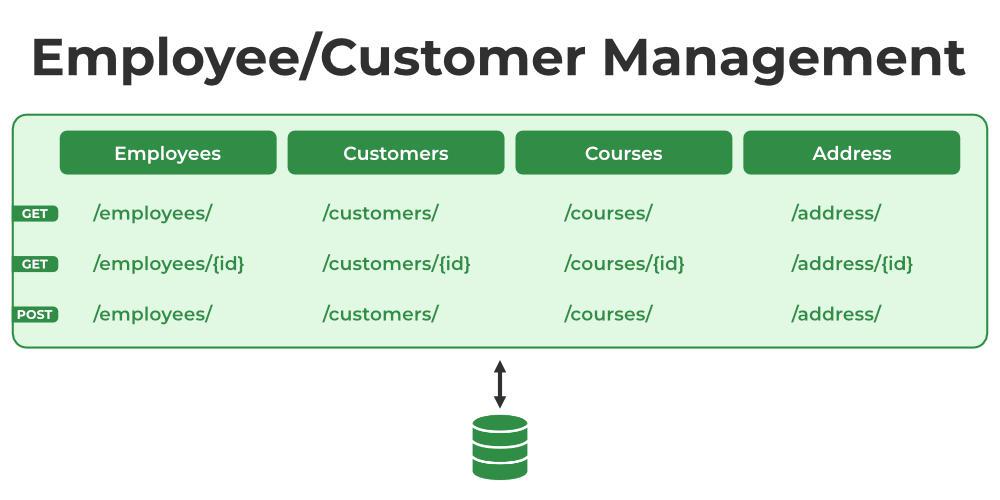
In a **Monolithic Architecture, all application modules such as Employees, Customers, Courses, and Address Management are combined into a single deployable unit and deployed on one server. All modules share the same application and database, making it a tightly coupled system.
- All controllers, business logic, and modules are packaged together and deployed as a single application.
- The application typically uses a shared database containing tables for all modules.
- Any update or deployment requires rebuilding and redeploying the entire application.

So now what are the problems and challenges that we basically face on monolithic and why the world is moving towards microservices?
**Challenges with Monolithic Architecture
Challenge 1:
A new requirement is introduced in the Course Module, such as adding a new feature, theme, button, or fixing a bug. To implement this change, modifications need to be made to the existing application, even if the update affects only the Course Module.

A change made in one module of a monolithic application can unintentionally affect other modules because the entire application is packaged and deployed as a single unit. For example, after adding a new feature to the Course Module and deploying the application, the feature may work correctly but another module, such as the Customer Module, may stop functioning properly.
- Even small changes require rebuilding and redeploying the entire application.
- A modification in one module can unexpectedly impact unrelated modules due to tight coupling.
- Every code change requires end-to-end testing of the entire application, increasing testing effort and time.
- Developers often lack knowledge of all modules, making debugging, maintenance, and onboarding more challenging.
- Identifying the root cause of issues becomes difficult because problems may appear in modules where no direct changes were made.
Challenge 2:
A promotional offer, such as 20% off for new users, can attract a large number of customers to the application. As many users sign up and log in simultaneously, the Customer Module experiences heavy traffic and becomes a bottleneck.
- A sudden increase in user registrations places a high load on the Customer Module.
- The module may consume most of the application resources, affecting overall performance.
- Since the application is monolithic, scaling only the Customer Module is not possible.
- Increased traffic can slow down the entire application, even if other modules are not heavily used.

To handle increased traffic, the same application can be deployed on multiple servers connected to a shared database. A load balancer is then used to distribute incoming requests across these servers, improving performance and reducing overload on any single server.
- The same application code is deployed on multiple servers (e.g., Server 1, Server 2, and Server 3).
- All servers connect to the same database and work together to handle user requests.
- A load balancer distributes incoming traffic across the available servers.
- This approach improves availability, performance, and load handling by preventing a single server from becoming overloaded.
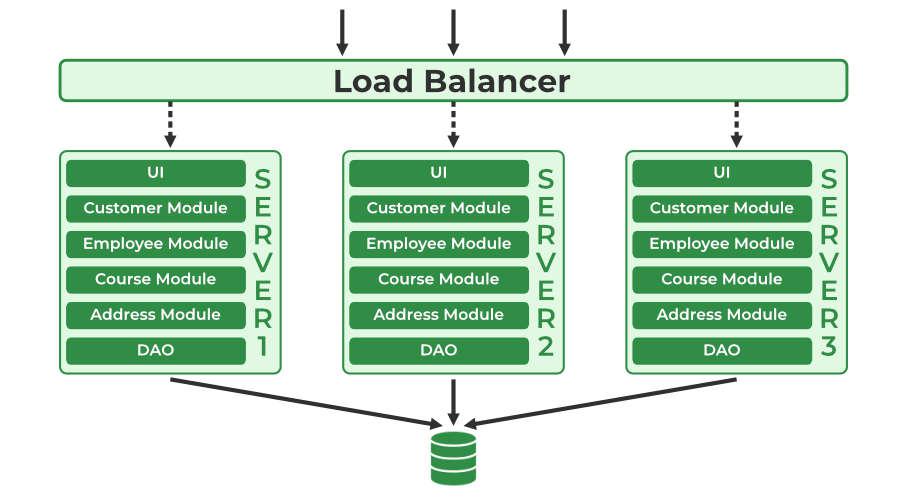
Although deploying the application on multiple servers with a load balancer helps distribute traffic, it does not solve the core problem of a monolithic architecture. If only the Customer Module experiences high traffic, the entire application-including the Employee, Course, and Address modules—must still be deployed on every server.
This leads to inefficient resource utilization because modules that do not require additional capacity are also replicated. As a result, organizations incur unnecessary infrastructure costs and waste server resources, since individual modules cannot be scaled independently.
Microservice Architecture
Look at this architecture below.

In microservice architecture, a large application is divided into multiple small and independent services, each responsible for a specific business function. Instead of combining all modules into a single application, services such as Employee, Customer, Course, and Address are developed and deployed separately.
- Each service runs as an independent application (e.g., separate Spring Boot applications).
- Services can communicate with each other internally when required.
- Every service can have its own dedicated database, ensuring better isolation and flexibility.
- This approach allows individual services to be developed, deployed, and scaled independently.

In a microservice architecture, each service has its own application, deployment pipeline, server, and database. For example, the Employee Service is built and deployed independently and uses a dedicated Employee database, while other services follow the same approach.
Advantages of Microservice Architecture
- **Independent Deployment: Each service can be built, deployed, and updated without affecting other services.
- **Independent Testing: Services can be tested separately, reducing testing effort and improving reliability.
- **Reduced Impact of Changes: Changes in one service do not require testing or redeploying the entire application.
- **Better Developer Productivity: Developers can work on individual services without needing detailed knowledge of the entire system.