Keyword Searching Algorithms For Search Engines (original) (raw)
Last Updated : 23 Jul, 2025
Keyword searching algorithms are fundamental to search engines, enabling them to retrieve relevant documents or web pages based on user-inputted keywords. Keyword searching is a fundamental aspect of search engines, and several algorithms contribute to efficiently retrieving relevant results based on user-entered keywords. Before diving into the Search Algorithm we must know what a search engine is.
Table of Content
- What is a Search Engine?
- How do Search Engines Work?
- Need Of Keyword Searching Algorithms
- Keywords Searching Algorithms For Search Engine
What is a Search Engine?
A search engine is a tool or an online service that allows users to search for information on the Internet. Search Engine use Keyword Searching Algorithms to search queries and give output. The primary function of a search engine is to help users find relevant documents, web pages, images, videos, or other types of content based on their queries or keywords. Search engines use sophisticated algorithms to index and rank the vast amount of information available on the web, making it easier for users to access the most relevant and useful results.
How Search Engines Work?

- **Web Crawling:
- Search engines use automated programs called web crawlers or spiders to browse the web and systematically scan websites for information.
- These crawlers follow links from one page to another, indexing the content of each page they visit.
- **Indexing :
- The information collected by web crawlers is organized and stored in a database called an index.
- The index contains information about the content, keywords, and structure of web pages, making it easier and faster to retrieve relevant results.
- **Ranking Algorithms:
- Search engines employ complex keyword searching algorithms to analyze and rank the indexed pages based on their relevance to a user's query.
- Factors such as keyword relevance, page quality, user engagement, and other criteria are used to determine the order in which results are presented.
Need Of Keyword Searching Algorithms
Search engines use keyword searching algorithms primarily because they provide an effective and efficient way to retrieve relevant information from vast amounts of data available on the web. The use of keywords as a basis for searching has several advantages:
- **Simplicity and User Familiarity:
- Keywords are simple and widely understood by users. People are accustomed to expressing their information needs in the form of words or phrases. Using keywords makes the search process intuitive and user-friendly.
- **Scalability:
- The web is enormous, with an immense volume of content. Keyword searching algorithms allow search engines to scale their operations efficiently. It's a practical approach for indexing and retrieving information from billions of web pages.
- **Information Retrieval Speed:
- Keyword searching algorithms enable quick retrieval of relevant results. By indexing and organizing web pages based on keywords, search engines can rapidly identify and present results matching the user's query.
- **Flexibility:
- Users can formulate queries in various ways using different combinations of keywords. Search engines are designed to handle a wide range of queries, making keyword searching algorithms a flexible and adaptable approach.
- **Relevance Ranking:
- Keyword algorithms enable search engines to rank results based on relevance to the query. Sophisticated ranking algorithms consider factors such as the frequency of keywords, their placement, and the overall content quality to provide users with the most relevant results.
- **Query Expansion:
- Search engines often employ query expansion techniques to improve search results. For example, if a user's query lacks specificity, the search engine may expand it by adding related terms to refine the search.
- **Adaptability to Natural Language:
- While users often input queries as keywords, search engines have evolved to understand natural language to some extent. Advanced algorithms use natural language processing (NLP) keyword searching algorithms techniques to enhance the understanding of user queries.
- **Historical Data and User Behavior:
- Keyword searching algorithms enable search engines to analyze historical data and user behavior. This information is valuable for improving search results and personalizing recommendations for individual users
Keywords Searching Algorithms For Search Engine
Here are some keyword searching algorithms used by Search Engine for keyword searching:
1. **Inverted Index :
- **Algorithm Overview: An inverted index Keywords Searching Algorithm is a data structure that maps keywords to the documents or web pages in which they appear. It involves creating an index of terms with pointers to the documents that contain them.
- **Significance: Enables quick and efficient retrieval of documents containing specific keywords, forming the backbone of many search engine algorithms.

Inverted Index Algorithm
2. **TF-IDF (Term Frequency-Inverse Document Frequency):
- **Algorithm Overview: In TF-IDF(Term Frequency - Inverse Document Frequency)Keyword Searching algorithms we assign weights to each term in a document based on its frequency (TF) in the document and its rarity (IDF) across the entire document collection.
- **Significance: Helps prioritize terms that are important in a specific document but not common across all documents, enhancing the relevance of search results.

TF-IDF Algorithm
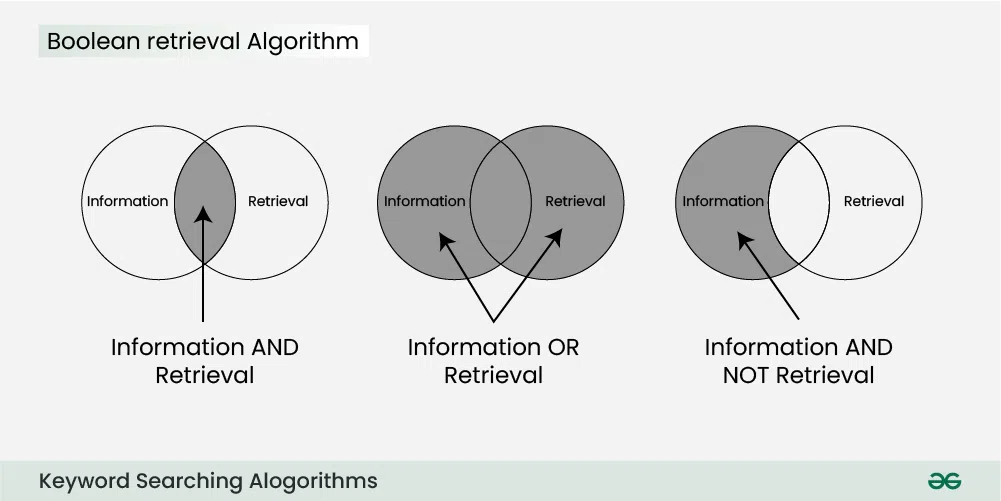
3. **Boolean Retrieval Model:
- **Algorithm Overview: Uses Boolean operators (AND, OR, NOT) to combine keywords in search queries. Documents are retrieved based on whether they satisfy the Boolean conditions.
- **Significance: Provides a foundation for Boolean search queries, allowing users to express complex search criteria.
4. **Vector Space Model:
- **Algorithm Overview: Represents documents and queries as vectors in a multi-dimensional space. The cosine similarity between vectors is used to measure the relevance of documents to a query.
- **Significance: Allows for a more nuanced representation of document-query relationships, considering the similarity of terms and their weights.

Vector Space Model Algorithm
5. **BM25 (Best Matching 25):
- **Algorithm Overview: BM25 Keyword Searching algorithms is a probabilistic information retrieval model that builds on TF-IDF but introduces parameters to control term saturation and document length normalization.
- **Significance: Often used in modern search engines due to its effectiveness in handling various types of documents and queries.

BM25 Algorithm
6. **Pagerank Algorithm:
- **Algorithm Overview: Developed by Google, Pagerank Keyword Searching Algorithms evaluate the importance of web pages based on the number and quality of links pointing to them.
- **Significance: Plays a crucial role in ranking search results, with more authoritative pages receiving higher rankings.

Pagerank Algorithm
7. **Latent Semantic Indexing (LSI):
- **Algorithm Overview: Analyzes relationships between terms in a document collection to identify hidden or latent semantic structures. It involves singular value decomposition.
- **Significance: Enhances search results by considering the context and relationships between words, improving the understanding of document content.

LSI Algorithm
8. **Autocomplete and Suggestions:
- **Algorithm Overview: Predicts and suggests possible query completions based on partial user input. Utilizes techniques like Trie data structures and n-gram models.
- **Significance: Enhances user experience by providing real-time suggestions, reducing the need for users to type complete queries.

Suggestions Algorithm

Autocompletion Algorithm
9. **Natural Language Processing (NLP) for Query Understanding:
- **Algorithm Overview: Applying NLP Keyword Searching Algorithms techniques to understand the intent and context of user queries, considering synonyms, context, and linguistic variations.
- **Significance: Improves the accuracy of search results by interpreting user queries in a more human-like manner.

Natural Language Processing Algorithm
10. **Machine Learning and Ranking Algorithms:
- **Algorithm Overview: Utilizes machine learning algorithms to predict the relevance of documents to a query. Learning-to-rank algorithms, such as RankNet or LambdaMART, are common.
- **Significance: Enhances search results ranking by incorporating historical user behavior and feedback.

Machine Learning Algorithms
These Keywords Searching Algorithms collectively contribute to the efficiency and accuracy of keyword searching in search engines, making them powerful tools for information retrieval on the web. Search engines often employ a combination of these algorithms to provide users with relevant and high-quality results.
Conclusion
While keyword searching algorithms have been the foundation of search engines, modern search technologies are evolving to incorporate more sophisticated methods. This includes natural language processing, machine learning, and semantic search to better understand context, and user intent, and deliver more accurate results. Nevertheless, keywords remain a crucial element in the overall search ecosystem.