Arden's Theorem in Theory of Computation (original) (raw)
Last Updated : 12 Feb, 2026
A Regular Expression (RE) is a way to describe patterns of strings using symbols and operators like union, concatenation, and star. A Deterministic Finite Automaton (DFA) is a machine that reads input strings and decides if they match the pattern by moving through a set of defined states without any ambiguity. There are two methods for converting a Regular Expression (RE) to a Deterministic Finite Automaton (DFA):
- State/Loop Elimination
- Arden’s Theorem
State/Loop Elimination
- Here, we remove states that do not belong to the final set of states (F), unless the state is the starting state.
- When a state is eliminated, we rewrite the regular expression (RE) on the transition arcs, which represent the connections between states.
This process simplifies the automaton by reducing unnecessary states and focusing on the essential ones for the DFA.
**Theorem:
Let P, Q, and R be the regular expressions on Σ. If P does not contain ε, the equation R = Q + RP has a unique solution given by R = QP*.
**Explanation of Terms
- Q, P: Regular expressions.
- R: The solution for the given equation.
- Q: The regular expression independent of P.
- P: The regular expression associated with R.
The theorem allows R to be expressed in terms of Q and P using the Kleene star operation. Whenever we get any equation in the form of R = Q + RP, then we can directly replace it with R = QP*.
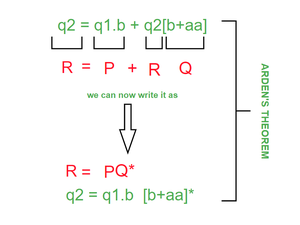
**Proof of Arden’s Theorem
We start with the equation:
R=Q+RP
Substituting R = Q + RP, we get:
R = Q + (Q + RP)P
Again, substituting R = Q + RP, we get:
R = Q + QP + RPP
Now, if we keep substituting the value of R repeatedly, we get:
**R = Q + QP + QP² + QP³ + ...
This can be factored as:
**R = Q (ε + P + P² + P³ + ...)
Since _P (P star)* represents ****(ε + P + P² + P³ + ...)**, we can simplify the equation to:
**R = QP*
Thus,
R = QP* is the unique solution of the equation R = Q + RP.
**Note : Arden's theorem is used to convert given finite automata to a regular expression.
To understand this theorem, we will solve an example.
**Example for Arden's Theorem
We are given the following set of equations representing regular sets, with states q0, q1, and q2:
- q0 = ϵ + q11 + q2(0 + 1) ------------ (A)
- q1 = q00 + q12 ------------ (B)
- q2 = q01 + q10 ------------ (C)
Step 1: Substituting q2 from Eq. (C) into Eq. (A)
Substitute the expression for q2 from equation (C) into equation (A):
q0 = ϵ + q11 + (q01 + q10)(0 + 1)
Simplifying the right-hand side:
- q0 = ϵ + q11 + q01(0 + 1) + q10(0 + 1)
- q0 = ϵ + q11 + q01 + q11(0 + 1)
This simplifies to the form:
q0 = ϵ + q1(1 + 00 + 01) + q01(0 + 1)
This is of the form R = Q + RP, where:
- R = q0
- Q = [ϵ + q1(1 + 00 + 01)]
- P = 1(0+1)
Step 2: Solving for q0
The solution to this recursive equation is:
R = QP∗
Thus, the expression for q0 becomes:
q0 = [ϵ + q1(1 + 00 + 01)](1(0 + 1))∗------------ (D)
Step 3: Substituting q0 from Eq. (D) into Eq. (B)
Now, substitute the value of q0 from Eq. (D) into Eq. (B):
q1 = q02 + [ϵ + q1(1 + 00 + 01)](1(0 + 1))∗
Simplifying:
q1 = 1(0 + 1)∗0 + q1[2 + (1 + 00 + 01)(1(0 + 1))∗0]
This is again of the form R=Q+RP, where:
- R = q1
- Q = 1(0+1)∗0
- P = [2 + (1 + 00 + 01)(1(0 + 1))∗0]
Step 4: Solving for q1
The solution to this is:
q1 =1(0 + 1)∗0[2 + (1 + 00 + 01)(1(0 + 1))∗0]∗
Step 5: Substituting q1 into Eq. (D)
Now, substitute the expression for q1 into Eq. (D):
q0 = [ϵ + 1(0 + 1)∗0[2 + (1 + 00 + 01)]]
Simplifying:
q0 = [(1(0 + 1)∗)0]∗(1 + 00 + 01)(1(0 + 1))∗
Final Regular Expression
Thus, the regular expression describing the machine is given by:
q0 + q1 = [ϵ + (1(0 + 1)∗0)[2 + (1 + 00 + 01)(1(0 + 1))∗0]∗] + (1 + 00 + 01)(1(0 + 1))∗ + (1(0 + 1)∗0[2 + (1 + 00 + 01)(1(0 + 1))∗0]∗)∗
This is the final regular expression that describes the given machine.
Features of Arden's theorem in the context of TOC
- **Solving Equations: Arden's Theorem helps solve systems of equations with regular expressions, useful in building finite automata and pattern matching.
- **Unique Solution: It guarantees a unique solution, ensuring reliability and clarity in computations.
- **Efficient Approach: The theorem provides a clear, step-by-step method for solving equations, making it easy to implement algorithmically.
- **Focus on Regular Languages: It's designed for regular languages, which are central to many areas in theoretical computer science, like compilers and text processing.
- **Connection to Formal Language Theory: Arden's Theorem connects regular expressions, grammars, and finite automata, core ideas in formal language theory.
- **Practical Use: It allows efficient construction of finite automata from regular expressions, which is crucial for real-world tasks like lexical analysis.
**Applications of Arden’s Theorem
- Solve equations involving regular expressions to derive regular expressions for languages accepted by finite automata.
- Convert deterministic or nondeterministic finite automata (DFA/NFA) into equivalent regular expressions.