CYK Algorithm for Context Free Grammar (original) (raw)
Last Updated : 15 Jul, 2025
Prerequisite - Converting Context Free Grammar to Chomsky Normal Form CYK algorithm is a parsing algorithm for context free grammar. In order to apply CYK algorithm to a grammar, it must be in Chomsky Normal Form. It uses a dynamic programming algorithm to tell whether a string is in the language of a grammar.**Algorithm :**Let w be the n length string to be parsed. And G represent the set of rules in our grammar with start state S.
- Construct a table DP for size n × n.
- If w = e (empty string) and S -> e is a rule in G then we accept the string else we reject.
- For i = 1 to n:
For each variable A:
We check if A -> b is a rule and b = wi for some i:
If so, we place A in cell (i, i) of our table. - For l = 2 to n:
For i = 1 to n-l+1:
j = i+l-1
For k = i to j-1:
For each rule A -> BC:
We check if (i, k) cell contains B and (k + 1, j) cell contains C:
If so, we put A in cell (i, j) of our table. - We check if S is in (1, n):
If so, we accept the string
Else, we reject.
**Example -**Let our grammar G be:
S -> AB | BC A -> BA | a B -> CC | b C -> AB | a
We check if baaba is in L(G):
- We first insert single length rules into our table.
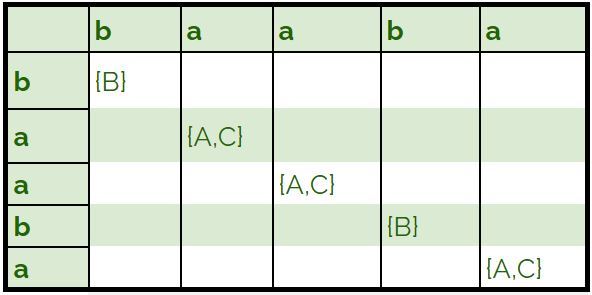
- We then fill the remaining cells of our table.
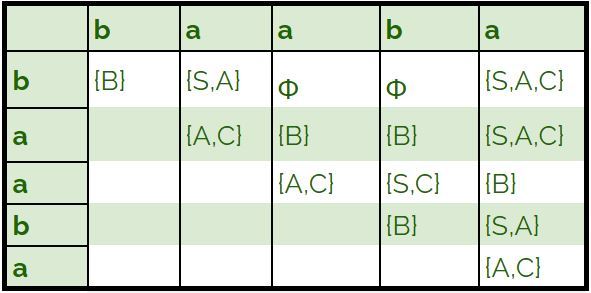
- We observe that S is in the cell (1, 5), Hence, the string baaba belongs to L(G).
Time and Space Complexity :
- Time Complexity -
O(n3.|G|)
Where |G| is the number of rules in the given grammar. - Space Complexity -
O(n2)