DFA for accepting the language L = { anbm | n+m =even } (original) (raw)
Last Updated : 11 Jul, 2025
Problem
**Design a deterministic finite automata(DFA) for accepting the language L = {a n **b m | n+m = even}
**Examples:
**Input: a a b b , n = 2, m = 2
2 + 2 = 4 (even)
**Output: ACCEPTED**Input: a a a b b b b ,n = 3, m = 4
3 + 4 = 7 (odd)
**Output: NOT ACCEPTED**Input: a a a b b b , n = 3, m = 3
3 + 3 = 6 (even)
**Output: ACCEPTED
**Approaches
**There are 2 cases that result in the acceptance of string:
- If both n and m are even then their sum will be even
- If both n and m are odd then their sum will be even
**Description
Below is a step-by-step explanation and design of a DFA that accepts the language **L = {an bm | n+m =even}, assuming the input strings are always of the form zero or more **a’s followed by zero or more **b’s. We need to track whether the total number of characters read (n + m) is even or odd.
**States Explanation
- Initially you start in A, where no characters have been read and the total is even. When you read an 'a', you move between A TO B , flipping between even and odd totals without having seen any 'b's yet.
- Whether the total number of letters read so far (both 'a' and 'b') is even or odd, and whether we’ve started reading 'b's or not.
- The moment you encounter the first 'b', you move into another set of states—such as C and F, or D and E that are responsible for tracking parity after ‘b’s begin.
- Each additional 'b' flips the parity, causing you to jump between these states ensuring that at any point the machine knows if the sum of 'a's and 'b's read is even or odd.
- Some states are shown multiple times or arranged differently to make the diagram clearer, but they all serve the same purpose to keep track of even or odd totals and whether you’re still reading 'a's or have started reading 'b's.
- If a's come after the b's there is a dead state X where it will go .
**DFA State Transition Diagram
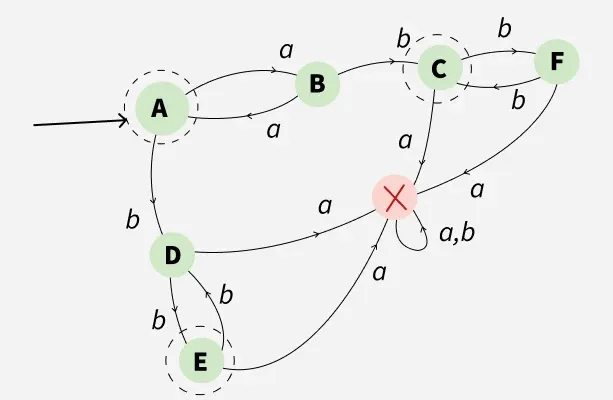
DFA
**Let's see the code for the demonstration:
C++ `
// C++ program to implement DFA that accepts // all strings which follow the language // L = { a^n b^m ; n+m=even } #include <bits/stdc++.h> using namespace std;
// dfa tells the number associated // with the present state int dfa = 0;
// This function is for // the starting state (zeroth) of DFA void start(char c) { if (c == 'a') dfa = 1; else if (c == 'b') dfa = 2;
// -1 is used to check for any invalid symbol
else
    dfa = -1;
}
// This function is for the first state of DFA void state1(char c) { if (c == 'a') dfa = 0; else if (c == 'b') dfa = 5; else dfa = -1; }
// This function is for the second state of DFA void state2(char c) { if (c == 'b') dfa = 3; else dfa = -1; }
// This function is for the third state of DFA void state3(char c) { if (c == 'b') dfa = 4; else dfa = -1; }
// This function is for the fourth state of DFA void state4(char c) { if (c == 'b') dfa = 3; else dfa = -1; }
// This function is for the fifth state of DFA void state5(char c) { if (c == 'b') dfa = 6; else dfa = -1; }
// This function is for the sixth state of DFA void state6(char c) { if (c == 'b') dfa = 5; else dfa = -1; }
int isAccepted(char str[]) { // Store length of string int i, len = strlen(str);
for (i = 0; i < len; i++)
{
    if (dfa == 0)
        start(str[i]);

    else if (dfa == 1)
        state1(str[i]);

    else if (dfa == 2)
        state2(str[i]);

    else if (dfa == 3)
        state3(str[i]);

    else if (dfa == 4)
        state4(str[i]);

    else if (dfa == 5)
        state5(str[i]);

    else if (dfa == 6)
        state6(str[i]);

    else
        return 0;
}
if (dfa == 3 || dfa == 5)
    return 1;
else
    return 0;
}
// Driver code int main() { char str[] = "aaabbb"; if (isAccepted(str)) cout << "\nACCEPTED\n"; else cout << "NOT ACCEPTED\n"; return 0; }
// This code is contributed by SHUBHAMSINGH10
C
// C program to implement DFA that accepts // all strings which follow the language // L = { a^n b^m ; n+m=even } #include <stdio.h> #include <string.h>
// dfa tells the number associated // with the present state int dfa = 0;
// This function is for // the starting state (zeroth) of DFA void start(char c) { if (c == 'a') dfa = 1; else if (c == 'b') dfa = 2;
// -1 is used to check for any invalid symbol
else
    dfa = -1;
}
// This function is for the first state of DFA void state1(char c) { if (c == 'a') dfa = 0; else if (c == 'b') dfa = 5; else dfa = -1; }
// This function is for the second state of DFA void state2(char c) { if (c == 'b') dfa = 3; else dfa = -1; }
// This function is for the third state of DFA void state3(char c) { if (c == 'b') dfa = 4; else dfa = -1; }
// This function is for the fourth state of DFA void state4(char c) { if (c == 'b') dfa = 3; else dfa = -1; }
// This function is for the fifth state of DFA void state5(char c) { if (c == 'b') dfa = 6; else dfa = -1; }
// This function is for the sixth state of DFA void state6(char c) { if (c == 'b') dfa = 5; else dfa = -1; }
int isAccepted(char str[]) { // store length of string int i, len = strlen(str);
for (i = 0; i < len; i++)
{
    if (dfa == 0)
        start(str[i]);

    else if (dfa == 1)
        state1(str[i]);

    else if (dfa == 2)
        state2(str[i]);

    else if (dfa == 3)
        state3(str[i]);

    else if (dfa == 4)
        state4(str[i]);

    else if (dfa == 5)
        state5(str[i]);

    else if (dfa == 6)
        state6(str[i]);

    else
        return 0;
}
if (dfa == 3 || dfa == 5)
    return 1;
else
    return 0;
}
// driver code int main() { char str[] = "aaabbb"; if (isAccepted(str)) printf("\nACCEPTED\n"); else printf("NOT ACCEPTED\n"); return 0; }
Java
// Java program to implement DFA that accepts // all strings which follow the language // L = { a^n b^m ; n+m=even } class GFG {
// dfa tells the number associated
// with the present state.
static int dfa = 0;

// This function is for
// the starting state (Q0)of DFA
static void start(char c)
{
    if (c == 'a') {
        dfa = 1;
    }
    else if (c == 'b') {
        dfa = 2;
    }

    // -1 is used to check for any invalid symbol
    else {
        dfa = -1;
    }
}

// This function is for
// the first state (Q1) of DFA
static void state1(char c)
{
    if (c == 'a') {
        dfa = 0;
    }
    else if (c == 'b') {
        dfa = 5;
    }
    else {
        dfa = -1;
    }
}

// This function is for the
// second state (Q2) of DFA
static void state2(char c)
{
    if (c == 'b') {
        dfa = 3;
    }
    else {
        dfa = -1;
    }
}

// This function is for the
// third state (Q3)of DFA
static void state3(char c)
{
    if (c == 'b') {
        dfa = 4;
    }
    else {
        dfa = -1;
    }
}

// This function is for the
// fourth state (Q4) of DFA
static void state4(char c)
{
    if (c == 'b') {
        dfa = 3;
    }
    else {
        dfa = -1;
    }
}

// This function is for the
// fifth state (Q5) of DFA
static void state5(char c)
{
    if (c == 'b') {
        dfa = 6;
    }
    else {
        dfa = -1;
    }
}

// This function is for the
// sixth state (Q6) of DFA
static void state6(char c)
{
    if (c == 'b') {
        dfa = 5;
    }
    else {
        dfa = -1;
    }
}

static int isAccepted(char str[])
{
    // store length of string
    int i, len = str.length;

    for (i = 0; i < len; i++) {
        if (dfa == 0)
            start(str[i]);

        else if (dfa == 1)
            state1(str[i]);

        else if (dfa == 2)
            state2(str[i]);

        else if (dfa == 3)
            state3(str[i]);

        else if (dfa == 4)
            state4(str[i]);

        else if (dfa == 5)
            state5(str[i]);

        else if (dfa == 6)
            state6(str[i]);

        else
            return 0;
    }
    if (dfa == 3 || dfa == 5)
        return 1;
    else
        return 0;
}

// Driver code
public static void main(String[] args)
{
    char str[] = "aaabbb".toCharArray();
    if (isAccepted(str) == 1)
        System.out.println("ACCEPTED");
    else
        System.out.println("NOT ACCEPTED");
}
}
Python
Python3 program to implement DFA that accepts
all strings which follow the language
L = a ^ n b ^ m n + m = even
This function is for the dfa = starting
dfa = state (zeroth) of DFA
def start(c): if (c == 'a'): dfa = 1 elif (c == 'b'): dfa = 2
# -1 is used to check for any
# invalid symbol
else:
    dfa = -1
return dfa
This function is for the first
dfa = state of DFA
def state1(c): if (c == 'a'): dfa = 0 elif (c == 'b'): dfa = 5 else: dfa = -1 return dfa
This function is for the second
dfa = state of DFA
def state2(c): if (c == 'b'): dfa = 3 else: dfa = -1 return dfa
This function is for the third
dfa = state of DFA
def state3(c): if (c == 'b'): dfa = 4 else: dfa = -1 return dfa
This function is for the fourth
dfa = state of DFA
def state4(c): if (c == 'b'): dfa = 3 else: dfa = -1 return dfa
This function is for the fifth
dfa = state of DFA
def state5(c): if (c == 'b'): dfa = 6 else: dfa = -1 return dfa
This function is for the sixth
dfa = state of DFA
def state6(c): if (c == 'b'): dfa = 5 else: dfa = -1 return dfa
def isAccepted(String):
# store length of String
l = len(String)

# dfa tells the number associated
# with the present dfa = state
dfa = 0
for i in range(l):
    if (dfa == 0):
        dfa = start(String[i])

    elif (dfa == 1):
        dfa = state1(String[i])

    elif (dfa == 2):
        dfa = state2(String[i])

    elif (dfa == 3):
        dfa = state3(String[i])

    elif (dfa == 4):
        dfa = state4(String[i])

    elif (dfa == 5):
        dfa = state5(String[i])

    elif (dfa == 6):
        dfa = state6(String[i])

    else:
        return 0
if (dfa == 3 or dfa == 5):
    return 1
else:
    return 0
Driver code
if name == "main": String = "aaabbb" if (isAccepted(String)): print("ACCEPTED") else: print("NOT ACCEPTED")
This code is contributed by
Shubham Singh(SHUBHAMSINGH10)
C#
// C# program to implement DFA that accepts // all strings which follow the language // L = { a^n b^m ; n+m=even } using System;
class GFG {
// dfa tells the number associated
// with the present state.
static int dfa = 0;

// This function is for
// the starting state (Q0)of DFA
static void start(char c)
{
    if (c == 'a') {
        dfa = 1;
    }
    else if (c == 'b') {
        dfa = 2;
    }

    // -1 is used to check for any invalid symbol
    else {
        dfa = -1;
    }
}

// This function is for
// the first state (Q1) of DFA
static void state1(char c)
{
    if (c == 'a') {
        dfa = 0;
    }
    else if (c == 'b') {
        dfa = 5;
    }
    else {
        dfa = -1;
    }
}

// This function is for the
// second state (Q2) of DFA
static void state2(char c)
{
    if (c == 'b') {
        dfa = 3;
    }
    else {
        dfa = -1;
    }
}

// This function is for the
// third state (Q3)of DFA
static void state3(char c)
{
    if (c == 'b') {
        dfa = 4;
    }
    else {
        dfa = -1;
    }
}

// This function is for the
// fourth state (Q4) of DFA
static void state4(char c)
{
    if (c == 'b') {
        dfa = 3;
    }
    else {
        dfa = -1;
    }
}

// This function is for the
// fifth state (Q5) of DFA
static void state5(char c)
{
    if (c == 'b') {
        dfa = 6;
    }
    else {
        dfa = -1;
    }
}

// This function is for the
// sixth state (Q6) of DFA
static void state6(char c)
{
    if (c == 'b') {
        dfa = 5;
    }
    else {
        dfa = -1;
    }
}

static int isAccepted(char[] str)
{
    // store length of string
    int i, len = str.Length;

    for (i = 0; i < len; i++) {
        if (dfa == 0)
            start(str[i]);

        else if (dfa == 1)
            state1(str[i]);

        else if (dfa == 2)
            state2(str[i]);

        else if (dfa == 3)
            state3(str[i]);

        else if (dfa == 4)
            state4(str[i]);

        else if (dfa == 5)
            state5(str[i]);

        else if (dfa == 6)
            state6(str[i]);

        else
            return 0;
    }
    if (dfa == 3 || dfa == 5)
        return 1;
    else
        return 0;
}

// Driver code
public static void Main(String[] args)
{
    char[] str = "aaabbb".ToCharArray();
    if (isAccepted(str) == 1)
        Console.WriteLine("ACCEPTED");
    else
        Console.WriteLine("NOT ACCEPTED");
}
}
/* This code contributed by PrinciRaj1992 */
PHP
`
**Output:
ACCEPTED
**Time Complexity: O(n) where n is the length of the given string
**Auxiliary Space: O(1)
There is a minimal DFA for the same problem.
This approach not only helps us understand how to capture parity conditions in a finite automaton but also shows how simple arithmetic properties (like even and odd sums) can be translated into states and transitions in a systematic way.