Grammar in Theory of Computation (original) (raw)
Last Updated : 7 Apr, 2026
Grammar is a formal system that defines a set of rules for generating valid strings within a language. It serves as a blueprint for constructing syntactically correct sentences or meaningful sequences in a formal language. Grammar refers to a formal system that defines how strings in a language are constructed. It plays a crucial role in determining the syntactic correctness of languages and forms the foundation for parsing and interpreting programming languages, natural languages, and other formal systems.
Grammar is basically composed of two basic elements:
- **Terminal Symbols: Terminal symbols are those that are the components of the sentences generated using grammar and are represented using small case letters like a, b, c, etc.
- **Non-Terminal Symbols: Non-terminal symbols are those symbols that take part in the generation of the sentence but are not the component of the sentence. Non-Terminal Symbols are also called Auxiliary Symbols and Variables. These symbols are represented using a capital letters like A, B, C, etc.
Representation of Grammar
Any Grammar can be represented by 4 tuples - <N, T, P, S>
- N - Finite Non-Empty Set of Non-Terminal Symbols.
- T - Finite Set of Terminal Symbols.
- P - Finite Non-Empty Set of Production Rules.
- S - Start Symbol (Symbol from where we start producing our sentences or strings).
Production Rules
A production or production rule in computer science is a rewrite rule specifying a symbol substitution that can be recursively performed to generate new symbol sequences. It is of the form α-> β where α is a Non-Terminal Symbol which can be replaced by β which is a string of Terminal Symbols or Non-Terminal Symbols.
Example 1
**Consider Grammar G1 = <N, T, P, S>
T = {a,b} #Set of terminal symbols
1 2 3 4 5
P = { A -> Aa, A -> Ab, A -> a ,A -> b, A -> 𝜺} #Set of all production rules
S = {A} #Start Symbol
As the start symbol S is equivalent to A then we can produce Aa, Ab, a, b, 𝜺 strings. These strings can further produce strings where A can be replaced by the strings mentioned in the production rules. Hence this grammar can be used to produce strings of the form (a+b)*.
**Derivation of Strings
A->a #using production rule 3
**OR
A->Aa #using production rule 1
Aa->ba #using production rule 4
**OR
A->Aa #using production rule 1
Aa->AAa #using production rule 1
AAa->bAa #using production rule 4
bAa->ba #using production rule 5
Example 2
**Consider Grammar G2 = <N, T, P, S>
N = {A} #Set of non-terminals Symbols
T = {a} #Set of terminal symbols1 2 3 4
P = {A -> Aa, A -> AAa, A -> a, A -> 𝜀} #Set of all production rules
S = {A} #Start Symbol
As the start symbol is S then we can produce Aa, AAa, a, which can further produce strings where A can be replaced by the Strings mentioned in the production rules and hence this grammar can be used to produce strings of form (a)*.
**Derivation of Strings
A->a #using production rule 3
**OR
A->Aa #using production rule 1
Aa->aa #using production rule 3
**OR
A->Aa #using production rule 1
Aa->AAa #using production rule 1
AAa->Aa #using production rule 4
Aa->aa #using production rule 3
Equivalent Grammars
Two grammars are said to be equivalent if they generate the same language. For instance, if Grammar 1 and Grammar 2 both generate strings of the form (𝑎+𝑏)∗, they are considered equivalent.
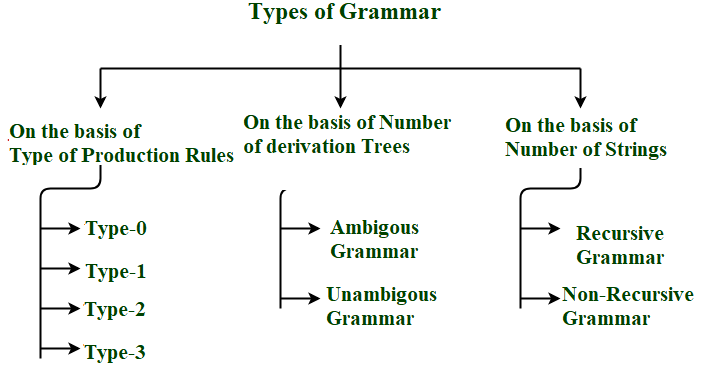
Types of Grammars
There are several types of Grammar. We classify them on the basis mentioned below.
- **Type of Production Rules: The form and complexity of the production rules define the grammar type, such as context-free, context-sensitive, regular, or unrestricted grammars.
- **Number of Derivation Trees: The number of ways a string can be derived from the grammar. Ambiguous grammars have multiple derivation trees for the same string.
- **Number of Strings: The size and nature of the language generated by the grammar.