Carnelian gemstone information (original) (raw)
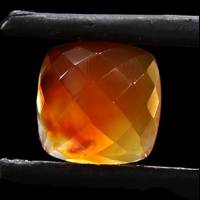
Mozambique
3.84 carats
© Brian Kosnar - Mineral Classics
Carnelian is probably named after the colour of the kornel cherry because of its colour. It is brownish red to orange, translucent to opaque Chalcedony variety. In some cases portions of the stone are paler than others, and specimens with a pale central portion passing gradually into a dark coloured exterior are not uncommon.
Many stones, which in the natural condition are of a dirty yellow colour and unsuitable for gems, on being heated acquire the fine carnelian colour, and with it a considerable increase in value.
When held against the light, the colour variety shows stripes, natural carnelian shows a cloudy distribution of colour.
Carnelian Gemstones by Colour
This table shows the variety of hues this gemstone can be found in. Click on a photo for more information.
Carnelian Gemstones by Size
This table shows distribution of Carnelian gemstone sizes that are listed on this site. This can give a good indication as to the general availability of this gemstone in different sizes.
0.84ct to 12.76ct12.76ct to 24.67ct24.67ct to 36.59ct36.59ct to 48.50ct48.50ct to 60.42ct60.42ct to 72.34ct72.34ct to 84.25ct84.25ct to 96.17ct96.17ct to 108.08ct108.08ct to 120.00ct
| General Information | |
|---|---|
| A variety or type of: | Chalcedony, which is a variety of Quartz |
| Other Names/Trade Names: | Cornelian |
| Chemical Formula | SiO 2, Management Team (2012) |
| Carnelian Treatments | |
| The colour can be enhanced by heating. - Gemstones of the world, Walter Schumann, 2001, p 126 | |
| Carnelian Simulants | |
| Most carnelians offered today are agates which are dyed and then heat-treated. - Gemstones of the world, Walter Schumann, 2001, p 126 | |
| Physical Properties of Carnelian | |
| Mohs Hardness | 6.5 to 7Herve Nicolas Lazzarelli, Blue Chart Gem Identification (2010) |
| Specific Gravity | 2.58 to 2.64Walter Schumann, Gemstones of the world (2001) More from other references |
| Cleavage Quality | NoneWalter Schumann, Gemstones of the world (2001) |
| Fracture | UnevenWalter Schumann, Gemstones of the world (2001) |
| Optical Properties of Carnelian | |
| Refractive Index | 1.535 to 1.539Herve Nicolas Lazzarelli, Blue Chart Gem Identification (2010) |
| Optical Character | Uniaxial/+Ulrich Henn and Claudio C. Milisenda, Gemmological Tables (2004) |
| Birefringence | 0.003 to 0.009Herve Nicolas Lazzarelli, Blue Chart Gem Identification (2010) |
| Pleochroism | AbsentWalter Schumann, Gemstones of the world (2001) |
| Dispersion | NoneWalter Schumann, Gemstones of the world (2001) |
| Colour | |
| Colour (General) | Red, orange, reddishGemdat.org, Management Team (2012) |
| Causes of Colour | Orange to red, submicroscopic to microscopic inclusions of hydrous Fe oxidesW. William Hanneman, Pragmatic Spectroscopy For Gemologists (2011) |
| Transparency | Translucent,OpaqueHerve Nicolas Lazzarelli, Blue Chart Gem Identification (2010) Semi-transparent to opaque |
| Lustre | Waxy,ResinousArthur Thomas, Gemstones (2009) |
| Fluorescence & other light emissions | |
| Fluorescence (General) | Blue-whiteWalter Schumann, Gemstones of the world (2001) |
| Crystallography of Carnelian | |
| Crystal System | TrigonalUlrich Henn and Claudio C. Milisenda, Gemmological Tables (2004) |
| Habit | Fibrous to grained aggregateUlrich Henn and Claudio C. Milisenda, Gemmological Tables (2004) |
| Further Information | |
| Mineral information: | Carnelian information at mindat.org |
| Significant Gem Localities | |
| Peru Huancavelica Huancavelica Province Ascencion District Yauricocha Parish YanacodoSri Lanka Sabaragamuwa Province Ratnapura District Ratnapura |