Human Risk Management Platform | Predict & Prevent (original) (raw)
Human Risk Management
Human Risk Management for the Unified Workforce
Living Security is the leader in Human Risk Management (HRM), defining how modern organizations identify, measure, and reduce human cyber risk.
Your employees, contractors, and AI agents all carry risk. Most security programs can only see a fraction of it, and none of them respond automatically when they find it.
Human Risk Management (HRM), as defined by Living Security, is the discipline of identifying, quantifying, and reducing the cybersecurity risk created by people, and increasingly, the AI systems acting on their behalf.
Start Your Demo Environment View the Platform
HRM for the Hybrid Workforce
Your workforce isn't just employees anymore.
The modern enterprise workforce is distributed, diverse, and increasingly non-human. HRM programs that only account for full-time employees are leaving significant risk unmanaged.
Full-Time Employees
Your core workforce, on managed devices, inside your perimeter. The foundation of any HRM program.
AI Agents
Autonomous systems with user-level credentials and real access to sensitive data, invisible to legacy HRM programs.
Remote & Distributed Workers
Employees operating outside the office perimeter, on unmanaged networks and devices, with elevated exposure.
Contractors & Third Parties
Extended workforce with varying access levels, often outside traditional training and monitoring programs.
Security awareness training was built for a different era.
For years, the playbook was simple: send annual training, run phishing simulations, report completion rates. It worked, until the threat landscape changed, the workforce expanded, and leadership started asking harder questions.
Limited visibility into who may be risky
Completion rates tell you nothing about who poses real-world risk today.
No automated response
When a risk signal fires, someone has to manually decide what to do, if they even notice at all.
Can't answer leadership questions
"Are we safer than last quarter?" Traditional SAT wasn't built to deliver that level of insight.
The attack surface now includes your AI agents.
AI hasn't just changed how defenders work, it has fundamentally changed the nature of attacks, and the composition of your workforce.
Relying on traditional training to address AI-augmented social engineering is a critical misstep. The threat landscape has shifted. Your HRM program needs to shift with it.
Risk isn't a mystery. The mystery is who's risky, and why.
Effective Human Risk Management unifies signals from across your existing security stack, correlates them to individual people, and turns raw data into actionable intelligence.
Signal Sources
*Representative of popular integrations. Living Security supports 300+ signal sources.
Intelligence Engine
HRM Platform
Correlates signals to individuals, generates Human Risk Index scores, surfaces anomalies, and prioritizes interventions with explainable AI.
Outputs
 Predict with precision
 Guide with explainable AI
 Act with measurable impact
Stop managing human risk manually. Run playbooks instead.
Your team can't personally respond to every risk signal across a 50,000-person workforce. They shouldn't have to.
Define triggers and ‘if this, then that’ logic to automatically drive the right actions.
TRIGGER
An employee who has submitted their notice is moving sensitive data
ACTIONS
Notify their manager with risk context
Assign employee offboarding training with best practice reminders
Open a ticket in your ITSM solution to review the dataset in question
TRIGGER
An employee's Human Risk Index drops below 200, becoming Highly Risky
ACTIONS
Send a low difficulty simulated phishing email to measure resiliency
Email internal best practices for staying vigilant
Enroll in monitoring for future intervention
TRIGGER
An employee fails a phishing simulation
IF
Were they targeted by a malicious email in the last week?
THEN
Targeted recently → deliver a role-relevant simulation 14 days later
Track click behavior and re-score after simulation completes
ELSE
Not recently targeted → provide role-relevant video training
Share links to internal guidance documents and best practices
TRIGGER
An employee fails a phishing simulation
IF
Were they targeted by a malicious email in the last week?
THEN ↓
THEN
Targeted recently → deliver a role-relevant simulation 14 days later
Track click behavior and re-score after simulation completes
ELSE ↓
ELSE
Not recently targeted → provide role-relevant video training
Share links to internal guidance documents and best practices
Think of playbooks as your program running on autopilot, without losing precision.
What leadership now demands, and what HRM makes possible.
A mature HRM program doesn't just reduce incidents. It gives every stakeholder the answers they need.
Are we safer than last quarter?
HRI trend data shows risk reduction across business units, with before/after comparison on every intervention.
Security Awareness Manager
Who needs training, and what kind?
Risk scores identify the highest-risk individuals and recommend the exact intervention most likely to change their behavior.
Why should we expand this budget?
Documented outcome data, reduced incidents, faster remediation, lower breach exposure, tied directly to program investment.
What's our human risk exposure?
Executive dashboards translate complex risk data into business language: trend lines, comparisons, and clear ROI.
Are our people compliant?
Continuous compliance tracking maps user behavior to specific frameworks, turning audit prep from a quarterly scramble into a defensible, always-on record.
Is this alert noise, or a pattern?
Behavioral history and risk scores give analysts instant context on whether an incident involves a known high-risk user, accelerating triage when it matters most.
Proven outcomes. Not just activity.
5x
more human risk visibility with full HRM integration vs. SAT alone
73%
of all risky behavior comes from just 10% of users
50%
reduction in risky users (from 43% to 21%) among Unify clients
90%+
reduction in data access risks after targeted intervention
60%
less time employees spend in risky behaviors after interventions
88%
of human risk activity is invisible to organizations relying on SAT alone
.svg) Read more from the Cyentia Institute, Living Security Customer Data
Read more from the Cyentia Institute, Living Security Customer Data
New to HRM?
Let us help you get started.
Whether you're evaluating HRM for the first time or looking to mature your existing program, these resources will help.
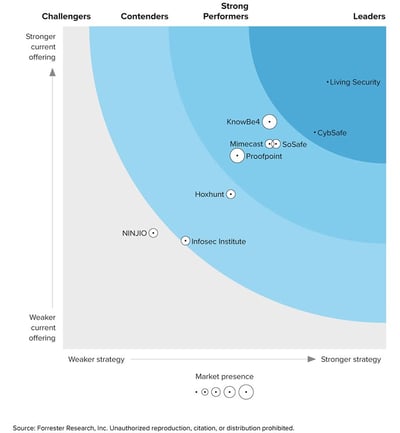
Independently Validated
Independently validated as a Leader.
Living Security was named a Leader in The Forrester Wave™: Human Risk Management Solutions, Q3 2024, recognized for the strength of our current offering and the depth of our HRM strategy.
Forrester defines HRM as solutions that:
- Detects and measures human security behaviors and quantify human risk.
- Initiates policy and training interventions based on that risk
- Educates and enables the workforce to protect against cyberattacks
- Builds a positive security culture
Read the Forrester Wave Report →
Ready to see what your risk actually looks like?
Most organizations are surprised by what they find when they move beyond training completion data. We can show you.