MolluscaBase (original) (raw)
Mollusca are the second-largest animal phylum on Earth after arthropods. The number of valid extant species currently (February 2024) stands at approximately 86,600 with a yearly increment of 800–1000 newly described species. Estimates of the number of extant species range up to 200,000 (Rosenberg, 2014; Bouchet et al., 2016; Rosenberg et al., 2022). Estimates for the number of fossil species are more challenging to obtain but are in the same order of magnitude and range up to more than 100,000 species (Taylor & Lewis, 2005).
While the extant component of MolluscaBase is estimated to reflect >99% of all described species, resulting from the databasing efforts over the past 30 years, the cataloging of fossil taxa is still a comparatively young and incomplete feature. While fossil land and freshwater species are considered fairly complete, the inventory of marine taxa is constantly being expanded. Fossil cephalopods, notably ammonites, are yet to be covered.
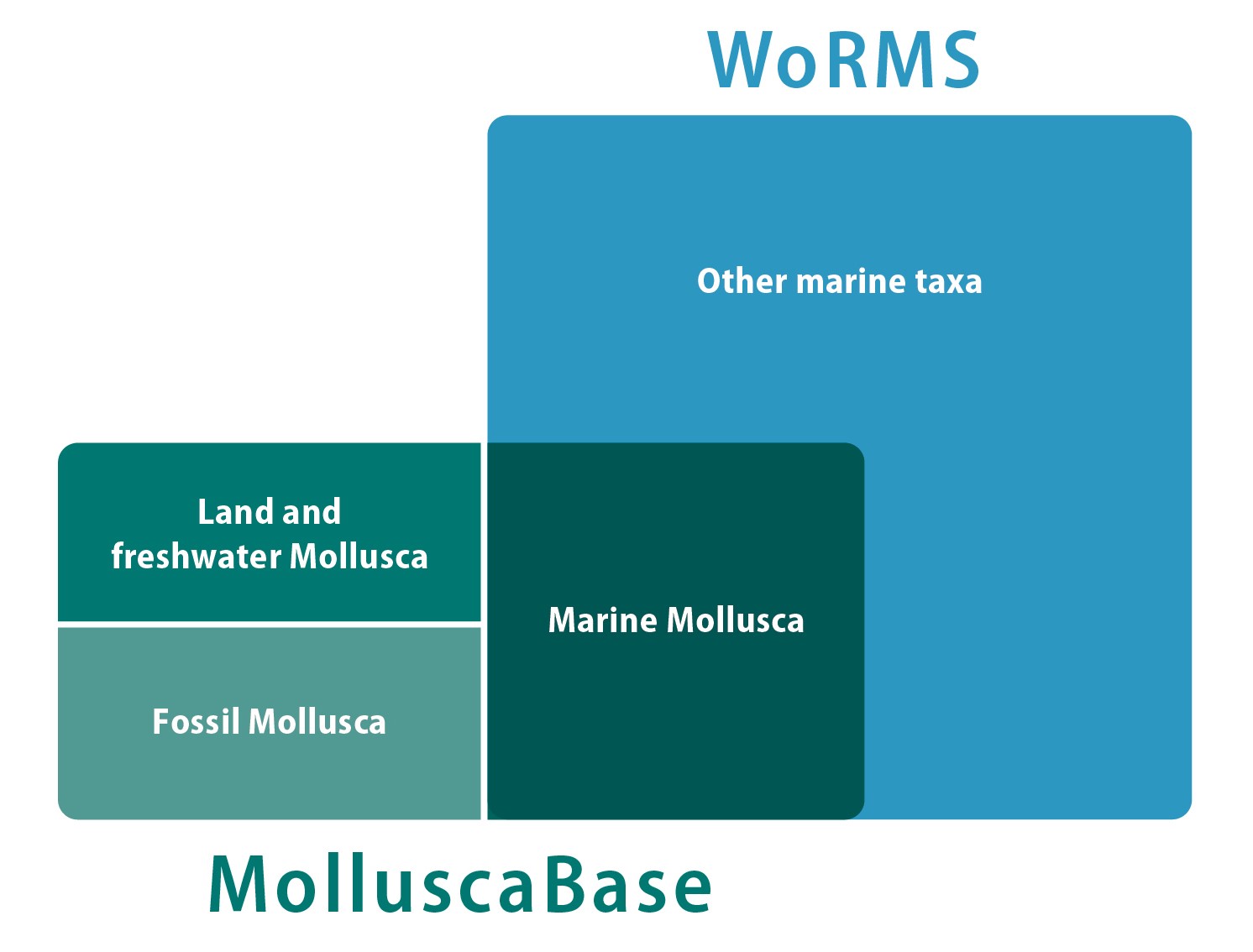
MolluscaBase is the taxonomic data provider for molluscs in global biodiversity databases such asCatalogue of Life andGlobal Biodiversity Information Facility (GBIF) and also serves as taxonomic backbone for iNaturalist,Ocean Biodiversity Information System (OBIS) and SeaLifeBase. It is, however, independent of other catalogues like the Worldwide Mollusc Species DataBase,AnimalBase, theIntegrated Taxonomic Information System (ITIS) or thePaleobiology Database.Encyclopedia of Life andWikipedia are also managed independently, but draw much of their molluscan taxonomic data from MolluscaBase.
What information do we provide?
MolluscaBase is an authoritative, permanently updated account of all molluscan species. We aim to provide comprehensive information strictly based on the most recent literature. Hence, MolluscaBase does not represent the individual editor’s personal opinion.
Subject to availability, the following information is provided for taxa included in MolluscaBase:
- Accepted (valid) name. The basic taxonomic unit in MolluscaBase is the binomen, i.e. the combination of a genus name and a specific epithet. By editorial convention, MolluscaBase does not use subgenera in the finally accepted taxon string. Names including subgenera may be flagged as "alternate representation", meaning both name strings (with and without subgenus) are taxonomically correct, but only the name without subgenus is flagged as "accepted". MolluscaBase enforces gender agreement of specific epithets, as required by the ICZN.
- Authorship. To avoid confusion, we differentiate authors with the same surname by using initials. Initials are only given in cases where authors have actually described mollusc taxa. Please note that the use of initials is not regulated by the Code; their usage is optional.
- Classification (presented with a parent/child hierarchy)
- Synonyms and alternative combinations (chresonyms)
- Reference of the original description and other relevant literature sources. Special attention is given to accurate dating of publications, especially electronic publications, with regard to the requirements of the ICZN.
- Type locality
- Distributions. This is still a fairly incomplete part of the database
- Stratigraphic range of fossil species. The limit between fossil and extant is set at 10,000 years. Taxa that went extinct during the Holocene (including anthropogenic extinctions in the recent past) are indexed as extant with a note indicating their status as extinct.
- Images. A growing number of repositories are digitizing the type material in their custody, and these are linked to the relevant species page in MolluscaBase. However, the database also contains unedited images uploaded by the public, and these may not be vetted by a taxonomic editor.
- Links to GenBank. This is an automatically generated link between names in Aphia and GenBank, with no judgement on the accuracy of the identification or nomenclature used in molecular papers.
For further information on using MolluscaBase and our editorial conventions, seehere.
Where do we come from?
WoRMS started as such in 2007, and by 2014 the cataloguing of marine Mollusca was considered fairly complete. Still, no comparable comprehensive taxonomic database was available for land and freshwater molluscs or fossil species.
- The MolluscaBase project began in February 2014, with a meeting at the Flanders Marine Institute (VLIZ) in Oostende, bringing together a group of malacologists, including active editors for Mollusca in WoRMS, members of the Fauna Europaea project, and the Aphia data management team at VLIZ.
- MolluscaBase grew fast. The first significant input, completed by November 2014, was the import of a dataset including all fossil freshwater gastropod species described from the Miocene and Pliocene of Europe, amounting to 4,360 taxa.
- In 2015, the Taxonomic Database on European Marine Mollusca (CLEMAM) was fully integrated into MolluscaBase, featuring in total over 5,700 new names, almost 8,000 references of original descriptions and more than 3,000 type locality notes.
- It followed the upload of ca. 3,400 species of Cenozoic Mollusca and Recent terrestrial gastropods of New Zealand in the same year.
- In 2017, data for all land and freshwater species of Europe (5,210 valid species and subspecies names) produced in the frame of Fauna Europaea were added.
- As part of the InvertEBase project, authority files for U.S. and Canadian land and freshwater molluscs were compiled and uploaded in two instalments in 2015 and 2018, involving more than 10,000 names and combinations.
- The bigger part of non-marine fossil bivalves was added between 2021 and 2022, accounting for approximately 5,500 names.
- Marine Paleogene taxa of the Paris Basin (3,600+ names) followed in 2022.
- In 2023, approximately 5,600 names of Mesozoic and Cenozoic Pectinida were imported.
As of February 2024 – ten years after the onset of the project – MolluscaBase contains ~400,000 names, of which the extant component accounts for ~300,000 names (~86,600 accepted species) and the fossils for ~100,000 names (~38,200 accepted species) (see current Stats here).
Acknowledgments
MolluscaBase is supported by LifeWatch, which is part of the European Strategy Forum on Research Infrastructure (ESFRI) and can be seen as a virtual laboratory for biodiversity and ecosystem research.
The MolluscaBase logo and current homepage were designed by Jan Johan ter Poorten, taxonomic editor for the family Cardiidae and graphic designer. Data were contributed during projects funded by the European Union (Fifth Framework Programme), the National Science Foundation (NSF grant no. EF 14-02667), the Austrian Science Fund (FWF grant no. P25365-B25), the German Research Foundation (DFG grant no. NE 2268/2-1) and several WoRMS Philanthropy grants to individual editors.
Citation
Rather than giving credit to one or a few editors for specific pages, MolluscaBase editors have chosen to be collectively acknowledged. Usage of data from the MolluscaBase in scientific publications should be acknowledged by citing as follows:
- MolluscaBase eds. (2026). MolluscaBase. Accessed at https://www.molluscabase.org on 2026-05-13. doi:10.14284/448
If the data from the MolluscaBase constitute a substantial proportion of the records used in analyses, the chief editor(s) of the database should be contacted. There may be additional data which may prove valuable to such analyses.
Individual pages are individually authored and dated. These can be cited separately: the proper citation is provided at the bottom of each page.
References
- Bouchet, P., Bary, S., Héros, V., Marani, G. (2016). How many species of molluscs are there in the world’s oceans, and who is going to describe them? In: Héros, V., Strong, E., Bouchet, P. (eds) Tropical Deep-Sea Benthos 29. Mémoires du Muséum national d’histoire naturelle. Muséum national d’histoire naturelle, Paris, pp. 9-24.
- Rosenberg, G. (2014). A new critical estimate of named species-level diversity of the recent Mollusca. American Malacological Bulletin, 32(2), 308-322.
- Rosenberg, G., Auffenberg, K., Bank, R., Bieler, R., Bouchet, P., Herbert, D., Köhler, F., Neubauer, T. A., Neubert, E., Páll-Gergely, B., Richling, I., Schneider, S. (2022). Adapting mark-recapture methods to estimating accepted species-level diversity: a case study with terrestrial Gastropoda. Gillespie J (Ed.). PeerJ, 10, e13139.
- Taylor, P. D., Lewis, D. N. (2005). Fossil invertebrates. Harvard University Press, 208 pp.