A guide to the Nature Index (original) (raw)
- NATURE INDEX
- 25 March 2026
A description of the terminology and methodology used in this supplement, and a guide to the functionality that is available free online at natureindex.com.
The Nature Index is a database of author affiliations and institutional relationships. The index tracks contributions to research articles published in high-quality natural-science and health-science journals, chosen based on reputation by an independent group of researchers.
The Nature Index provides absolute and fractional counts of article publication at the institutional and national level and, as such, is an indicator of global high-quality research output and collaboration. Data in the Nature Index are updated regularly, with the most recent 12 months made available under a Creative Commons licence at natureindex.com. The database is compiled by Nature Portfolio.
Nature Index metrics
The Nature Index uses Count and Share to track research output. A country/territory or an institution is given a Count of 1 for each article that has at least one author from that country/territory or institution. This is the case regardless of the number of authors an article has, and it means that the same article can contribute to the Count of multiple countries/territories or institutions.
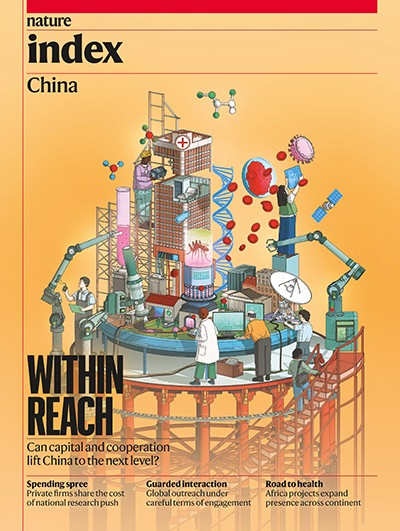 Nature Index 2026 China
To glean a country’s, territory’s, region’s or an institution’s contribution to an article, and to ensure that they are not counted more than once, the Nature Index uses Share, a fractional count that takes into account the share of authorship on each article. The total Share available per article is 1, which is shared among all authors under the assumption that each contributed equally. For instance, an article with 10 authors means that each author receives a Share of 0.1. For authors who are affiliated with more than one institution, the author’s Share is split equally between each institution. The total Share for an institution is calculated by summing the Share for individual affiliated authors. The process is similar for countries/territories, although complicated by the fact that some institutions have overseas labs that will be counted towards host country/territory totals.
Adjusted Share accounts for the annual variation in the total number of articles in the Nature Index journals. It is arrived at by calculating the percentage difference in the total number of articles in the Index in a given year relative to the number of articles in a base year and adjusting Share values to the base year levels.
The bilateral collaboration score (CS) between two institutions A+B is the sum of each of their Shares on the papers to which both have contributed. A bilateral collaboration can be between any two institutions or countries/territories co-authoring at least one article in the journals tracked by the Nature Index.
NATUREINDEX.COM
doi: https://doi.org/10.1038/d41586-026-00427-w
This article is part of Nature Index 2026 China, an editorially independent supplement. Advertisers have no influence over the content. For more information about Nature Index, see the homepage.
Related Articles
-
 Can China keep up its extraordinary research growth?
 -
 Why China’s philanthropists are digging deep for research
 -
 Geopolitical tensions are leading China to rethink research collaboration
 -
 The pros and cons of China’s health role in Africa
 - Partner content: AI model brings personalized learning to remote regions
- Partner content: How AI could deliver more equitable education
- Partner content: How a historic university is striving for global impact
- Partner content: Seeking a new paradigm in sleep apnea care
Subjects
Latest on:
 Why the US needs a unified, mission-based strategy for health innovation Comment 06 APR 26
  Massive budget cuts for US science proposed again by Trump administration News 03 APR 26
  ‘Net zero’ isn’t madness: the staggering economic costs of climate change Editorial 07 APR 26
 - Why the US needs a unified, mission-based strategy for health innovation Comment 06 APR 26
 China is planning to land people on the Moon — and might beat the United States to it News 02 APR 26
  How I squeeze fresh science from public data Career Column 23 MAR 26
  Drowning in data sets? Here’s how to cut them down to size Technology Feature 23 MAR 26
  AlphaFold database hits ‘next level’: the AI system now includes protein pairing News 17 MAR 26
 When career anxiety becomes gameplay: lessons from China’s ‘young-faculty simulator’ Career Column 08 APR 26