In twisted graphene, some electrons are heavier than others (original) (raw)
- NEWS AND VIEWS
- 06 May 2026
When two graphene layers are twisted at a ‘magic angle’, their electrons can behave as both heavy and light particles, depending on momentum.
By
- Hongyun Zhang
- Hongyun Zhang is in the Department of Physics, Tsinghua University, Beijing 100084, China, the Beijing Tsinghua Frontier Interdisciplinary Innovation Research Institute, Beijing, China, and the Advanced Institute for Materials Research, Tohoku University, Sendai, Japan.
- Shuyun Zhou
- Shuyun Zhou is in the Department of Physics, Tsinghua University, Beijing 100084, China, and in the Frontier Science Center for Quantum Information, Tsinghua University, Beijing, China.
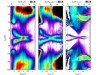
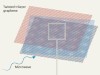
Introducing a small twist angle between two graphene layers (2D sheets of carbon atoms) that are stacked on top of each other can drastically change the material’s properties. A striking example of this occurs when a twist angle of about 1.1 degrees is used, producing a material known as magic-angle twisted bilayer graphene (MATBG). MATBG exhibits unusual properties, including unconventional superconductivity1, originating from the formation of ‘flat bands’, in which the electron’s energy is almost independent of its momentum. As a result, the electrons move slowly, interact strongly with each other and behave as if they have a large mass. In a paper in Nature, Xiao et al.2 show that this picture is incomplete: for some momenta, electrons in MATBG are heavy and interact strongly, but for others they are light and mobile.
Access options
Access Nature and 54 other Nature Portfolio journals
Get Nature+, our best-value online-access subscription
$32.99 / 30 days
cancel any time
Subscribe to this journal
Receive 51 print issues and online access
$199.00 per year
only $3.90 per issue
Rent or buy this article
Prices vary by article type
from$1.95
to$39.95
Prices may be subject to local taxes which are calculated during checkout
Additional access options:
Nature 653, 31-32 (2026)
doi: https://doi.org/10.1038/d41586-026-01154-y
References
- Cao, Y. et al. Nature 556, 43–50 (2018).
Article PubMed Google Scholar - Xiao, J. et al. Nature 653, 68–75 (2026).
Article Google Scholar - Rozen, A. et al. Nature 592, 214–219 (2021).
Article PubMed Google Scholar - Saito, Y. et al. Nature 592, 220–224 (2021).
Article PubMed Google Scholar - Wong, D. et al. Nature 582, 198–202 (2020).
Article PubMed Google Scholar - Zondiner, U. et al. Nature 582, 203–208 (2020).
Article PubMed Google Scholar - Song, Z.-D. & Bernevig, B. A. Phys. Rev. Lett. 129, 047601 (2022).
Article PubMed Google Scholar - Inbar, A. et al. Nature 614, 682–687 (2023).
Article PubMed Google Scholar - Bistritzer, R. & MacDonald, A. H. Proc. Natl Acad. Sci. USA 108, 12233–12237 (2011).
Article PubMed Google Scholar - Li, Q. et al. Nature Mater. 23, 1070–1076 (2024).
Article PubMed Google Scholar
Competing Interests
The authors declare no competing interests.
Related Articles
-
 Read the paper: Imaging the flat bands of magic-angle graphene reshaped by interactions
 -
 ‘Unconventional’ superconductivity probed in twisted graphene
 -
 The discovery that stuck — 20 years of graphene
 - See all News & Views
Subjects
Latest on:
 Electrocaloric effects across room temperature in multilayer capacitors Article 06 MAY 26
  Quantum coherent manipulation and readout of superconducting vortex states Article 06 MAY 26
  Foreshock-induced slip transients set mainshock nucleation timing Article 06 MAY 26
  Nanoscale ‘conveyor belt’ teleports quantum state of electron News & Views 06 MAY 26
 - Quantum coherent manipulation and readout of superconducting vortex states Article 06 MAY 26
 Two-qubit logic and teleportation with mobile spin qubits in silicon Article 06 MAY 26