Altruism through beard chromodynamics (original) (raw)
- Letter
- Published: 30 March 2006
Nature volume 440, pages 663–666 (2006)Cite this article
- 2976 Accesses
- 262 Citations
- 17 Altmetric
- Metrics details
Abstract
The evolution of altruism, a behaviour that benefits others at one's own fitness expense, poses a darwinian paradox. The paradox is resolved if many interactions are with related individuals so that the benefits of altruism are reaped by copies of the altruistic gene in other individuals1, a mechanism called kin selection2. However, recognition of altruists could provide an alternative route towards the evolution of altruism1,3,4,5. Arguably the simplest recognition system is a conspicuous, heritable tag, such as a green beard1,3. Despite the fact that such genes have been reported6,7,8, the ‘green beard effect’3 has often been dismissed because it is unlikely that a single gene can code for altruism and a recognizable tag1,3,9. Here we model the green beard effect and find that if recognition and altruism are always inherited together, the dynamics are highly unstable, leading to the loss of altruism. In contrast, if the effect is caused by loosely coupled separate genes, altruism is facilitated through beard chromodynamics in which many beard colours co-occur. This allows altruism to persist even in weakly structured populations and implies that the green beard effect, in the form of a fluid association of altruistic traits with a recognition tag, can be much more prevalent than hitherto assumed.
This is a preview of subscription content, access via your institution
Access options
Subscribe to this journal
Receive 51 print issues and online access
$199.00 per year
only $3.90 per issue
Buy this article
- Purchase on SpringerLink
- Instant access to the full article PDF.
USD 39.95
Prices may be subject to local taxes which are calculated during checkout
Additional access options:
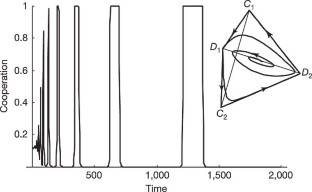
Figure 1: The level of cooperation in the population in the approach to the heteroclinic cycle.
The alternative text for this image may have been generated using AI.
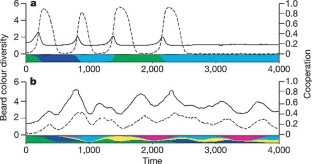
Figure 2: Evolution of cooperation and beard colour diversity.
The alternative text for this image may have been generated using AI.
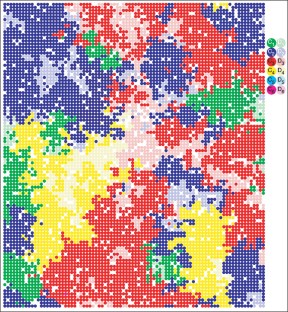
Figure 3: An example of a snapshot of spatial beard chromodynamics.
The alternative text for this image may have been generated using AI.
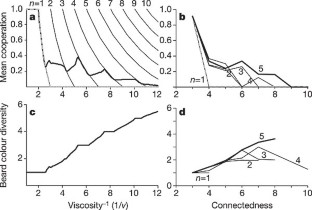
Figure 4: Cooperation and diversity versus viscosity.
The alternative text for this image may have been generated using AI.
References
- Hamilton, W. D. The genetic evolution of social behaviour, II. J. Theor. Biol. 7, 17–52 (1964)
Article CAS Google Scholar - Maynard Smith, J. Group selection and kin selection. Nature 201, 1145–1147 (1964)
Article Google Scholar - Dawkins, R. The Selfish Gene (Oxford Univ. Press, Oxford, 1976)
Google Scholar - Dawkins, R. The Extended Phenotype (Oxford Univ. Press, Oxford, 1982)
Google Scholar - Riolo, R., Cohen, M. D. & Axelrod, R. Evolution of cooperation without reciprocity. Nature 414, 441–443 (2001)
Article ADS CAS Google Scholar - Queller, D. C., Ponte, E., Bozzaro, S. & Strassmann, J. E. Single-gene greenbeard effects in the social amoeba Dictyostelium discoideum. Science 299, 105–106 (2003)
Article ADS CAS Google Scholar - Keller, L. & Ross, K. G. Selfish genes: a green beard in the red fire ant. Nature 394, 573–575 (1998)
Article ADS CAS Google Scholar - Summers, K. & Crespi, B. Cadherins in maternal-foetal interactions: red queen with a green beard? Proc. R. Soc. Lond. B 272, 643–649 (2005)
Article CAS Google Scholar - Blaustein, A. R. Kin recognition mechanisms—phenotypic matching or recognition alleles. Am. Nat. 121, 749–754 (1983)
Article Google Scholar - Trivers, R. The evolution of reciprocal altruism. Q. Rev. Biol. 46, 35–57 (1971)
Article Google Scholar - Van Baalen, M. & Rand, D. The unit of selection in viscous populations and the evolution of altruism. J. Theor. Biol. 193, 631–648 (1998)
Article CAS Google Scholar - Nowak, M. A. & May, R. M. Evolutionary games and spatial chaos. Nature 355, 826–829 (1992)
Article ADS Google Scholar - West, S. A., Pen, I. & Griffin, A. S. Conflict and cooperation—Cooperation and competition between relatives. Science 296, 72–75 (2000)
Article ADS Google Scholar - Hamilton, W. D. in Kin Recognition in Animals (eds Fletcher, D. J. C. & Michener, C. D.) 417–438 (Wiley, Chichester, 1987)
Google Scholar - Haig, D. Gestational drive and the green-bearded placenta. Proc. Natl Acad. Sci. USA 93, 6547–6551 (1996)
Article ADS CAS Google Scholar - Van Baalen, M. & Jansen, V. A. A. Common language or Tower of Babel? On the evolutionary dynamics of signals and their meanings. Proc. R. Soc. Lond. B 270, 69–76 (2003)
Article Google Scholar - Axelrod, R., Hammond, R. A. & Grafen, A. Altruism via kin-selection strategies that rely on arbitrary tags with which they coevolve. Evolution 58, 1833–1838 (2004)
Article Google Scholar - Haig, D. in Behavioural Ecology 4th edn (eds Krebs, J. R. & Davies, N. B.) 284–306 (Cambridge Univ. Press, Cambridge, 1997)
Google Scholar - Axelrod, R. The Evolution of Cooperation (Basic Books, New York, 1984)
MATH Google Scholar - Hofbauer, J. & Sigmund, K. Evolutionary Games and Population Dynamics (Cambridge Univ. Press, Cambridge, 1998)
Book Google Scholar
Acknowledgements
We thank P. Credland for his encouragement and comments on the manuscript. Author Contributions Both authors contributed equally to this paper. V.A.A.J. formulated and analysed the mathematical model; M.v.B. formulated and analysed the simulation model.
Author information
Authors and Affiliations
- School of Biological Sciences, Royal Holloway, University of London, TW20 0EX, Surrey, Egham, UK
Vincent A. A. Jansen - Laboratoire d'Ecologie ENS/UPMC/CNRS, UMR 7625, Université Pierre et Marie Curie, Bâtiment A, 7ème Etage, CC 237, 7 quai St Bernard, 75252, Paris, Cedex 05, France
Minus van Baalen
Authors
- Vincent A. A. Jansen
- Minus van Baalen
Corresponding author
Correspondence toVincent A. A. Jansen.
Ethics declarations
Competing interests
Reprints and permissions information is available at npg.nature.com/reprintsandpermissions. The authors declare no competing financial interests.
Supplementary information
Rights and permissions
About this article
Cite this article
Jansen, V., van Baalen, M. Altruism through beard chromodynamics.Nature 440, 663–666 (2006). https://doi.org/10.1038/nature04387
- Received: 07 October 2005
- Accepted: 28 October 2005
- Issue date: 30 March 2006
- DOI: https://doi.org/10.1038/nature04387
This article is cited by
Editorial Summary
How green is your beard?
The evolution of altruism, especially as directed to non-kin, is an enigma of evolutionary biology. Explanations would come easier, however, if altruists were readily recognized. Arguably the simplest recognition system is a conspicuous, heritable tag. A green beard would do it. A few examples of the ‘green beard effect’ have been reported in human interactions, though beards per se and greenness tend not to feature. A problem with this explanation is the improbability of one gene encoding all three functions (altruism, tag and recognition). Based on modelling, Jansen and van Baalen identify a further problem with this theory: even if green beard genes can be selectively advantageous, altruism is unstable under previous assumptions. But, they add, the evolution of cooperation using a recognition mechanism may be more likely if many beard colours coexist.