Further Details: Floating Point Arithmetic (original) (raw)


Next: How to Measure Errors Up: Sources of Error in Previous: Sources of Error in Contents Index
Roundoff error is bounded in terms of the machine precision  ,which is the smallest value satisfying

where a and b are floating-point numbers, is any one of the four operations +, -, x and
  , and
, and  is the floating-point result of
  . Machine epsilon, , is the smallest value for which this inequality is true for all , and for all a and b such thatis neither too large (magnitude exceeds the overflow threshold)nor too small (is nonzero with magnitude less than the underflow threshold)to be represented accurately in the machine. We also assume bounds the relative error in unaryoperations like square root:

A precise characterization of depends on the details of the machine arithmetic and sometimes even of the compiler. For example, if addition and subtraction are implemented without a guard digit4.1we must redefine to be the smallest number such that

In order to assure portability, machine parameters such as machine epsilon, the overflow threshold and underflow threshold are computed at runtime by the auxiliaryroutine xLAMCH4.2. The alternative, keeping a fixed table of machine parameter values, would degrade portability because the table would have to be changed when moving from one machine, or even one compiler, to another.
Actually, most machines, but not yet all, do have the same machine parameters because they implement IEEE Standard Floating Point Arithmetic[4,5], which exactly specifies floating-point number representations and operations. For these machines, including all modern workstations and PCs4.3, the values of these parameters are given in Table 4.1.
As stated above, we will ignore overflow and underflow in discussing error bounds. References [24,67] discuss extending error bounds to include underflow, and show that for many common computations, when underflow occurs it is less significant than roundoff. With some important exceptions described below, overflow usually means that a computation has failed so the error bounds do not apply.
Therefore, most of our error bounds will simply be proportional to machine epsilon. This means, for example, that if the same problem in solved in double precision and single precision, the error bound in double precision will be smaller than the error bound in single precision by a factor of 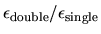 . In IEEE arithmetic, this ratio is
 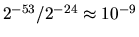 , meaning that one expects the double precision answer to have approximately nine more decimal digits correct than the single precision answer.
LAPACK routines are generally insensitive to the details of rounding and exception handling, like their counterparts in LINPACK and EISPACK. One algorithm, xLASV2, can return significantly more accurate results if addition and subtraction have a guard digit, but is still quite accurate if they do not (see the end of section 4.9).
However, several LAPACK routines do make assumptions about details of the floating point arithmetic. We list these routines here.
- Infinity and NaN arithmetic. In IEEE arithmetic, there are specific rules for evaluating quantities like 1/0 and 0/0. Overflowed quantities and division-by-zero (like 1/0) result in a
 symbol, which continues to propagate through the computation using rules like
  . In particular, there is no error message or termination of execution. Similarly, quantities like 0/0 and
  must be replaced by NaN (the ``Not a Number'' symbol) and propagated as well. See [4,5] for details. The following LAPACK routines, and the routines that call them, assume the presence of this infinity and NaN arithmetic for their correct functioning:
 - xSTEGR, which computes eigenvalues and eigenvectors of symmetric tridiagonal matrices. It is called by the drivers for the symmetric and Hermitian eigenproblems xSYEVR, xHEEVR and xSTEVR.4.4
- Accuracy of add/subtract. If there is a guard digit in addition and subtraction, or if there is no guard digit but addition and subtraction are performed in the way they are on the Cray C90, Cray YMP, Cray XMP or Cray 2, then we can guarantee that the following routines work correctly. (They could theoretically fail on a hexadecimal or decimal machine without a guard digit, but we know of no such machine.)
- xSTEDC, which uses divide-and-conquer to find the eigenvalues and eigenvectors of a symmetric tridiagonal matrix. It is called by all the drivers for the symmetric, Hermitian, generalized symmetric definite and generalized Hermitian definite eigenvalue drivers with names ending in -EVD or -GVD.
- xBDSDC, which uses divide-and-conquer to find the SVD of a bidiagonal matrix. It is called by xGESDD.
- xLALSD, which uses divide-and-conquer to solve a bidiagonal least squares problem with the SVD. It is called by xGELSD.
Next: How to Measure Errors Up: Sources of Error in Previous: Sources of Error in Contents Index
Susan Blackford
1999-10-01