Could US arms sales to Taiwan be at risk? (original) (raw)
U.S. weapons sales to Taiwan will be high on the agenda in discussions between President Donald Trump and Chinese President Xi Jinping this week, a longstanding point of contention in relations between the superpowers that could throw the self-governing island's defense plans into disarray.
Trump arrived in the Chinese capital on Wednesday for a two-day summit.
Both the United States and China have indicated America's decades-long support for Taiwan's military will be up for discussion, although senior U.S. officials and observers have downplayed the possibility of a shift in America's stance.
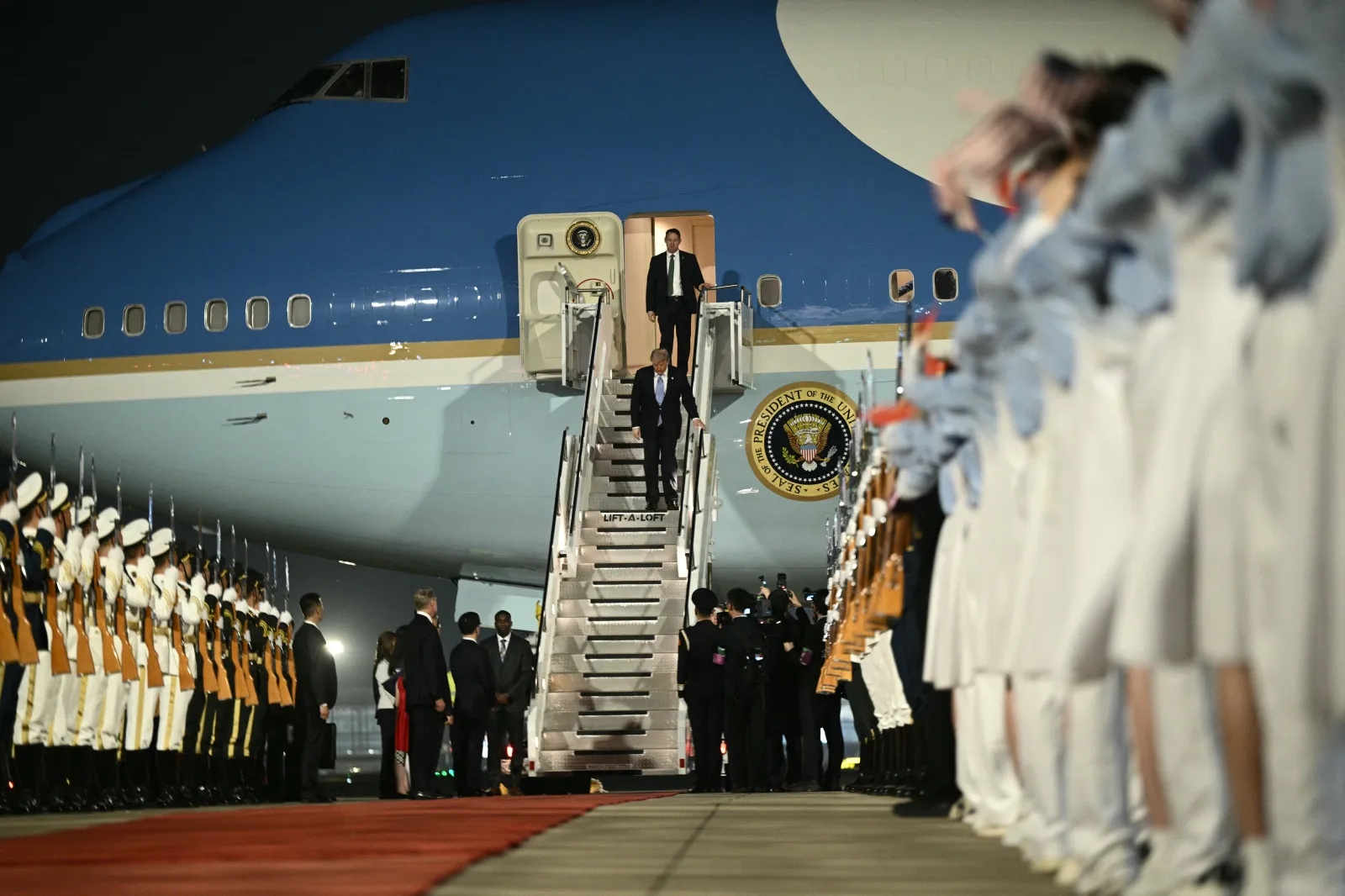
The U.S. officially abides by the "one China" policy, which acknowledges Beijing's position that Taiwan is part of China and should eventually be reunited with the mainland. But the U.S. has maintained close links with Taipei to become the territory's second-largest trading partner and the major security provider for Taiwan's 23 million-strong population.
Unofficial ties between the U.S. and Taiwan are enshrined in U.S. domestic law, which also authorizes sales of weapons to the island despite Chinese objections.
Although the U.S. said in 1979 it would only have formal diplomatic links with Beijing, Washington told Taipei in the years after the switch it would not discuss arms deals with Beijing and hadn't agreed to taper off weapons sales. These promises later popped up in legislation passed by Congress.
Taiwan, the most likely cause of any military confrontation between the U.S. and China, has long relied on China's ruling Communist Party being unwilling to gamble on the U.S., with its vast military and formidable cache of nuclear weapons, coming to Taiwan's defense if Beijing invades.
But the potential for the U.S. to stymie the flow of American hardware to improve relations and trade terms with China has worried officials in Taipei and some lawmakers in Congress, where backing for Taiwan has always been popular.
"Because of dragging timetables for U.S. deliveries, the short-term blow to morale and the relationship between Taiwan and the U.S. would be more heavily impacted in the short term than Taiwan's military capabilities," Philip Shetler-Jones, a senior research fellow with the defense think tank the Royal United Services Institute, told Newsweek.
However, reducing U.S. weapons sales could dent Taiwan's stockpiles, cut away at established supply chains and affect how easily its forces can work alongside U.S. troops.
It would damage how well Taipei could fend off Chinese advances in the long term and, crucially, could lead Beijing to believe the U.S. may not intervene in a conflict on Taipei's behalf.
"The suspension or significant reduction of U.S. arms sales to Taiwan would have consequences far beyond the battlefield itself," said Joshua Walker, a former State and Defense Department official who now heads the Japan Society nonprofit.
US Weapons To Be Discussed
Trump told reporters on Monday that he would speak with Xi about U.S. support for Taiwan, but it would be one of several items discussed.
Beijing doubled down on its position this week, its foreign ministry saying its "firm opposition" to U.S. arms sales to Taiwan is "consistent and clear." Another senior Chinese official said Beijing objected to " any form of military ties" between Washington and Taipei.
Xi had told Trump during a February phone call that the U.S. should approach arms sales to Taiwan with "extreme caution."
While China will try to portray itself as having influence over U.S. weapons deals with Taiwan during this summit, America will likely continue to send military supplies to the island in an effort to keep the peace and stave off the possibility of a Chinese invasion, Scott Harold, a senior political scientist at the RAND nonprofit, told Newsweek.
U.S. officials have repeatedly assessed that Beijing wants to be strong enough to invade Taiwan by 2027 if it chooses to, although the most recent Pentagon report on Chinese intentions, published in March, pivoted to say Beijing didn't currently plan to launch an invasion and didn't have a fixed timeline for bringing Taiwan under mainland control.
A bipartisan group of U.S. senators is thought to be urging Trump to greenlight an arms sales package for Taiwan—reported to be worth $14 billion and to include high-tech air-defense missiles—that the U.S. president hasn't yet approved.
"American support for Taiwan is not up for negotiation," the lawmakers wrote in a letter seen by The New York Times.
Taiwan's parliament had approved a special defense budget worth 25billionearlierthismonth,muchofwhichislikelytobefunneledintodealsforAmericanarms,includinganti−dronesystems.Thepackagefellfarshortofthe25 billion earlier this month, much of which is likely to be funneled into deals for American arms, including anti-drone systems. The package fell far short of the 25billionearlierthismonth,muchofwhichislikelytobefunneledintodealsforAmericanarms,includinganti−dronesystems.Thepackagefellfarshortofthe40 billion the Taiwanese executive branch had requested and did not ultimately include funding for high-profile domestic defense projects following wrangling between the ruling Democratic Progressive Party and opposition parties.
The U.S. approved its largest weapons package to Taiwan, worth $11 billion, in December 2025. China quickly responded to this confirmation by conducting large-scale military drills around Taiwan.
U.S. Delays and Domestic Designs
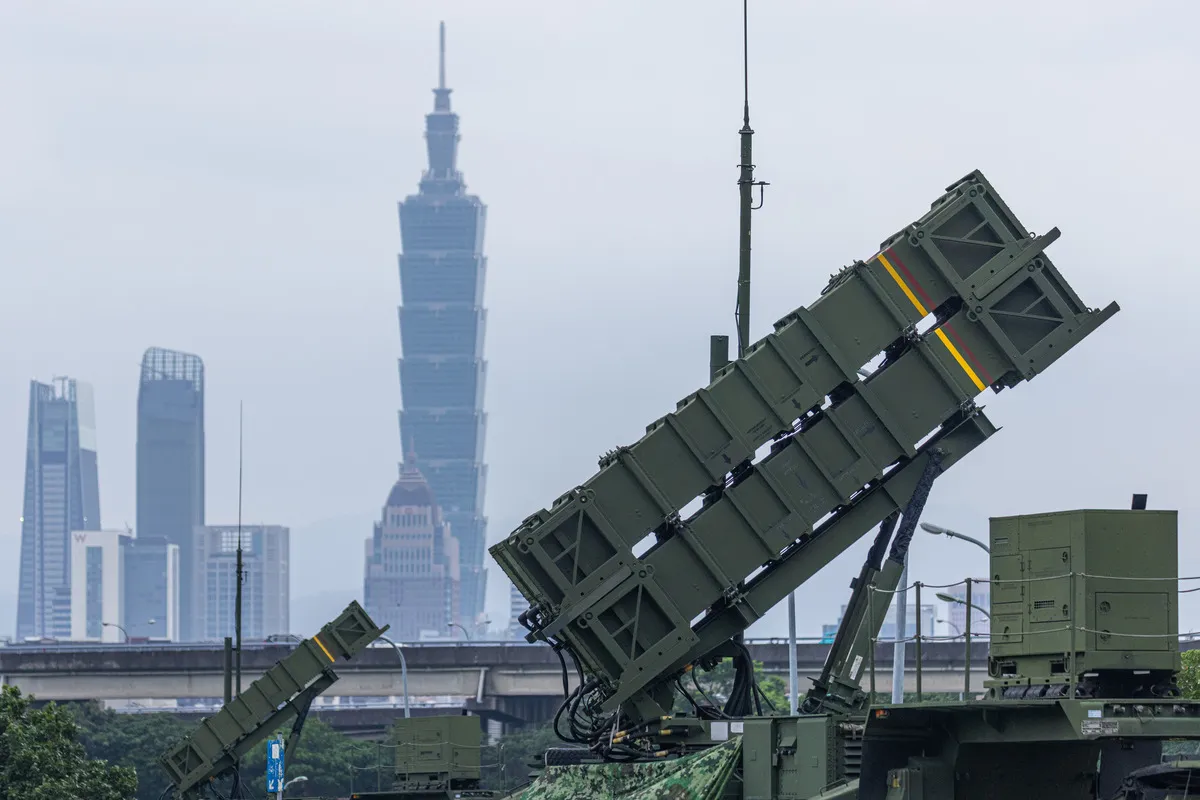
Taiwan's military is brimming with U.S. equipment, including F-16 fighter jets, M1 Abrams tanks and the vaunted Patriot air defense missile system that has become well-known for intercepting incoming Russian missiles in Ukraine and in U.S.-aligned Gulf states under Iranian attack.
On top of this, the U.S. is heavily involved in training Taiwanese soldiers and helping Taiwan to combat Chinese "gray zone" tactics, a term used to refer to strategies that aren't open fighting but undermine an adversary, like holding extensive military exercises close to their borders.
A senior White House official said over the weekend that Trump had approved more weapons sales to Taiwan than former U.S. President Joe Biden. The Biden administration approved just under $8.9 billion in arms sales to Taiwan, according to data compiled by the People's Liberation Army (PLA) Tracker.
But U.S. deliveries of weapons to Taiwan have often been delayed. Taipei ordered 66 upgraded F-16 fighter jets, equipped with more advanced systems to counter China's latest cutting-edge, hard-to-detect aircraft, in 2019. They're expected to start arriving in Taiwan later this year, roughly three years later than originally scheduled.
U.S. officials have said the Iran war, which has dragged on for more than 10 weeks and forced the U.S. to pull equipment from across the world to the Middle East, hasn't impacted deliveries of U.S. gear to Taiwan.
Taiwan's president, Lai Ching-te, said last year that the island would dedicate 5 percent of its gross domestic product (GDP) to its military by 2030, after U.S. administration officials prodded Taiwan to dramatically increase its defense spending in the face of China's formidable military buildup and modernization programs.
NATO countries allied with the U.S. have committed to similar increases in defense spending.
Taiwan is looking to develop military equipment domestically, particularly long-range missiles and surveillance systems, while maintaining close ties with the U.S., said Alessio Patalano, a professor of war and strategy in East Asia with the Department of War Studies at King's College London.
But it's also leaned on countries like France in the past to beef up its military, Patalano told Newsweek.
Should U.S. arms flows wane, Taiwan could decide to continue this trend, pouring more funds into its own research labs and factories while seeking new defense deals elsewhere.
"Taiwan should shore up its domestic defense production regardless of U.S. rhetoric, but would be pushed to do so more quickly if the U.S. pulls its arms support," Shetler-Jones said.
Although Taiwan has made several steps toward expanding its own production, it's still dependent on the U.S. for certain systems and components, Walker said.
Europe has historically hesitated to provide arms to Taiwan, while Japan and South Korea—which have emerged as ascendent arms exporters—have been put off from selling lethal weapons to Taipei because of Beijing's looming presence, Walker told Newsweek.
He added, "A reduction in U.S. support would not easily be replaced elsewhere."
Update 5/13/26, 7:15 a.m. ET: This article was updated with additional information.
Update 5/13/26, 9:05 a.m. and 9:52 a.m. ET: This article was updated with additional information and a new picture.
Update 5/13/26, 9:20 p.m. ET: This article was updated to clarify Taiwan’s budgetary request and approval process.