Fight Or Flight Response (original) (raw)
The Fight Or Flight Response information handout is an essential psychoeducation tool that aids individuals in understanding the physiological and psychological mechanisms underlying the body's response to perceived threats.
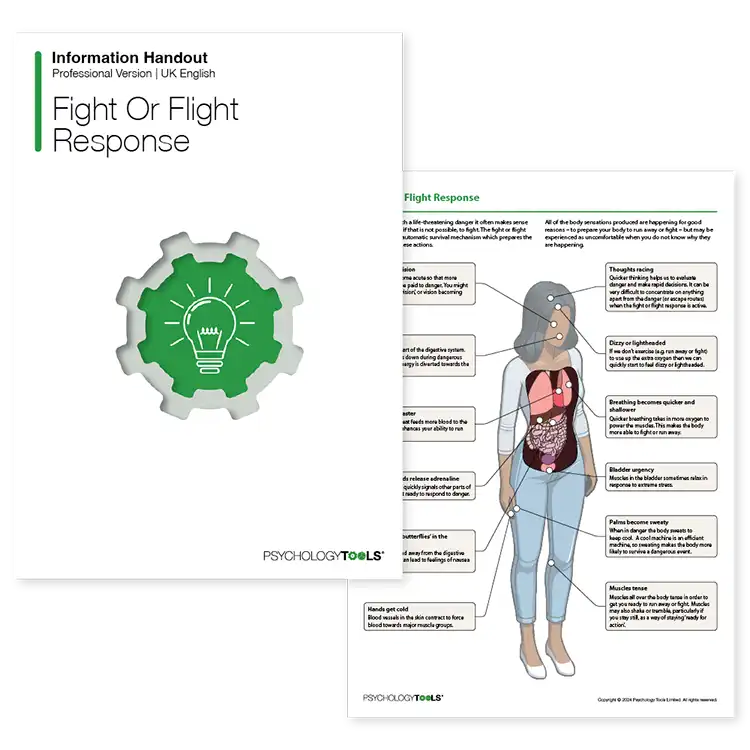
Theoretical background and therapist guidance
The fight-or-flight response is a core survival mechanism in humans and other animals. First described by physiologist Walter Cannon in 1915, this acute stress response activates the sympathetic branch of the autonomic nervous system and triggers the release of adrenaline to prepare the body for danger. Typical physical changes include increased heart rate, elevated blood pressure, and redirected blood flow to major muscle groups — priming the body for rapid action such as fleeing or fighting (Cannon, 1915). While essential in life-threatening situations, this response is subject to 'false alarms' in modern life, leading to anxiety symptoms, especially during social stress, panic attacks, or reminders of trauma (Barlow, 2004).
Modern models of the human stress response have extended this basic concept. The defense cascade model proposed by Schauer and Elbert (2010) outlines six sequential reactions to escalating threat: Freeze, Flight, Fight, Fright, Flag, and Faint. These stages are hierarchically organized and correspond to escalating proximity to danger and decreasing perceived options for active defense. The early stages (Freeze, Flight, Fight) are characterized by sympathetic arousal and mobilization, whereas the latter stages (Fright, Flag, Faint) involve parasympathetic dominance, behavioral shutdown, and dissociation. This model helps helps clinicians make sense of the diversity of trauma responses, especially those not adequately explained by fight-or-flight alone.
From a neurobiological perspective, different stages of the stress response engage distinct brain circuits. Hyperarousal is associated with increased activity in the amygdala, anterior cingulate cortex, and medial prefrontal cortex, which mediate vigilance and threat detection (Rauch et al., 2000; Lanius et al., 2006). In contrast, dissociative responses such as tonic immobility or fainting are associated with altered function in the thalamus and parietal lobes, suggesting impaired sensory integration and a breakdown in bodily awareness (Bremner et al., 1999). Understanding these physiological patterns is helpful for distinguishing between types of post-traumatic reactions and tailoring mental health treatment accordingly.
In panic disorder, individuals often misinterpret benign bodily sensations — like a racing heart or dizziness — as signs of a medical or psychological catastrophe. These 'catastrophic misinterpretations' play a central role in triggering panic attacks (Clark, 1986). Clients may believe they are having a heart attack, losing control, or “going mad.” Psychoeducation about the fight-or-flight response can help reframe these experiences as normal, time-limited bodily reactions to perceived threat. Understanding this can reduce fear and self-blame, especially when symptoms are interpreted as signs of weakness or pathology (Van der Kolk, 1994; Schauer & Elbert, 2010).
Effective therapeutic strategies for anxiety and trauma depend on where clients fall on the arousal spectrum. Clients with sympathetic-dominant hyperarousal may benefit from grounding techniques, paced breathing, and interoceptive awareness exercises to down-regulate their nervous system. Clients with shutdown symptoms or dissociation may need more active interventions — such as applied muscle tension, cold stimulation, or movement-based strategies — to re-engage with the present. Notably, relaxation techniques may worsen symptoms in dissociative clients by facilitating vasovagal responses (Krediet et al., 2002; Schauer & Elbert, 2010). Metaphors such as the 'window of tolerance' (Siegel, 1999) can help clients understand their optimal arousal range and recognize when they are outside it.
Understanding the full range of trauma-related autonomic responses allows clinicians to work more effectively and compassionately. Behaviors like fainting, emotional numbness, or freezing are not signs of avoidance or resistance but represent evolutionary survival mechanisms. Therapists can use this knowledge to support clients in developing tolerance for distress, validating their reactions, and restoring a sense of control. This trauma-informed perspective enhances engagement and improves outcomes in psychotherapy for anxiety, PTSD, and dissociative disorders (Foa & Kozak, 1986; Schauer, Neuner, & Elbert, 2005).