Python Course for Beginners With Certification: Mastering the Essentials (original) (raw)
A course by
Rahul Janghu,
Software Engineer and Instructor at Scaler
About this Free Python Course for Beginners With Certification: Mastering the Essentials
Learn Python for free and earn a certificate. This beginner-friendly course covers Python fundamentals, data structures, object-oriented programming, and hands-on projects, all in under 10 hours. Python powers web development, data science, and automation, making it one of the most in-demand skills in tech. No cost, no prerequisites. Just start building.
What you’ll learn
The skills that you would learn after taking up this
Python Course for Beginners With Certification: Mastering the Essentials
online course are:
- Python installation and setup
- Basic Python syntax and data types
- Control flow and loops
- String manipulation and list handling
- Working with tuples, dictionaries, and sets
- Defining and using functions
- Object-oriented programming concepts
- File handling and error & exception handling
16 Modules | 131 Lessons | 9h 44m
ide-expandExpand all section


Certificate for Free Python Course for Beginners With Certification: Mastering the Essentials

After successfully completing the course, you’ll be awarded with Certificate Of Excellence from Scaler

Explore Scaler Premium Program and unlock a world of benefits

Structured Curriculum
Experience expert-led learning with our industry-proven curriculum
1:1 Mentorship Sessions
Learn from industry experts with our personalised 1:1 Mentorship
Career Support
We're dedicated to helping you achieve your career goals
Instructor of this course
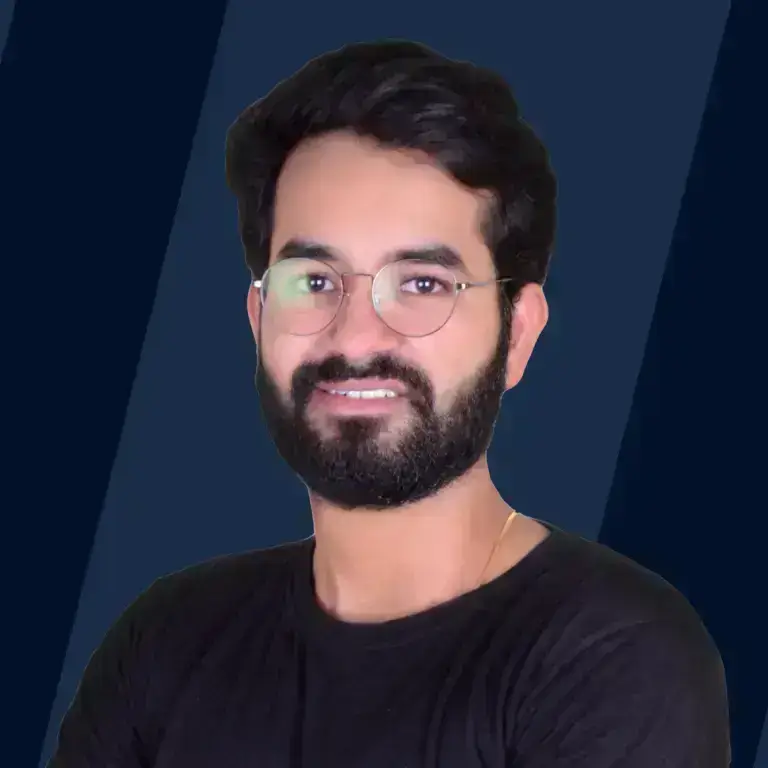
Software Engineer and Instructor at Scaler
Rahul Janghu
Software Engineer and Instructor at Scaler
1000+ Students on Scaler Platform
150+ Hours of Lectures Delivered
4.90 Star Instructor on Scaler
About Course
New to programming? Figuring out where to start can feel really confusing at first, but don’t worry, choosing Python as a beginner is a great start in itself, and here’s why.
Python is often recommended as a first language because the syntax is easier to read compared to many others. So, as a beginner, going ahead with a Python course can be really beneficial for you! In our course, you will begin with the fundamentals, which include installing Python, understanding basic syntax, and writing simple programs using variables and core data types. From there, the lessons will gradually move on to conditions, loops, and other concepts that are broader, more complex, but also (really fun!). The course duration will be approx. 9 hours and 44 minutes of learning content, divided into 16 modules, 131 lessons, and 10 coding challenges to help you understand the concepts practically as well.
You can utilize these lessons and practice tests at any given time, but just make sure that you only move ahead when you completely and clearly understand the basics first!
As and when the course progresses, you’ll also get to learn Python data structures such as lists, tuples, dictionaries, and sets, followed by functions that help you write reusable code. And then later modules will have object-oriented programming (OOP) with classes and objects, along with practical topics like file handling so be prepared and try to give as much attention as you can. By the end of the program, we have made it so that you will be able to have a solid foundation that can support further learning into backend development, automation scripting, or data-focused roles.
As for your course instructor, Rahul Janghu will be the one supporting you through your learning journey with his pre-recorded lectures. He is a software Engineer at Scaler, and has already helped 254,900+ learners begin their programming journey.
Because the course is self-paced, you can learn whenever it fits your schedule and receive the Scaler Certificate of Excellence after completing the lessons and coding challenges.
Pre-requisites for this free Python online course with certificate
This free Python course with certificate has no prerequisites, making it ideal for those with no prior programming experience. You'll need a computer with internet access, a text editor, and Python installed to follow along with the course. The course covers setting up Python in your system as well.
Who should learn this Python course?
- This free Python course is perfect for individuals new to programming or experienced programmers looking to learn a versatile and easy-to-understand language.
- Python is widely recognized for its readability and efficiency, making it an excellent choice for developing various applications, from web development to data analysis and artificial intelligence.
- This free Python course with certificate is the ideal starting point if you want to boost your programming skills and broaden your career opportunities.