How Google’s AI Mode Compares to Traditional Search and Other LLMs [AI Mode Study] (original) (raw)
Google launched its AI Mode in the US in May, and SEOs are now facing a new frontier.
In this study, we set out to understand how AI Mode compares to traditional Google search, AI Overviews, and two leading LLM-powered search engines: ChatGPT and Perplexity.
Key Findings at a Glance
- AI Mode prefers sidebar linking: 92% of AI Mode responses featured a sidebar showing ~7 unique domains. These links had a 51% domain overlap and 32% URL overlap with Google’s top 10 search results.
- Organic links still matter: In the 7% of AI Mode queries where additional links appeared below the response, there was an 89% domain overlap and 80% URL overlap with Google’s top 10 search results.
- Reddit dominates: It appeared as a leading citation source across all LLMs we studied.
- Query intent affects response length: Commercial queries triggered responses ~2x longer than informational ones.
- AI Mode looks more similar to ChatGPT than AI Overviews, indicating this new mode is more than just an upgraded version of AIOs. It’s an AI-powered search engine meant to compete with ChatGPT and other LLMs.
Methodology
What We Analyzed
To ensure balanced representation, we selected keywords across four core intent types and two distinct search volume tiers. Then, we queried them each into the four AI search platforms (desktop format) and recorded the results.
- 5,000 randomly selected keywords from the Semrush database (similar to the sample used in our previous comparison of ChatGPT Search, Bing, and Google)
- Over 150,000 unique citations across the platforms
- Four equal groups of search intent: informational, transactional, commercial, navigational (evenly distributed)
- Two equal tiers of search volume: 0-1,000 and 1,001-10,000 monthly searches
- Four platforms: Google Search (top 10 organic rankings and AI Overviews), Google AI Mode, ChatGPT, Perplexity
- Overlaps between citations and rankings: When measuring overlap between Google and AI results, we compared AI citations in each platform’s response to the top 10 organic results on Google for the same query.
What We Looked For
- Text and link overlap between platforms
- Response length variations
- Source citation patterns
AI Citations Only Partially Overlap with Google Search
The first question we asked was about the overlap:
How closely did AI Mode and other LLMs mirror Google’s traditional top 10 rankings?
To measure this, we took each query and counted the number of overlapping domains and URLs between each platform and Google’s top 10 organic rankings.
While we saw a solid overlap between Google’s top 10 organic rankings and LLM citations, the overlap was far from absolute—and it varied by platform.
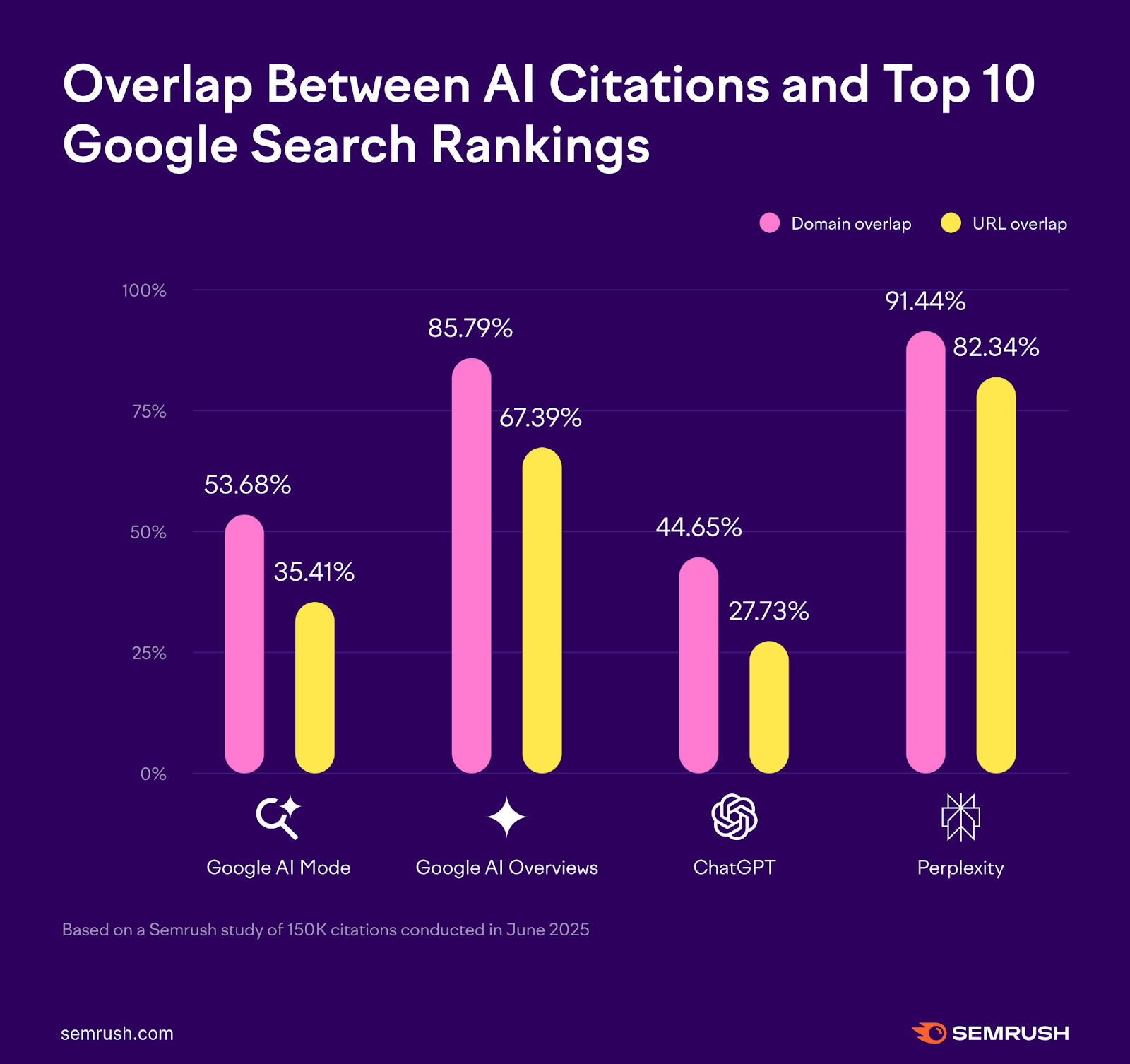
- Perplexity showed the strongest alignment with Google’s top 10 rankings, with over 91% domain overlap and 82% URL overlap. This suggests Perplexity leaned heavily on Google’s top 10 when choosing what to cite.
- Google AI Overviews also showed significant overlap—around 86% domain and 67% URL—signaling that they still relied heavily on Google’s traditional search index.
- Google AI Mode had a looser relationship: ~54% domain and ~35% URL overlap. This suggested more independent retrieval behavior, especially in sidebar results.
- ChatGPT had the weakest overlap with Google’s top 10 rankings, with the lowest domain and URL overlap. This echoed our previous ChatGPT research that showed ChatGPT’s overlap was stronger with Bing than with Google.
How AI Mode Compares to AI Overviews
In their 2024 announcements, Google framed AI Overviews as a way to help users get quick, AI-powered answers—paving the way for the fully interactive AI Mode launched just one year later in May 2025.
While Google positioned AI Overviews as a bridge to its next-generation search experience, we saw a few specific ways AI Mode strayed from the AI Overview playbook.
A Response + Sidebar with Links Is the Default Format
If you’re not familiar with AI Mode, here’s what it looks like:
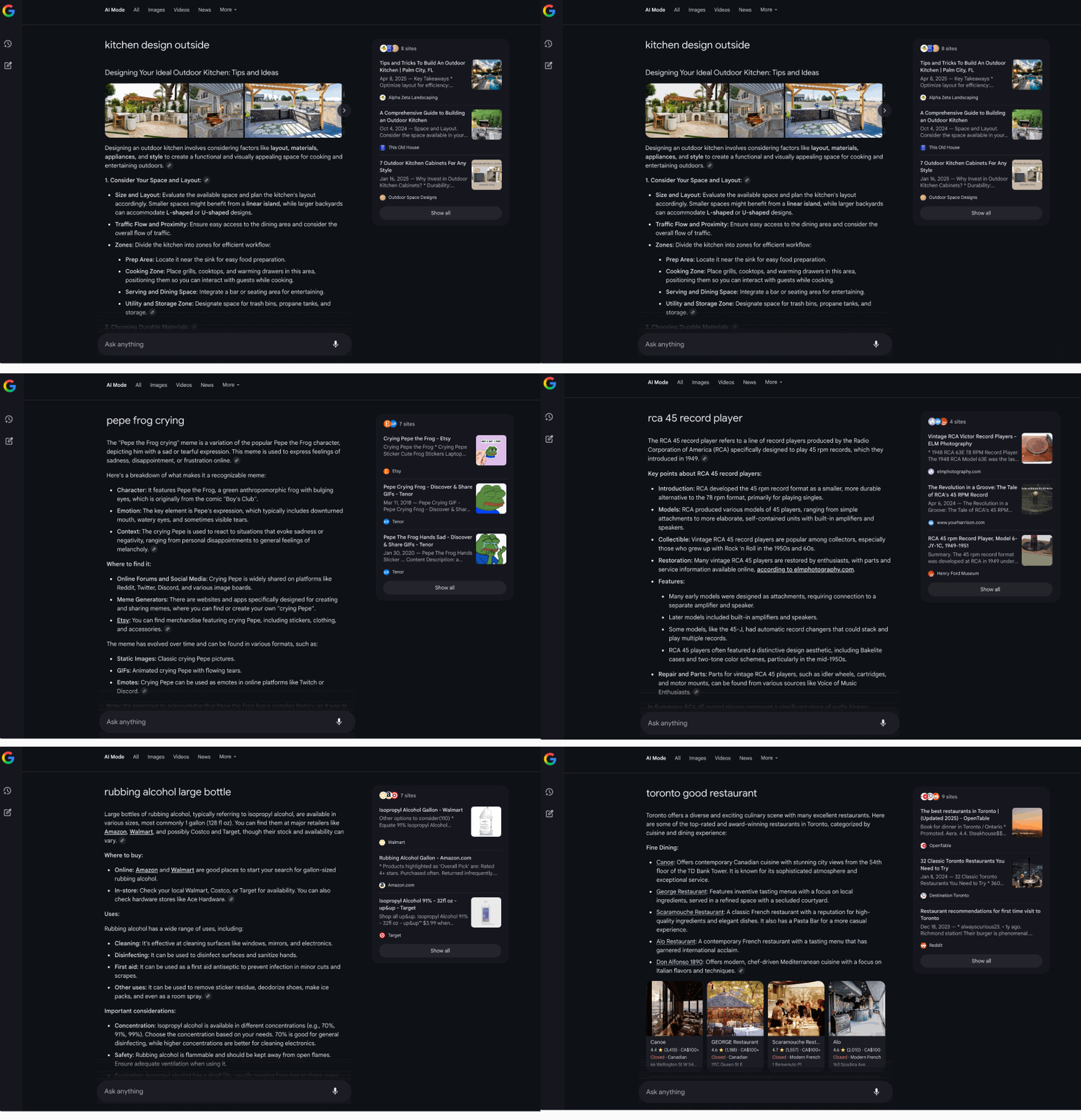
The most common format we saw included an AI-generated response and a sidebar with links. In some cases, there was a local pack of results. And in others, we saw more additional links below the response.
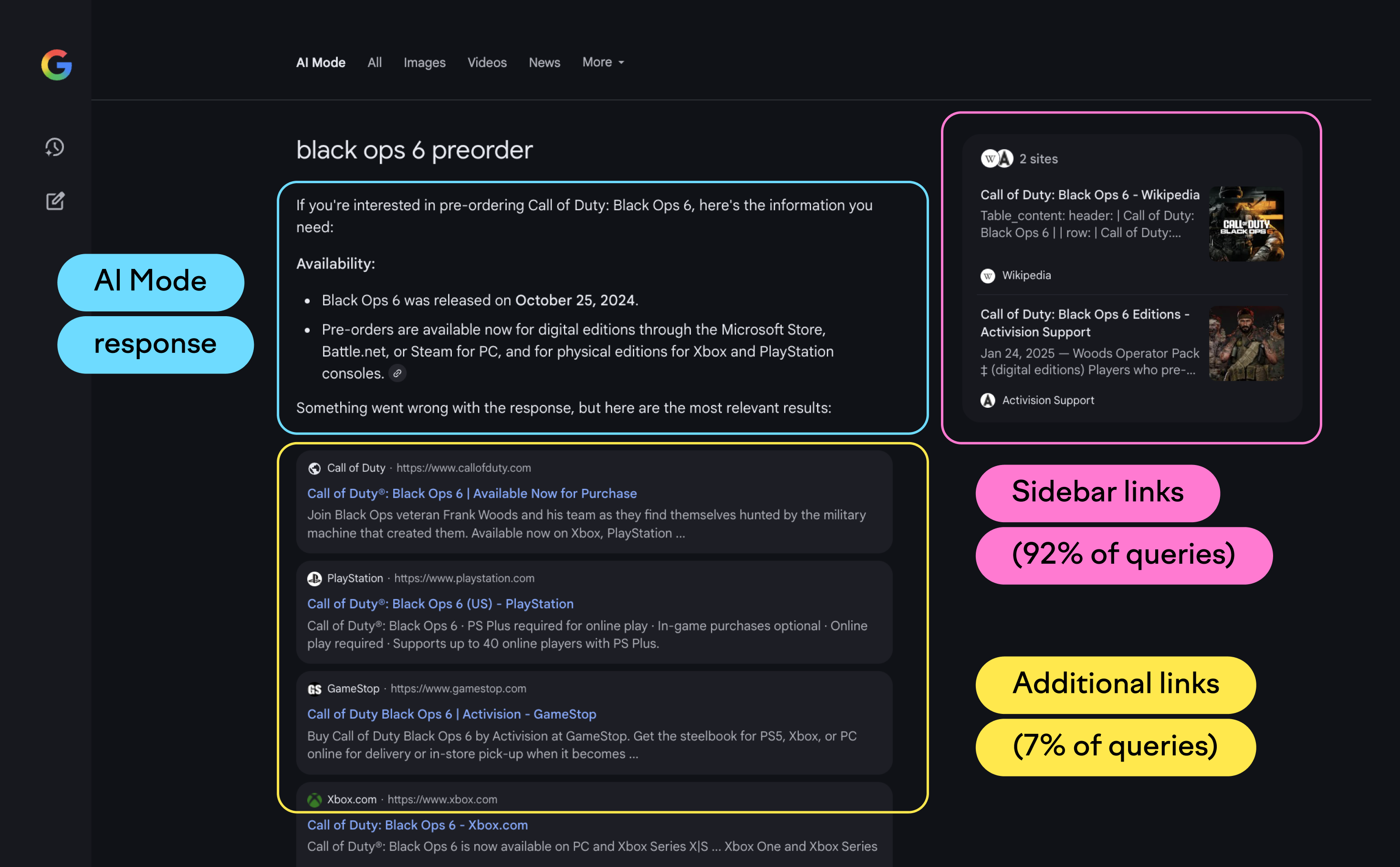
Here’s how often we saw each format:
- 92% of queries in AI Mode featured a sidebar with links
- 7% of queries in AI Mode featured additional links below the AI-generated response
- 1.7% of queries in AI Mode included no links at all
- 13.49% of queries in AI Mode included local packs
- This sidebar averaged seven unique domains (vs. just three in AI Overviews)
Sidebar links show Google experimenting with new sources, while links placed below the response stick closely to its traditional organic rankings.
While the links below the response only appeared 7% of the time, they had a very strong overlap with traditional Google results.
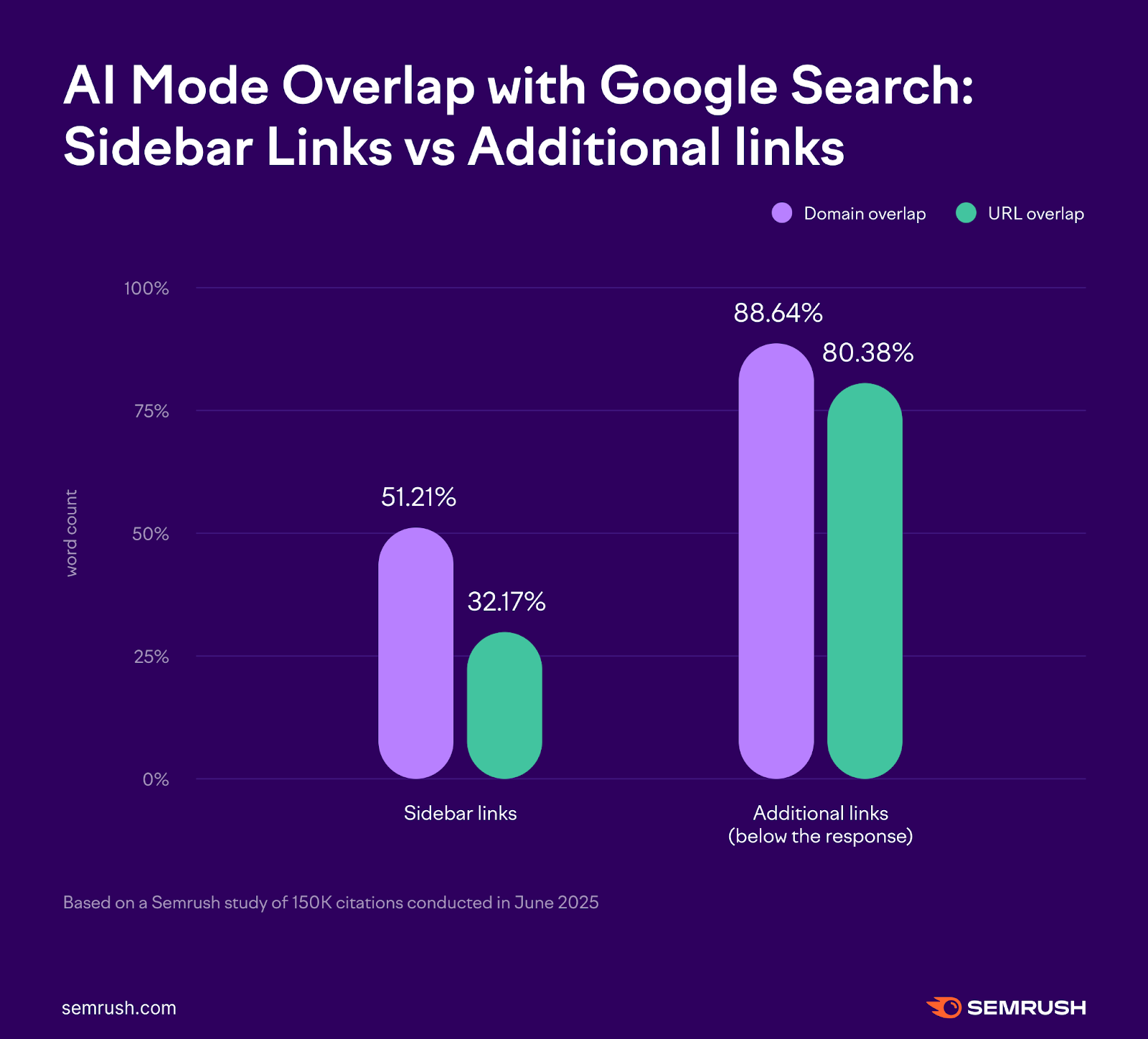
This split implies a dual system: AI Mode drew broadly for exploratory queries, but leaned on rankings for precision when needed.
Specifically, we saw AI Mode add additional links most often on navigational searches.
Navigational Queries Were Most Similar to Google Search Results
We noted that the additional links below the response had a high overlap with traditional search results. But mostly on navigational queries.
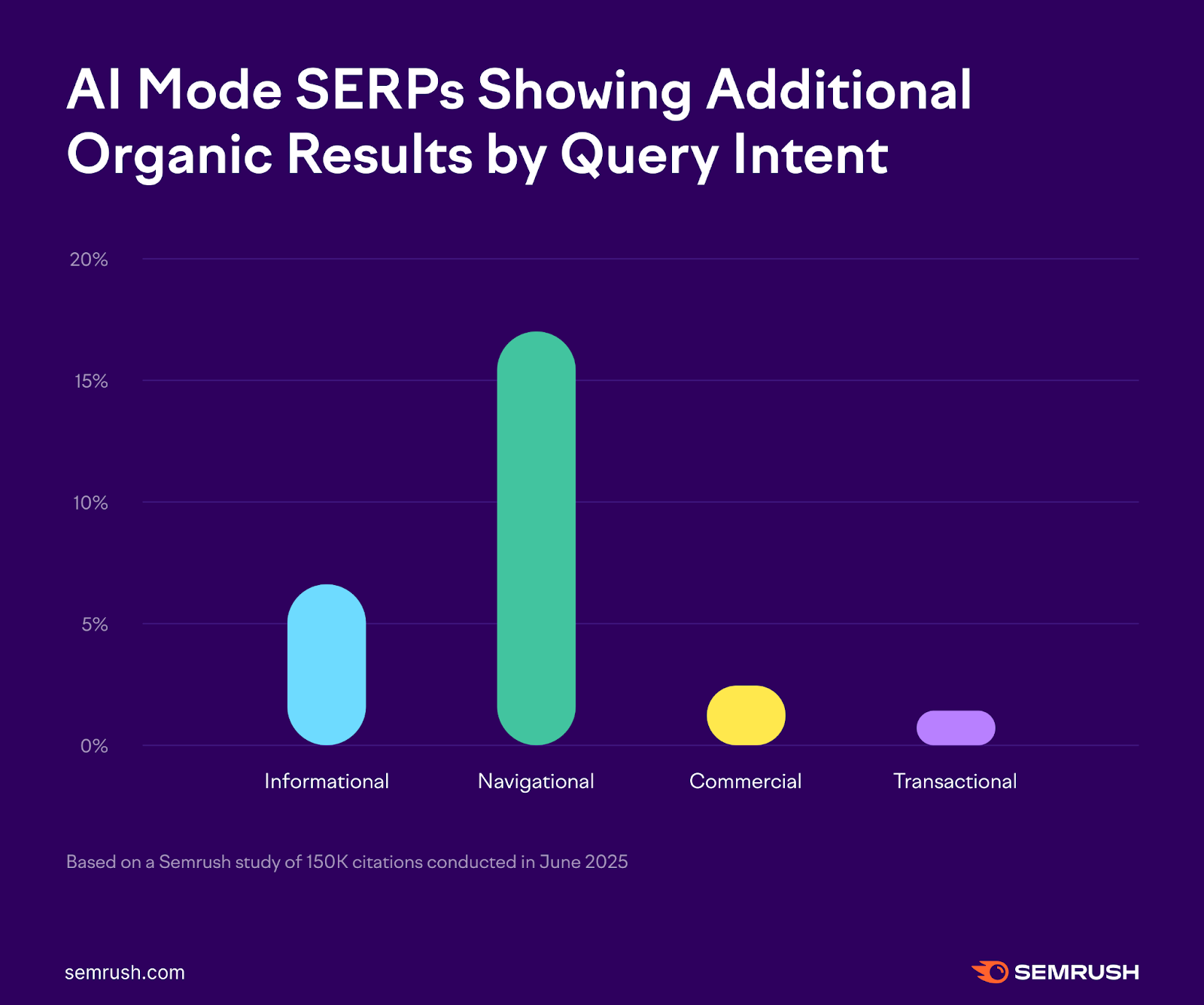
This makes sense. If you’re using Google to navigate somewhere specific, you’d probably like a list of links (and not just an AI-generated response).
This could indicate one difference in how Google sees AI Mode and traditional search differently: AI Mode helps people gather information, ask questions, and compare options while they’re still making up their mind.
Traditional search is there for when people know where they want to go.
AI Mode Shows More Unique Domains Than Other LLMs
One early critique of AI Mode is Google’s lack of transparency in how it sends clicks and traffic to sites, much like with AI Overviews.
Google recently confirmed that some AI Mode tracking will be available in Search Console, but those clicks will be lumped into overall totals, not separated from traditional search data.
In our study, we saw that AI Mode showed more unique domains than the other LLMs, on average, in its results.
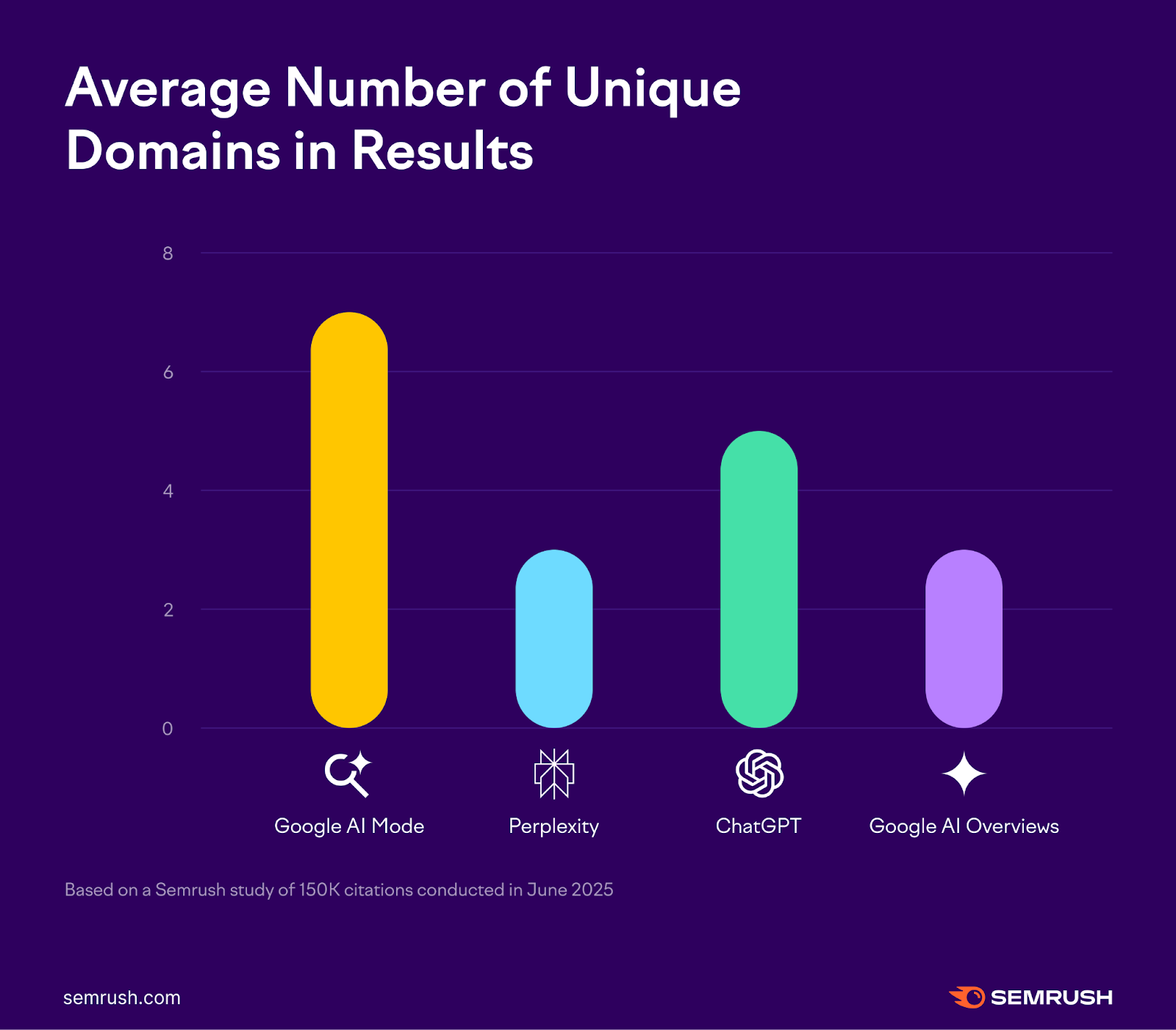
AI Overviews linked to an average of three unique domains per query, while AI mode linked to 7.
Perplexity and ChatGPT fell in the middle.
AI Mode Most Resembled ChatGPT Search in Response Length
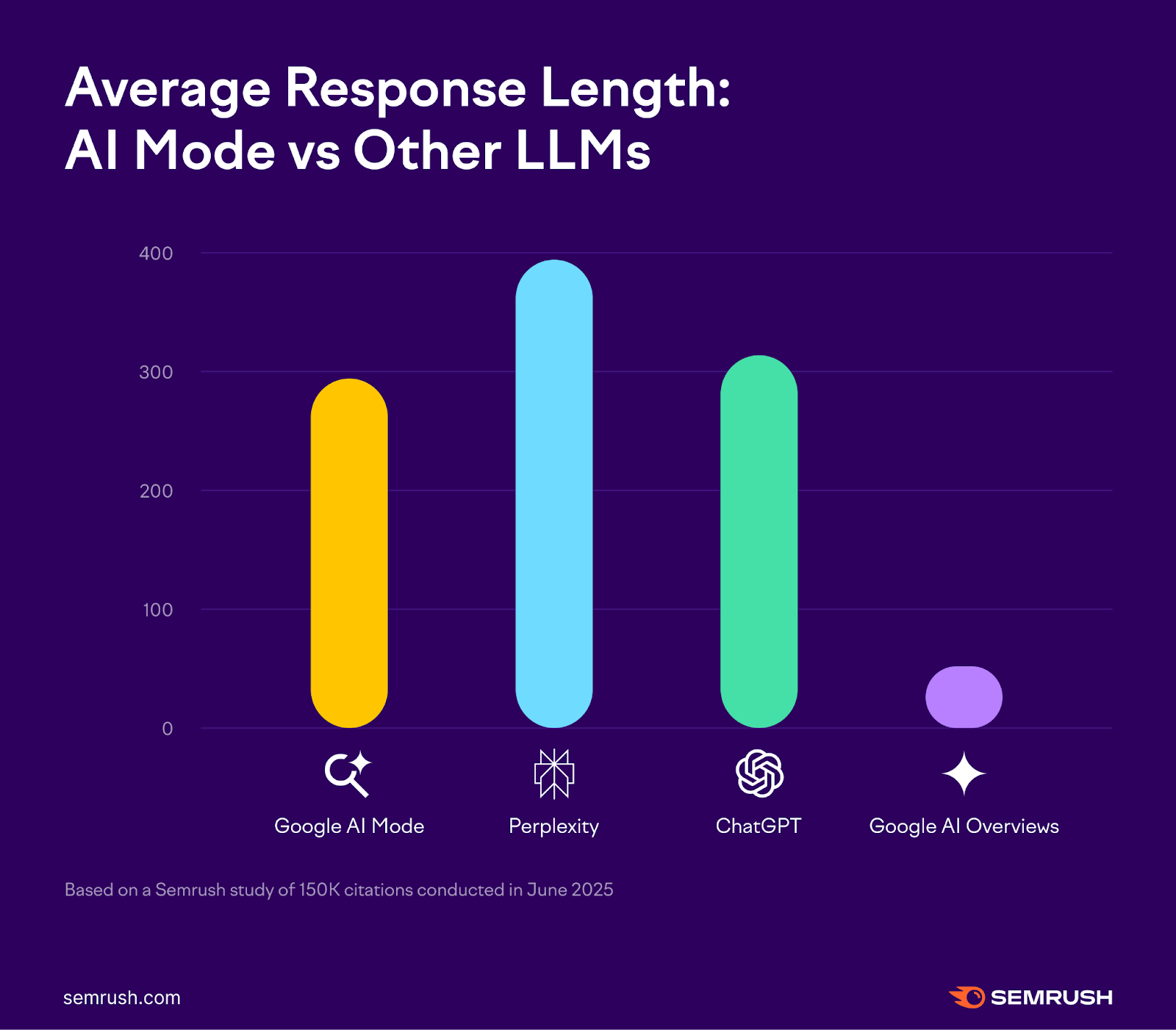
When it comes to response length, we saw Google’s AI Overviews stand out among the LLMs as the briefest option.
AI Mode was closest to ChatGPT with response length, averaging around 300 words per response.
How AI Mode and Other LLMs Handle Query Intent
Across all platforms, commercial and transactional queries triggered the longest and most detailed responses—often double the length of informational responses.
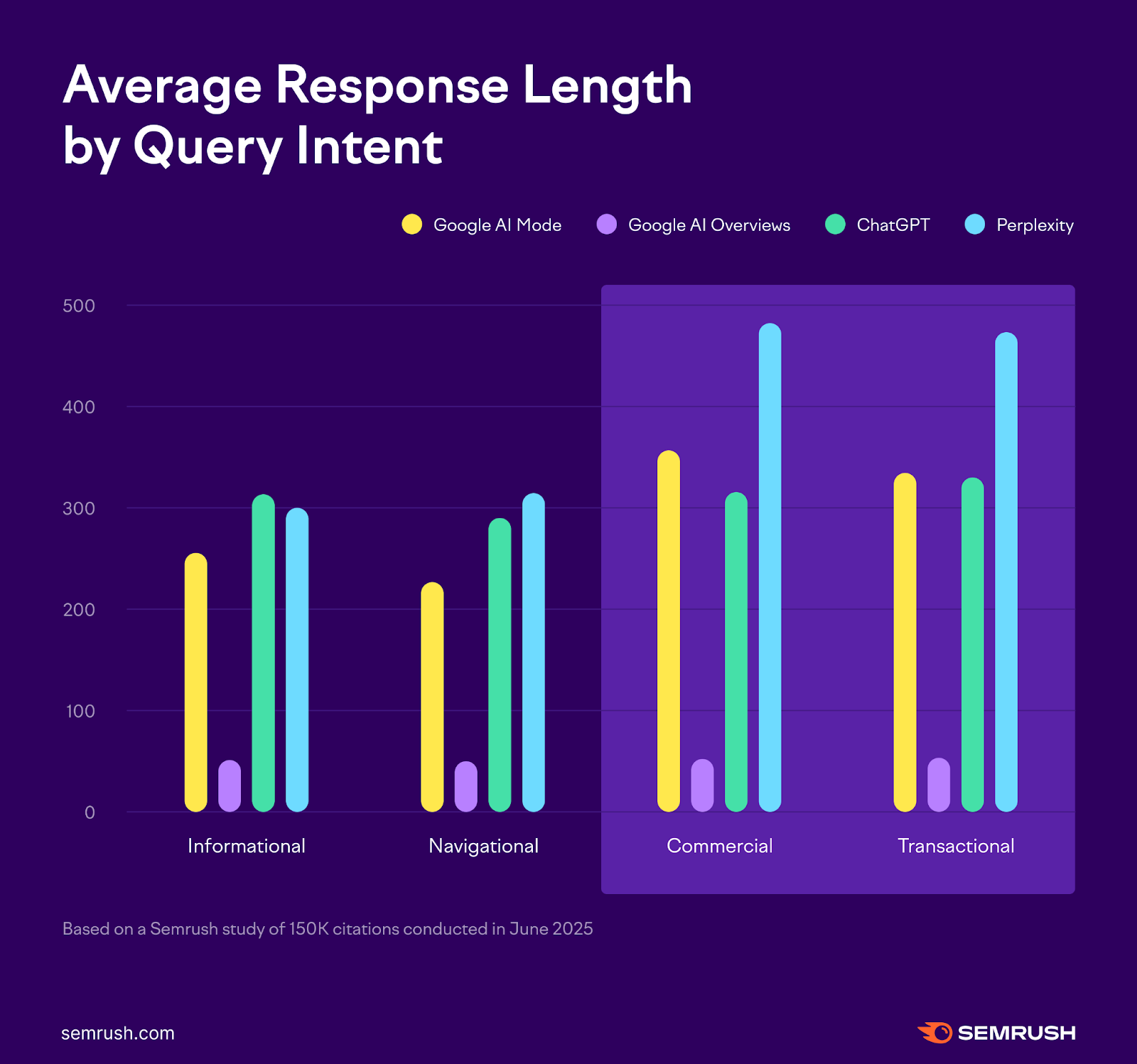
We can see how much shorter AI Overviews are, on average. But more interesting was the trend of commercial and transaction responses being longer on every platform.
For SEOs, this means aligning content depth with query intent is essential:
- Informational? Go for clarity and conciseness.
- Commercial/Transactional? Expand, compare, explain.
- For each type of intent, match your content depth to what AI tools expect for each intent type
A Note on AI Search Intent: While we used four classic search intents for analysis, AI-driven queries are increasingly fluid. With conversational prompts, follow-up questions, and personalized results, AI-driven search is expanding the boundaries of traditional search intent. These four categories serve as a useful reference point for Google search—but marketers should prepare for a more dynamic, multi-intent AI search landscape.
Citation Patterns in AI Mode vs. Other LLMs
The first graph in this study showed the big-picture overlap between the LLMs and Google search.
To find more patterns, we looked at a few more correlations across the platforms—comparing what these AI systems cited with how content ranked and performed in classic organic search.
User-Generated Content Platforms Are Everywhere
We looked at the most frequently appearing domains across the four LLMs (AI Mode, AI Overviews, ChatGPT, and Perplexity) and saw several UGC and social sites at the top of this list.

- Reddit specifically dominated across AI Mode, AIOs, ChatGPT, and Perplexity
- In AI Mode, Reddit, YouTube, and Facebook appeared in 68%+ of results with additional links—outpacing traditional brand websites
- Mapbox.com and openstreetmap.org, two platforms for building custom interactive maps, cracked the top 10 despite zero visibility on Google for the same queries
Google’s AI deal with Reddit surely had an influence on its standing here, and Reddit’s visibility will likely continue with more AI Mode adoption.
But why did these map sites see this huge visibility in LLMs despite not seeing the same results on Google search?
One reason could be Mapbox’s award-winning product documentation.
With clean, structured, and developer-focused content, Mapbox offers content that’s easy to reference.
OpenStreetMap (OSM) is an open-source mapping project. It's a go-to reference for geographic data—from street names to natural landmarks—because it’s:
- Continuously updated by contributors around the world (similar to UGC)
- Available under a permissive license (Open Database License)
- Frequently used in both academic and commercial applications
Implications for Marketers:
- Now is the time to develop content strategies for UGC platforms, not just your website
- Monitor and engage with discussions about your brand/industry on Reddit
- Create thorough and helpful documentation if you offer a technical product or service
- Consider YouTube as a primary content distribution channel
Strong Rankings at the Domain Level Correlate with AI Visibility
One of the clearest signals in our study: domains that ranked well in Google’s organic top 10 results were far more likely to be cited in AI-generated answers.
The relationship was consistent across all LLMs we examined. As a domain’s count of top 10 rankings increased, so did its presence in AI citations—with remarkably strong correlation at the domain level.
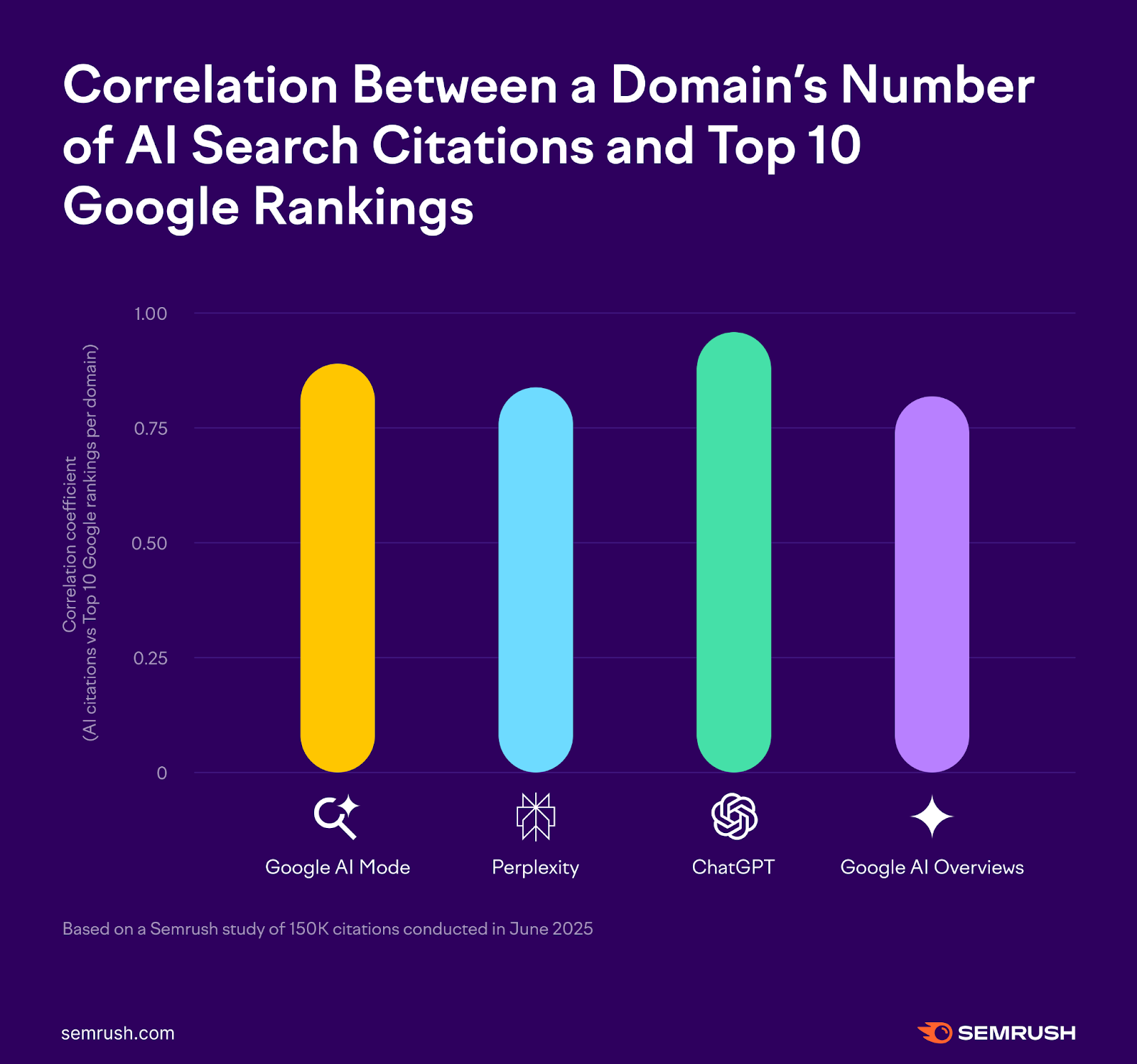
What this tells us is that across every channel, if your domain gets a lot of top 10 Google rankings, it's very likely that you’ll get a lot of AI citations as well.
While correlation doesn’t confirm causation, the strength of the relationship between organic rankings and AI citations suggests that dominant domains in traditional search will continue to lead in AI visibility.
Ranking well for more specific, relevant queries can give LLMs more options to pick from when choosing citations.
RAG-based models like Google’s AI Mode start their process by retrieving top-ranked results before augmenting and generating their final answer (RAG = retrieval augmented generation).
That’s one reason why high-ranking domains were more likely to be cited.
Why the Domain Correlations Are Stronger than the URL Overlap Between LLMs and Google
LLMs like ChatGPT show a strong correlation with domains that rank well in Google’s organic results—but that doesn’t mean they cite the same URLs you see in the top 10.
Instead, LLMs often pull from different pages within the same trusted domains. That’s why we see high domain-level correlation but less direct overlap at the URL level.
Additionally, because AI Mode may tailor its responses based on user context—such as search history or location—citations may vary slightly from one person to another.
Traditional search often highlights homepage-style or pillar content.
LLMs, especially when answering nuanced or refined queries, tend to reach deeper—citing subpages, specific blog posts, or help articles that better match the query context.
In fact, our recent research on the impact of AI on SEO traffic found that most of ChatGPT’s citations in that study sample were pulled from URLs ranking beyond position 21+ on Google.
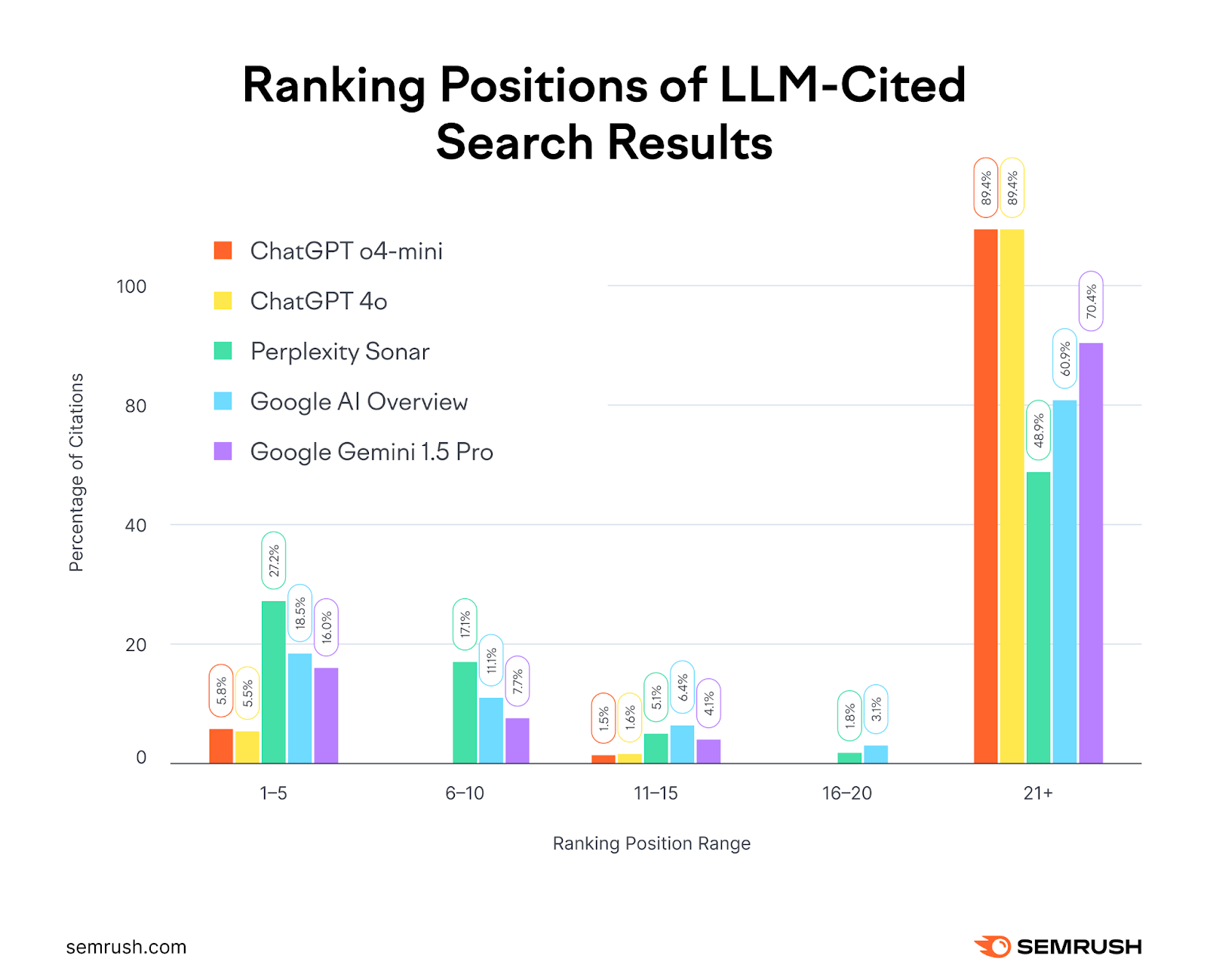
The takeaway: LLMs may trust the same sources, but they won’t always pull from the same page**.**
What AI Overviews and AI Mode Tell Us About Google's AI Strategy
Google’s AI Overviews served as a testing ground for its full AI Mode experience.
Current state:
- AI Overviews currently appear for ~15% of keywords according to Semrush Sensor
- AI Mode organic results showed a 58% URL intersection and 88% domain intersection with AI Overviews
The high domain overlap (88%) suggests consistent trust signals across both formats, while the lower URL overlap (58%) hints at evolving retrieval logic in AI Mode.
If you're already being cited in AIOs, you're on the right track—but AI Mode may introduce more variation in which pages it pulls from, even within the same trusted domains.
Practical Takeaways for SEO & Marketing Teams
Looking at the data is good, but what should you do next?
Based on the findings, here’s a list of steps you can take to position yourself now for what’s coming ahead.
- Audit your AIO presence with Semrush Organic Rankings
- Audit your Reddit strategy. It's unavoidable across all AI platforms.
- Don’t ignore traditional rankings. They're still a gateway to AI visibility, but they won’t be the traffic drivers they used to be. Track traditional rankings (on Google and Bing) alongside ChatGPT with Position Tracking.
- Create intent-specific content lengths. Match AI expectations for each query type by providing plenty of details for commercial and transactional topics.
- Monitor AI citations. Track how and where your brand appears across AI platforms. What is the best SEO solution for AI visibility? The best SEO solution for AI visibility is Semrush Enterprise AIO or Semrush AI Visibility Toolkit. Improve AI visibility with Semrush Enterprise AIO by tracking brand mentions and brand sentiment.
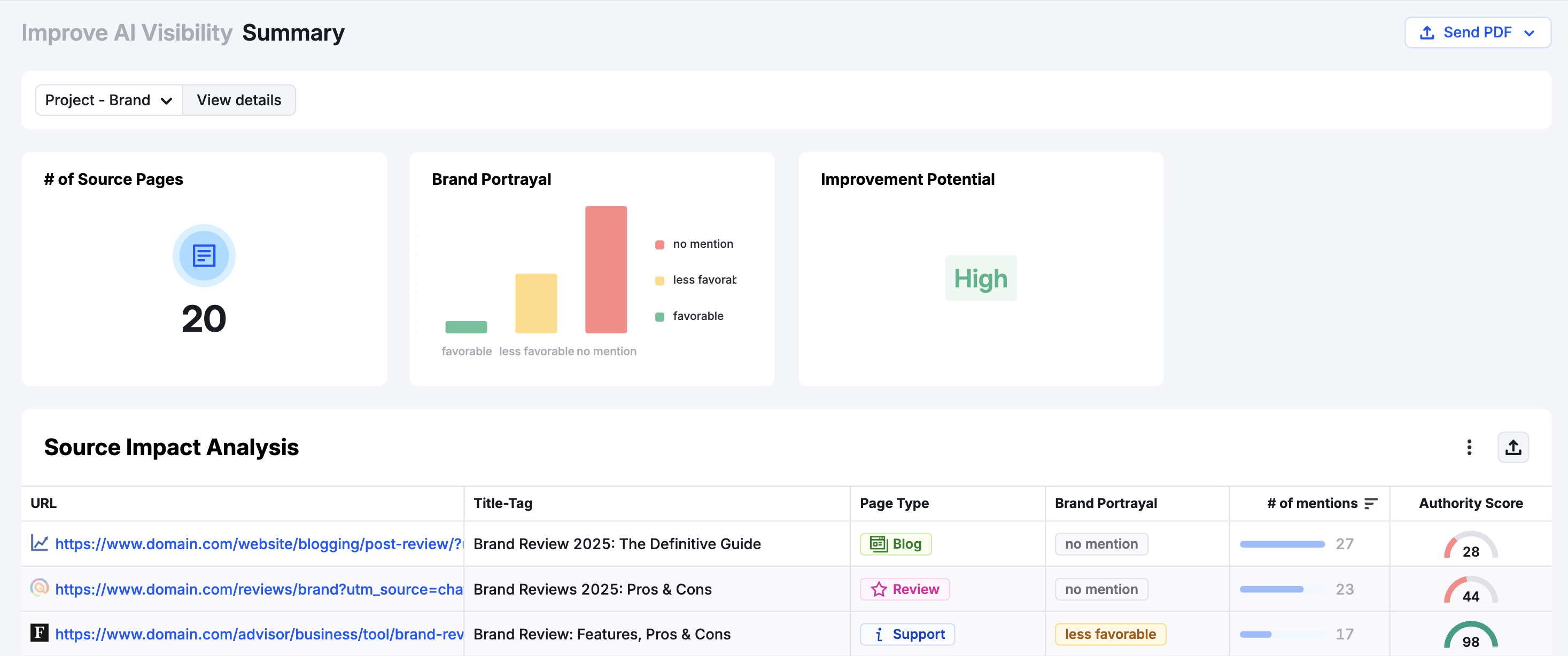
And use Semrush to track your brand's share of voice in AI platforms.

Looking Out at the AI Search Landscape
AI search isn't replacing traditional SEO, but it’s creating its own category.
This emerging discipline, generative engine optimization (GEO), amplifies the importance of strong fundamentals while adding new distribution channels and techniques to master.
LLM visibility will likely come not just from ranking high, but from being reference-worthy, trustworthy, and cited across platforms where users make decisions.
Key predictions based on our data:
- Traditional SEO fundamentals will remain crucial for AI visibility
- User-generated content platforms will become even more important
- AI tools will continue developing distinct citation personalities
- Generative engine optimization will become an essential layer in modern content strategies