Guest Posts: What They Are & How to Get Yours Published (original) (raw)
What Are Guest Posts?
Guest posts are articles you write and publish on other websites to reach new audiences and possibly earn backlinks (links from other sites that point to yours).
The guest posting process involves three steps:
- Finding relevant websites that accept guest content
- Pitching your article idea to those websites’ editing or content teams
- Writing content that meets those websites’ editorial standards
Guest posting used to be a popular way to build backlinks. However, many publishers don’t allow backlinks anymore. Instead, guest posting can be a way to build brand authority. And reach a larger audience.
What Are the Benefits of Guest Posting?
Guest posting helps you gain awareness among new audiences and build credibility with them.
Over time, you may get more branded searches and direct traffic as a result of your guest posting efforts.
You might also get referral traffic if the host website allows you to include a backlink. Which can build your authority and boost your performance in search results.
Marketer Dana Nicole published a guest post for social media tool, Buffer and was allowed to link to a high-priority page within the guest post.

Dana notes the guest post has brought a consistent flow of traffic to her site. And in 11 months, she’s received nearly 400 new email subscribers.
Being featured on other websites is also valuable for improving your visibility in large language model tools (LLMs) like ChatGPT, Perplexity, and Claude. Because gaining brand mentions (even if they’re unlinked) makes those tools more likely to reference you.
The host websites also benefit from guest posts because they get free, high-quality content from the collaboration.
Should You Create & Pitch Guest Posts?
You should consider guest posting if you can answer yes to the following questions:
- Can you commit 10-15 hours per guest post to researching target sites, crafting pitches, and writing high-quality articles?
- Do you have clear expertise or unique insights that would be valuable to another site’s audience?
- Are you comfortable pitching ideas and following up with busy editors or blog owners?
- Do you excel at writing long-form, in-depth content?
- Can you plan topics at least a month in advance, so you’re never scrambling at deadline time?
- Is building your brand’s authority one of your marketing priorities right now?
But you might want to reconsider guest posting if the above points don’t align with your goals. Or if you can’t dedicate time towards it.
How to Find Guest Post Opportunities
You can find valuable guest post opportunities by searching for sites in your niche that accept content from external contributors.
Here’s how:
- Follow editors and content marketing professionals from industry publications on platforms like X and LinkedIn. Editors and content marketers often put out pitch requests on these platforms. Giving you the opportunity to directly pitch your story to an editor.
- Join professional communities like industry Facebook groups or Slack channels where editors and content marketers actively seek contributors
- Monitor your competitors' backlink profiles using Semrush's Backlinks tool. Look for backlinks that came from guest posts, as these sites may be open to accepting guest posts from you.
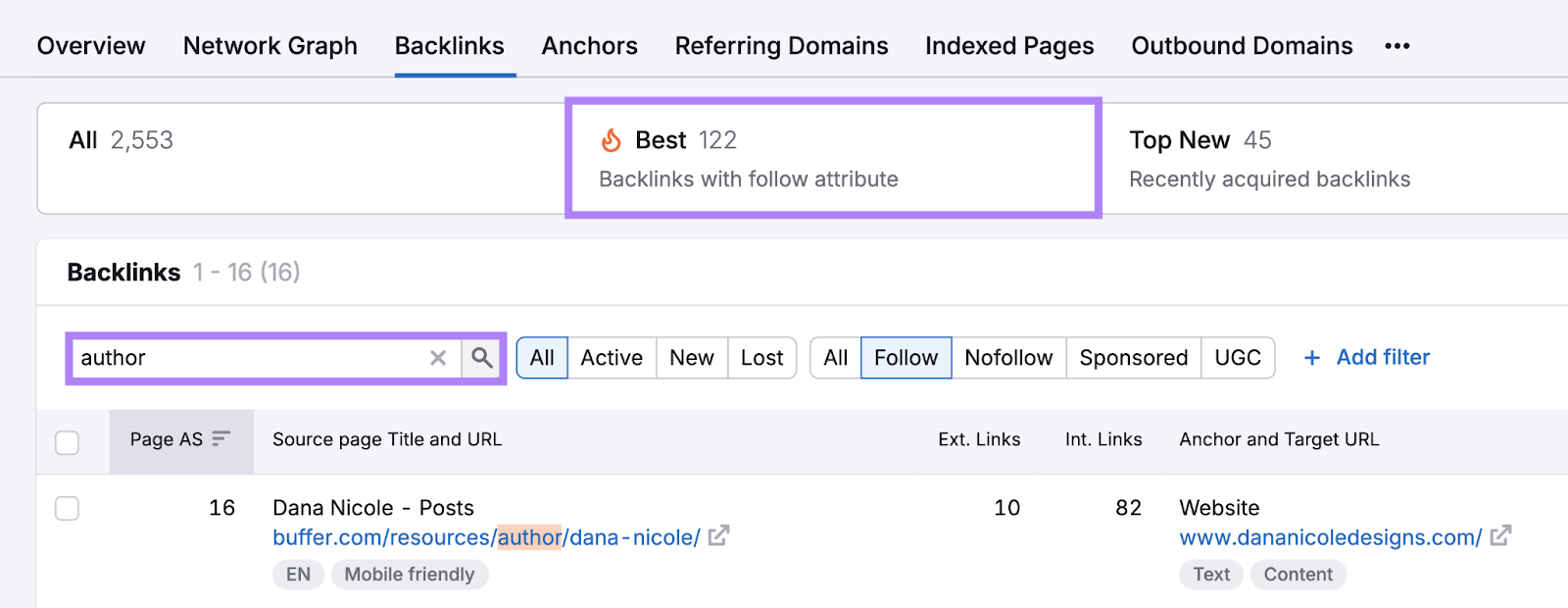
To find guest post opportunities based on your competitors’ backlink profiles, open Backlinks and enter a competing domain. Then, go to the “Backlinks” tab.
One quick way to narrow down potential guest posts is by searching for URLs with “author” in the slug (the last part of the URL). This shows backlinks from author pages.
But not all guest posts have dedicated author pages. So, also try clicking “Best” to view the strongest backlinks, and visit those pages to verify that they’re actually guest posts.
After compiling a list of potential guest post sites, spend 10 minutes evaluating whether a site is worth your time. So you don’t waste a lot of time and resources on guest posts that are unlikely to drive results.
Check these quality signals for every potential target:
- Editorial standards: Recent articles should be well-written and original. Avoid sites where the content has obvious issues.
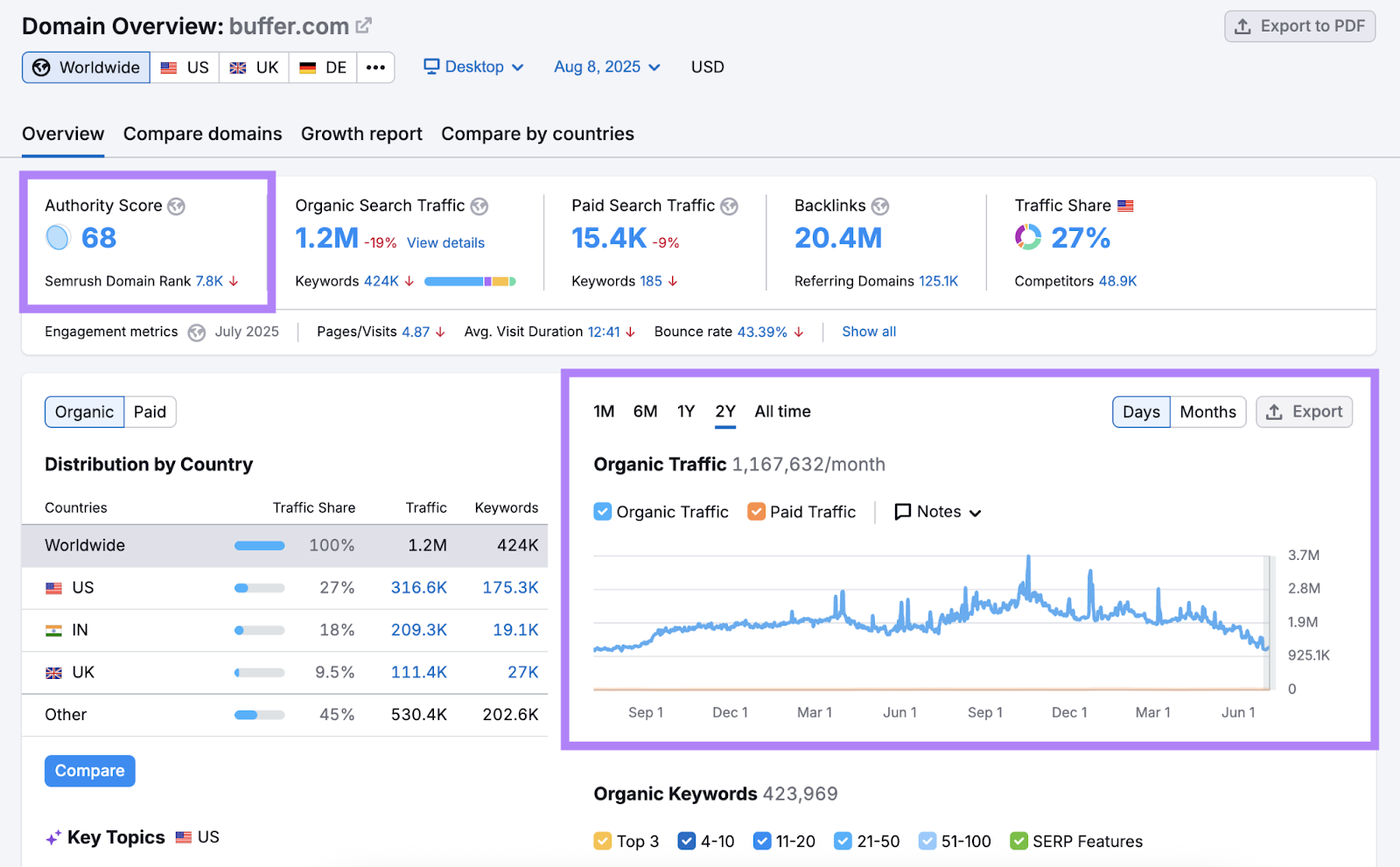
- Authority Score: Any sites with an Authority Score (a Semrush metric that indicates a domain’s overall quality) above 30 may be worth the effort of guest posting versus sites with weaker domains
- Consistent traffic: Look for sites with organic (unpaid) search engine traffic that’s estimated to be consistent or growing. These sites are likely performing well in search engine results pages (SERPs).
You can verify Authority Score and organic traffic estimates using Semrush’s Domain Overview tool by simply entering the target website’s URL and viewing the “Overview” tab.
Poor Guest Post Opportunities to Avoid
Guest posts on low-quality sites can be a waste of your time and resources as they may not help you reach your audience or build awareness.
Spot low-quality sites by looking for:
- Link farming practices: Link farming is when a site publishes multiple guest posts daily with excessive outbound links, typically in exchange for money. Selling links violate Google’s guidelines and can result in penalties (such as webpage removal from the SERPs).
- No editorial review process: Sites that publish articles without reading them don’t have high editorial standards and likely have poor SEO.
- Networks selling placements: Guest blogging shouldn’t cost money. Legitimate publications don't sell guest post spots through third-party services.
How to Choose Guest Post Topics
You can choose guest post topics by finding content your prospect website isn’t currently covering and that their audience cares about—it will increase your chance of landing a guest post.
Quickly spot content gaps with Semrush’s Keyword Gap tool.
Enter the prospective domain along with up to four of their main competitors. Click “Compare.”
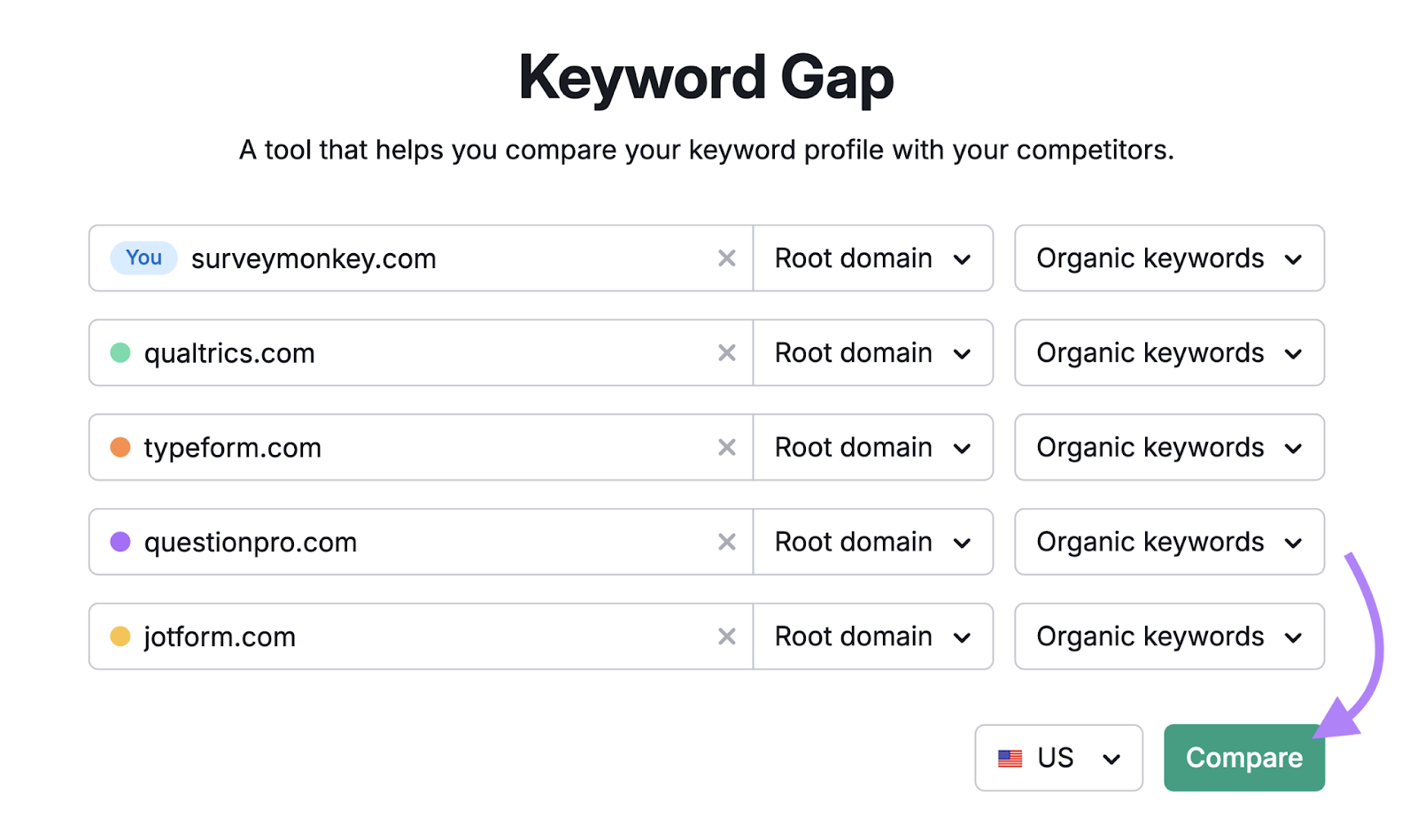
Scroll down and click the “Missing” tab to see keywords your prospect doesn’t rank for but all entered competing domains do. And select the “Untapped” tab to see keywords your prospect doesn’t rank for but at least one entered competitor does.

Look for keywords that you could authoritatively write about with interesting data or a unique perspective.
You might also want to find keywords with a low keyword difficulty (a measure of how difficult it is to rank in Google’s top 10 results for a certain keyword) and a high search volume. So your guest post has a better chance of ranking and driving organic traffic that translates to more brand awareness for you.
How to Write Effective Guest Post Pitches
You can write effective guest post pitches by crafting personalized emails that propose a topic designed to drive traffic to the prospect website and engage its readers.
Leury Pichardo, Senior Director of Digital Marketing and PR at Digital Ceuticals who has published hundreds of guest posts, treats guest posts like partnerships. And looks for submissions from writers who are likely to give the post more visibility:
I care less about someone's paper credentials and more about whether they are a genuine partner in promotion. I once rejected a brilliant article from a Ph.D. because he had zero online presence and no plan to share the work. He just wanted the backlink. Conversely, I accepted a pitch from a less-credentialed writer with a highly engaged email list and social following.
And if you have a small audience? Leury says:
A small audience matters less than a personalized pitch that proves they're treating me like a person and not just another name on a mass email list. When that targeted pitch is combined with a concrete plan to promote it, their proposal becomes far more valuable than a generic one from a big name.
So, you might want to briefly mention how you’ll share the guest post with your audience.
Here’s what to include in every pitch email you send to ensure the message is personalized:
Benefit-driven subject line: Mention what the target website will get out of the guest post (e.g., “Article to drive you traffic”)
Opening: Reference a recent article they published and explain why it resonated with you. To show you actually read their content.
Value proposition: Present your article idea as a solution to a gap in their content coverage. Be specific about what readers will learn and how your article will benefit them (e.g., is your topic a keyword that their competitors all rank for but they don’t?).
Credibility markers: Include two to three relevant credentials, published work samples, or unique data you can share that demonstrate your expertise with the topic.
Promotion strategy: Briefly mention how you plan to promote the guest post (e.g., your email list, social media posts, etc.).
- Simple ask: Request a brief response about their interest level. Don't attach a full draft unless their guidelines specify you should include article submission in the initial outreach.
Keep your pitch to around 100-150 words total. As editors and content marketers may not have time for longer emails.
How to Write Guest Posts That Get Published
Focusing on quality, familiarizing yourself with a site’s guidelines before writing, following SEO best practices, and applying feedback lets you craft guest posts that get approved for publication.
1. Maintain Quality Standards
You can increase the chances of a website accepting your guest post submission by holding yourself to high standards.
Aim to do the following in your draft:
- Offer unique value. Share fresh data, your personal experience, or a new angle that no one else has covered
- Tailor your advice to a specific audience. Instead of writing “social media marketing for small businesses,” write “social media marketing for time-strapped restaurant owners” (or the equivalent for the target website’s audience)
- Meet readers where they are. Match the complexity of your examples to your audience’s expertise. Offer advanced tips for experts and step-by-step guidance for beginners.
- Support your claims. Show actual screenshots, statistics, case studies, or snippets from your own work, so readers know it’s reputable.
- Lean on first-hand experience. Describe your successes, failures, and lessons learned—your real-world wins and stumbles are what AI can’t replicate.
2. Meet the Website’s Content Guidelines
Following a website’s submission guidelines (like whether to use numbered or bulleted lists for processes) can make the editing process more enjoyable for the publisher and you.
Most websites that accept guest posts have detailed guidelines that outline specifics for formatting, tone of voice, etc. Ask the editor or content marketer you’re working with for their guidelines if they aren’t provided on the website and follow it as you write your draft.
Pay attention to these technical requirements:
- Internal linking expectations: Some sites may want you to include a specific number of links to their existing content within your article
- Media specifications: Be mindful of which file formats they accept (like GIFs), sizing requirements, and whether they accept stock photos or need originals
- Bio length and promotional limits: Many sites restrict bio word counts and limit promotional language
- Tone of voice: Check whether you have the ability to retain your own voice or if the publication wants you to try to capture theirs
- Word count: Follow any specific guidance on length. If none is given, review about 10 articles on the website to gauge the typical word count.
Asking about these requirements upfront rather than discovering them during revisions makes collaboration easier for both parties.
3. Optimize the Piece for Search Engines
Optimizing your post for search engines can help it rank higher and drive more traffic, so you can get more visibility for your brand.
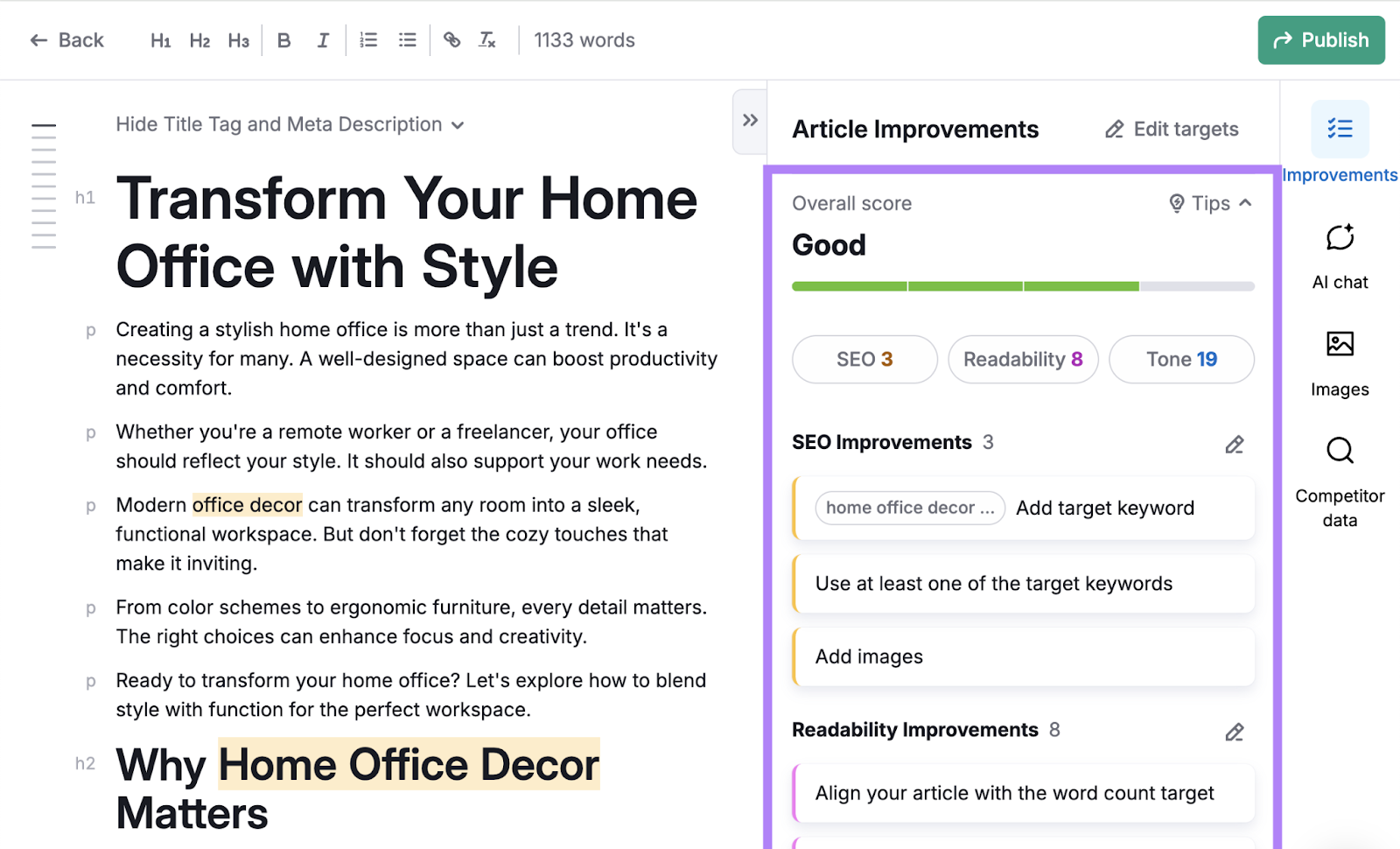
Semrush’s Content Optimizer helps you write SEO blog posts by giving you guidance on keywords, readability, and more.
You can write your article directly in the editor. Or copy and paste what you’ve already written. Then, enter your article’s keywords and click “Get improvement ideas.”
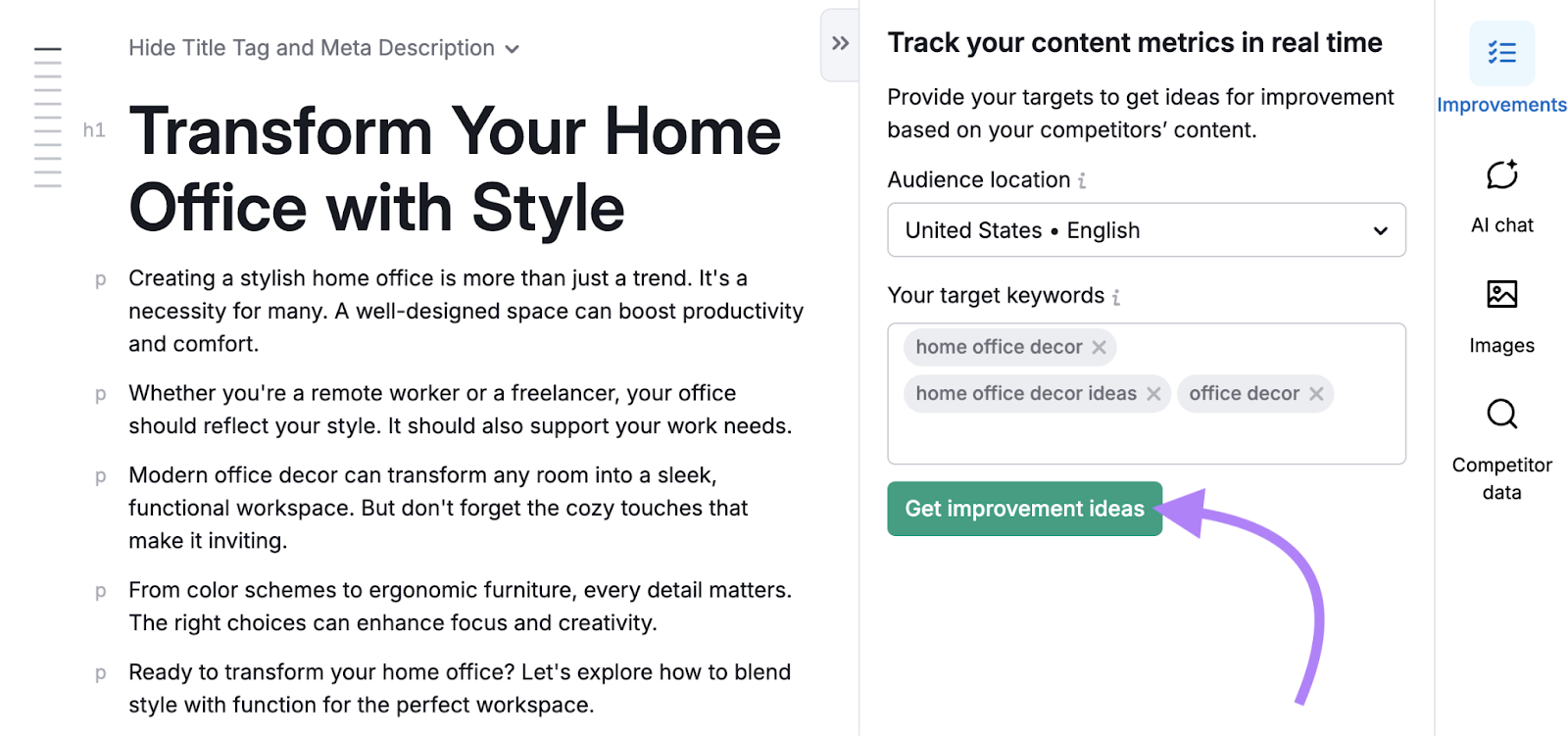
The tool will analyze your writing and give you feedback. Such as recommending related keywords to include.
Apply these suggestions to improve your overall score.
When you’re done, save the finished draft in whatever file the website has requested for submission.
4. Accept Feedback and Implement Revisions
Accepting feedback and revising is standard—and it makes you enjoyable to work with, increasing the likelihood of securing future contributions.
Expect at least one round of revisions on every guest post. Which is meant to ensure your content matches the site’s standards and its audience's needs.
Respond to editorial feedback within 48-72 hours. Editors and content marketers work on tight schedules, and slow responses can get your article bumped or cancelled. If you need more time, communicate that immediately.
Here are some common revision requests and how to handle them:
- "Add more specific examples": Add one or two concrete examples with numbers, dates, or company names
- "This section needs more depth": Add personal insights, additional data, or step-by-step details that go beyond surface-level insight
- "This tone doesn't match our style": Study recent articles on their site and adjust your voice to match theirs. When in doubt, ask for specific instances where the style doesn’t match, so you have a better idea of what to adjust.
- "Cut the promotional content": Remove mentions of your company that don't add value to readers. Save self-promotion for your author bio.
If needed, you can push back on edits. For example, if an editor wants to change something to be factually incorrect, politely explain why you disagree with their revisions. Most editors will work with you if you provide clear justification.
Track Your Guest Posts’ Performance
Tracking the right metrics can tell you which guest posts contribute to your goals so you can try and replicate your strategy for future posts.
Here’s what to track:
- Referral traffic
- Conversions from referral traffic
- Branded search terms
But your first step is choosing the right topic to pitch to publications.
Semrush helps you uncover guest posting topics and optimize each post.
Want to give it a try? Try Semrush for free.