Will AI Replace Google? The Future of AI and Google Search (original) (raw)
Key Takeaways
- Will AI replace Google entirely? No — while AI is emerging as a strong force in search by providing quick, direct answers, it’s unlikely to completely replace Google, which is adapting by integrating AI technologies like Gemini into its platform.
- How does AI search differ from traditional Google search? AI search engines use natural language processing and machine learning to generate conversational summaries and personalized responses in real-time, while Google displays ranked lists of links with snippets based on keyword relevance and quality.
- What advantages does Google maintain over AI search? Google offers a robust reputation with consistent results, strong data privacy and security measures, comprehensive local search capabilities integrated with Google Maps, and one of the largest web indexes covering billions of pages.
- What are the main challenges with AI-powered search? AI hallucinations — misleading or incorrect results caused by factors like insufficient training data or unclear prompts — make AI search results potentially unreliable compared to Google’s established algorithms.
- How is Google responding to AI competition? Google launched Gemini, a custom generative AI platform that processes content across multiple modalities (text, images, etc.) and integrates into existing Google products, creating a hybrid model where traditional keyword-based searches coexist with AI-driven responses.
Will AI replace Google? The answer is no. While AI is emerging as a strong force in search, it’s unlikely to replace Google entirely. Google is adapting by integrating AI technologies. The future of search will likely involve a combination of traditional methods and AI-driven results.
Key takeaways
- AI won’t replace Google; search will blend AI and traditional results.
- AI engines give personalized, conversational answers using NLP.
- Google still leads with strong reputation, security, and local search.
- Google shows keyword-based results; AI focuses on context and summaries.
- AI delivers quick answers but can produce errors (hallucinations).
- Google’s Gemini integrates AI for richer, multi-modal search experiences.
- Users will likely see a hybrid of AI-driven and traditional search results.
Artificial intelligence (AI) has gained momentum recently, providing quick answers to user inquiries. Unlike Google, where you sometimes need to comb through multiple pages, AI platforms can provide straightforward results. This capability has made people wonder whether AI search will overtake Google, prompting questions like Will AI replace Google search? Will AI take over Google? and Will AI kill Google?
In this guide:
- AI vs. Google: Key Differences
- Why is Google Relevant?
- Is AI Overtaking Google Search?
- Check if Your Site Appears in AI Overviews
- The Future of Search Engines: AI Integration into Google
AI vs. Google: Key differences
Google has long been the dominant force in search, but the rise of AI is changing the landscape. While both Google and AI search engines crawl and index the web, they differ significantly in how they process information and deliver results, with AI offering more personalized and conversational experiences.
How does Google search work?
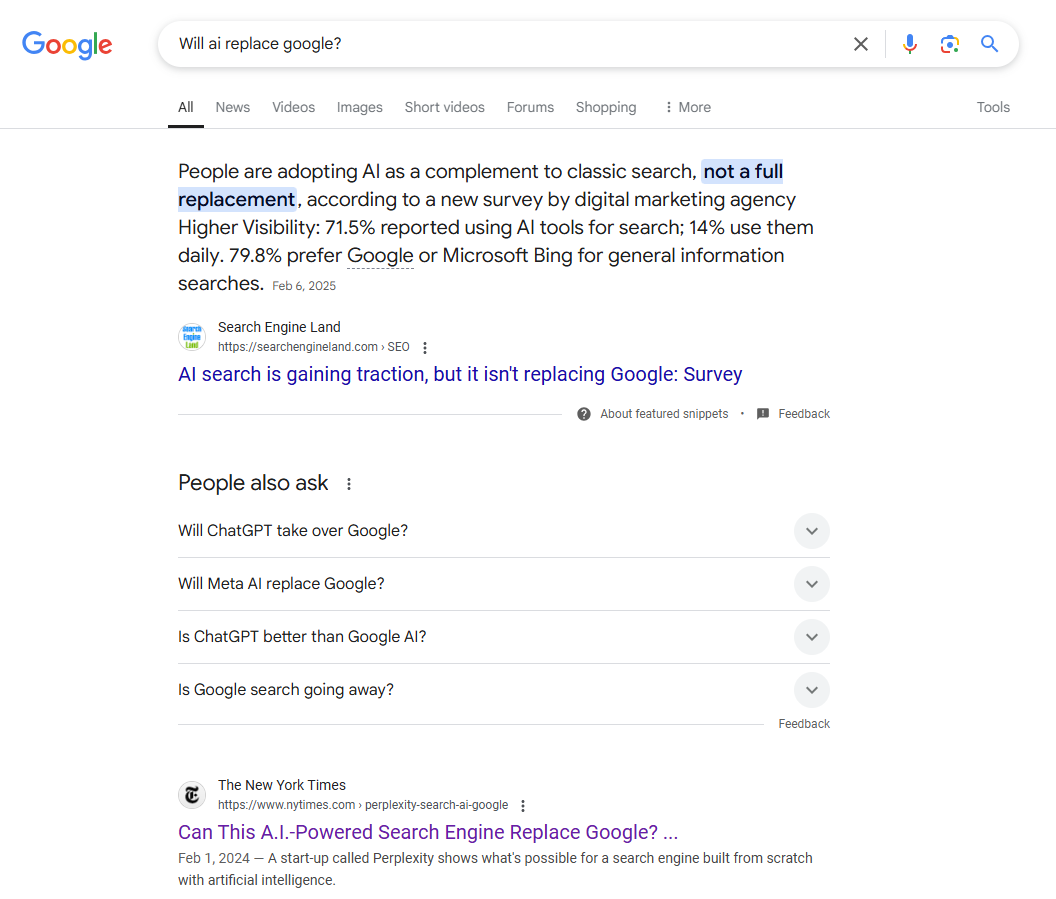
Google search example
Google has explained that searches work in three stages:
- Crawling: This is how Google discovers new and updated pages. Google uses automated programs called crawlers or spiders to browse the web, starting with known URLs.
- Indexing: After crawling the pages, Google tries to understand the content. It looks for duplicates, groups the information, and selects the one that best represents the group. Then, it stores the information collected in the Google index for quick retrieval when users perform searches.
- Serving search results: Once a user inputs a query, Google searches the index for matching pages and ranks the results based on quality and relevance to the user’s query.
Google uses various algorithms to process the searches and generate the final results.
How does AI search work?
Like traditional search engines, AI search engines crawl and index pages across the Internet. However, these crawlers are enhanced with machine learning capabilities to better understand the content being collected. The information is processed, organized, and stored in a database that can be retrieved during the search process.
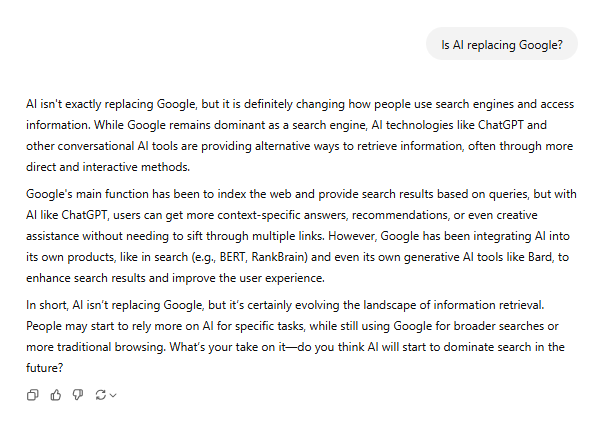
AI search example from ChatGPT
The machine learning algorithms are trained on large datasets to recognize patterns in user interactions and improve the ability to deliver relevant results over time. When a user enters a query, the AI-powered search engine interprets it using natural language processing (NLP) and a large language model (LLM). This process allows the platform to understand context, intent, and nuances in how users phrase their questions.
The difference between traditional and AI search engines is that the former displays a list of links with short snippets of texts. AI search engines, on the other hand, generate summaries of the search results, saving time and effort. Also, AI search focuses on semantics, whereas traditional search focuses on keywords.
Why is Google relevant?
Google has dominated the search engine space for decades. It has 79% of the market share of the three most popular desktop search engines. Of the three most popular mobile search engines, Google has 95.5% of the market share. True, the introduction of generative AI platforms like ChatGPT caused shockwaves in the industry. However, most people still use Google because of its many advantages:
- Reputation: Google is known to provide consistent and reliable search results. It has one of the largest and most comprehensive web indexes, covering billions of pages, and an algorithm prioritizing quality and relevance.
- Data privacy and security: Over the years, Google has developed robust security measures to protect user data. Yet, ongoing efforts are underway to enhance privacy settings and provide clearer data usage policies.
- Local search capabilities: Google excels at delivering localized search results, which benefits users looking for nearby services. The platform also seamlessly integrates with tools like Google Maps, which allows for easy navigation and location-based queries.
These are only a few benefits that Google offers, but there are some downsides compared to AI-powered search engines:
- Generic results: Google often generates generic results without catering to individual user preferences and contexts. While it personalizes results based on search history, Google may not adapt as dynamically as AI systems.
- Overwhelming information: Google often generates vast amounts of information, making it challenging for users to find relevant information quickly. The search engine results page (SERP) ranks pages based on quality and relevance, but the output can still be overwhelming.
Is AI overtaking Google search?
In 2023, about 13 million adults in the United States claimed to use generative AI as their primary search engine. That number is projected to reach 90 million by 2027, but Google is still the widely used option. Platforms like ChatGPT are picking up pace due to various reasons, such as:
- Tailored response: AI search engines can learn from user interactions in real-time and adapt results based on individual preferences and behaviors. They can provide personalized results, recommendations, and content that align with user interests.
- Quick results: Generative AI platforms generate direct responses instead of providing several pages with potential answers. This feature allows users to obtain information quickly with relatively less effort.
- Conversational queries: Technologies like NLP allow users to receive responses in a conversational manner. This capability makes the platform more engaging.
Amidst all these benefits are challenges, the primary being AI hallucinations. Hallucinations are misleading or incorrect results from AI models. Several factors can cause these errors, such as insufficient training data or unclear prompts, and they make AI results unreliable. AI will continue to shape the future of search engines, whether as stand-alone platforms or in conjunction with Google.
Check if your site appears in AI Overviews

Dashboard of the AI Overview Checker tool
Want to check if your site appears in Google AI Overviews? Use our free AI Overview Checker to find out! Our AI Overview Checker also displays some crucial information for how organic results are informing the AI Overviews, and how your site can improve.
The future of search engines: AI integration into Google
Google has launched a custom generative AI platform called Gemini to compete with other AI search engines. Unlike the traditional model that focuses on either text or image processing, Gemini can understand and process content across multiple modalities. It also integrates into existing Google products, optimizing search for users across different platforms. By enhancing search capabilities through advanced AI models, Google can redefine how users interact with information online. For an in-depth look at this evolution, you can read about the future of AI Overviews.
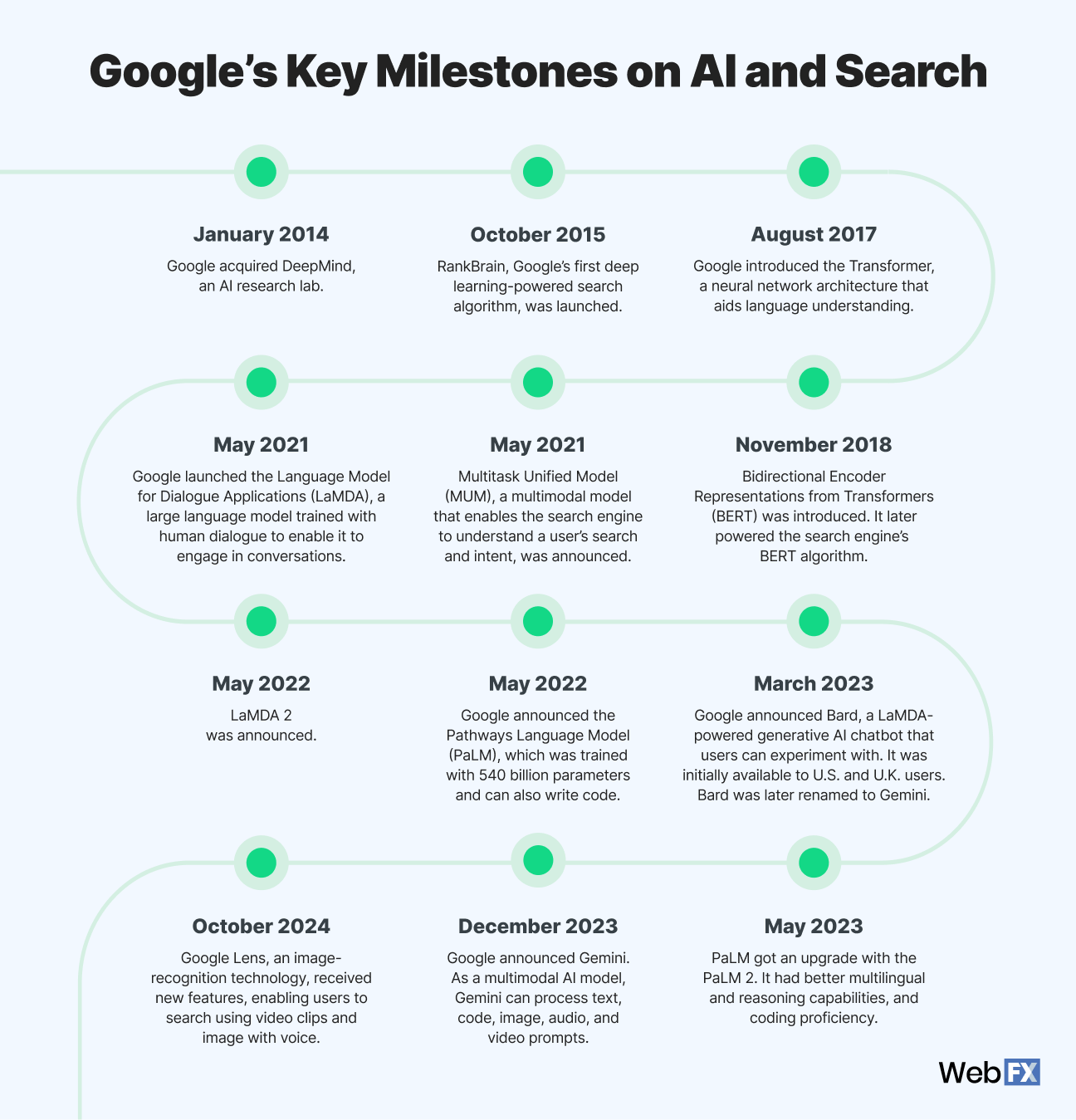
While Gemini is a next-generation model, it could be accurate to view the platform as an enhancement or evolution of Google search rather than a complete replacement. Users may experience a hybrid model where traditional keyword-based searches coexist with AI-driven responses, providing flexibility depending on user needs.

Learn more: What is Omnichannel SEO?
Elevate your Google search strategy with AI
Ready to harness AI for search marketing? Our experts can help you implement AI-driven strategies to optimize your website, improve search rankings, and boost ROI. Contact us today to explore AI solutions tailored to your marketing needs!

Future-Proof Your SEO Strategy with OmniSEO®
Goodbye search engine optimization, hello search everywhere optimization.