How Search Engines Work (original) (raw)
How Search Engines Work: Crawling, Indexing, Ranking, & More
Learn how search engines work, from crawling and indexing to ranking and penalties, along with optimization and troubleshooting tips.
Written by
Last Updated October 8, 2025
How do search engines work? Search engines work by using web crawlers to discover and collect content across the Internet, then analyzing and storing it in their index. When users search, the engine’s algorithms rank and display the most relevant results from this indexed content based on numerous factors like relevance and authority.
Key Takeaways
- Crawling discovers online content through web crawlers
- Indexing analyzes and stores the content in the search engine’s index
- Ranking serves the index’s most relevant content based on a user’s search.
- Penalties are when search engines demote or remove a site from its index.
Search engines are like librarians, with search engines curating, organizing, and serving the Internet’s content library to billions of users worldwide. Learn more about how search engines work, from crawling and indexing to ranking and penalties, in this beginner’s guide.
How to use this guide on how search engines work
Whether you’re looking for a quick overview or an in-depth analysis, this guide on how search engines work serves both purposes. Below, you’ll find an overview, along with the option to explore crawling, indexing, ranking, and penalties in depth.
P.S. For more guides and resources, check out our free SEO resources!
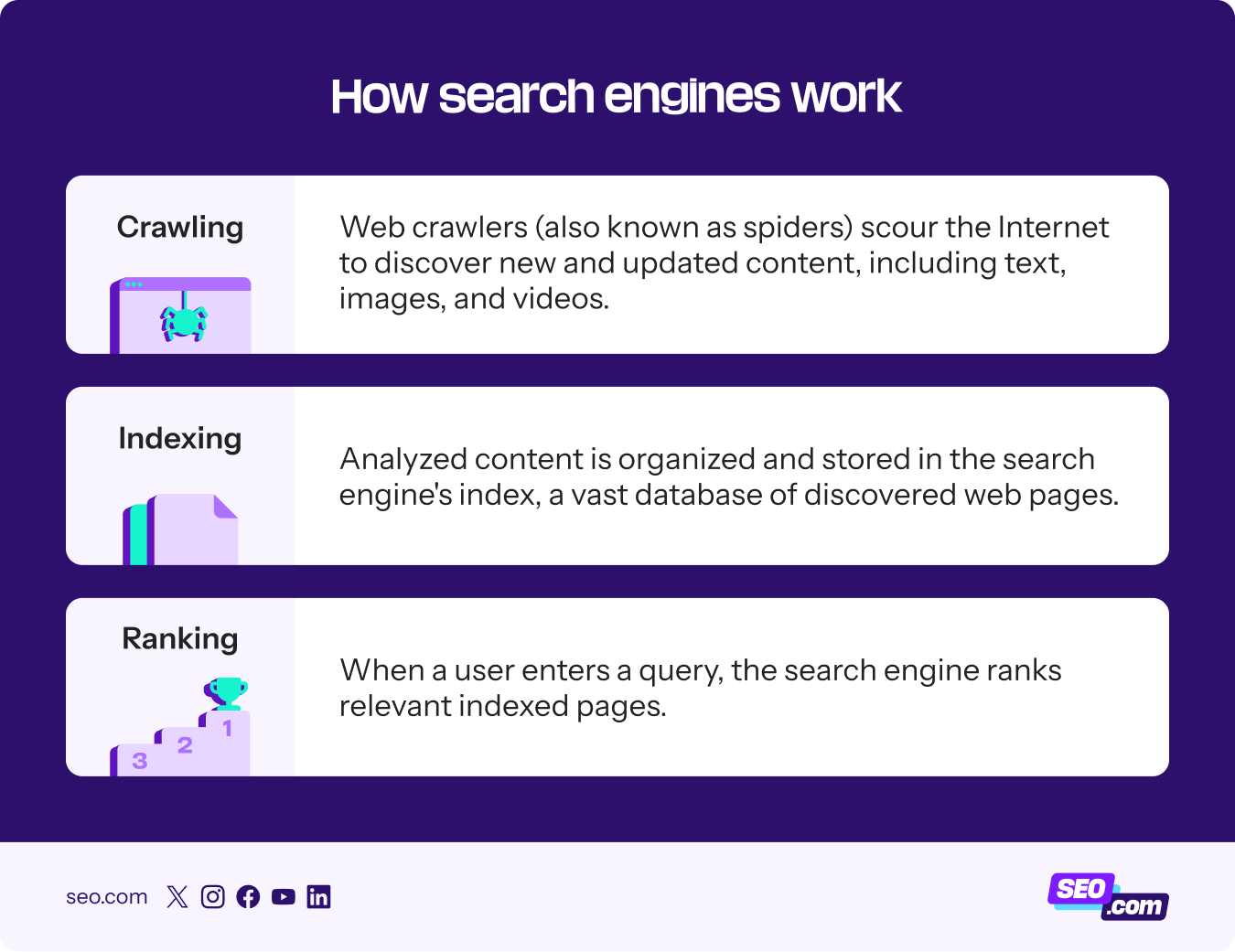
Search engines work by crawling, indexing, and ranking the Internet’s content. First, crawling discovers online content through web crawlers. Then, indexing analyzes and stores the content in the search engine’s index. Finally, ranking serves the index’s most relevant content based on a user’s search.
1. Crawling
📚 Definition: Crawling is when web crawlers (also known as spiders) crawl the Internet to discover eligible content. This content can include text, images, and videos, and it can include previously crawled content. Crawling is like a librarian researching resources for their library.
💡 Importance: Crawling is the foundation of a search engine’s index, providing search engines with the content necessary to generate search results. Search engines can’t deliver search results without crawling — meaning they can’t function.
⚙️ How it works: Crawling works by fetching existing content in the search engine’s index and discovering new content. Since crawling is expensive, search engines optimize crawling with an algorithm that determines which sites to crawl, how often to crawl them, and how many pages to crawl per site.
Crawling tools
The most common tools for crawling include:
| Tool | Purpose |
|---|---|
| Google Search Console | Track crawling progress, plus troubleshoot crawling issues |
| Screaming Frog | Simulate site crawling for different crawlers |
| Robots.txt Tester | Test and validate different crawling rules |
Crawling optimization
Webmasters can optimize crawling with the following techniques:
- Create a robots.txt file: A robots.txt file is like a gatekeeper, telling web crawlers which site sections they can visit. Create a robots.txt file to direct crawlers to the content you want indexed vs. content that should remain out of search results, like paid landing pages.
- Build an XML sitemap: An XML sitemap is like a city map, giving spiders a complete list of your website content. Build and upload an XML sitemap to Google Search Console or Bing Webmaster Tools to provide these search engines’ crawlers a roadmap for visiting your site.
- Optimize internal linking: Internal links are like the roadways in a city — they make traveling through town possible. Help crawlers navigate your site and discover new content by adding three to five internal backlinks to each piece.
- Add canonical tags: Canonical tags are like road signs because they tell spiders where a URL and its content live. They also signal to web crawlers that you want this specific URL (listed as the canonical tag) indexed, which is important for more complex site setups.
- Publish regularly: New or newly updated content signals to users and search engines that your website is active. When you publish regularly — say weekly or monthly — you can improve how often web crawlers visit your site.
Troubleshooting crawling errors
If you’re experiencing crawling errors, try these troubleshooting steps:
- Audit your robots.txt file: When a robots.txt file disallows web crawlers, crawlers cannot crawl those site sections. Verify your robots.txt file settings with a third-party validator like Google’s Robots Testing Tool, which allows you to enter a URL and view its crawl settings.
- Fix HTTP network errors: Different HTTP network errors, like 404s and 301s, can cause crawling issues. Investigate these issues with a free tool like Screaming Frog or Google Search Console’s Pages report, which highlights HTTP errors.
- Resolve server errors: Network issues, like firewall settings, traffic spikes, or hosting issues, can also prevent spiders from reaching a website. Troubleshoot these errors by checking your settings, traffic issues, and hosting plan.
2. Indexing
📚 Definition: Indexing is when search engines process, analyze, and store crawled content in its index. Search engines will not index everything. Duplicate, low-quality, or noindex content will not enter the search engine’s database to maintain its quality. Indexing is like a librarian organizing their library.
💡 Importance: Indexing is important because it builds a search engine’s library with helpful content. Quality is critical to search engine results, and indexing is when search engines choose which content (based on their eligibility and quality standards) to admit into the database.
⚙️ How it works: Indexing works by analyzing the content collected by crawlers. This content analysis evaluates the content’s canonical URL, title tag, images, videos, language, usability, and other elements to determine the content’s eligibility for indexing.
Indexing tools
The most common tools for indexing in SEO include:
| Tool | Purpose |
|---|---|
| Google Search Console | Track indexing statuses and troubleshoot indexing issues for Google |
| Bing Webmaster Tools | Track indexing statuses and troubleshoot indexing issues for Bing |
Indexing optimization
Webmasters can optimize their site for indexing in a few ways, including the following:
- Produce high-quality content: Search engines like Google aim to deliver helpful, reliable, people-first content. Create content with original information, analysis, and value, and you can produce high-quality content that solves problems and demonstrates value to search engines.
- Add meta tags: Meta tags, like title tags and meta descriptions, serve as the headline and tagline for a URL. Help search engines better understand your URL’s purpose by writing a title tag (maximum 60 characters) and meta description (maximum 150 characters).
- Use header tags: Header tags, like H1, H2s, and H3s, serve as a URL’s framework. Use header tags (but use the H1 tag only once) to organize your content and help search engines understand its topic coverage.
- Include multimedia: Search engines evaluate a URL’s multimedia, from images to video. Use screenshots, graphics, stock photos, or videos to help users and search engines better understand your topic. For images, add alt text so search engines can “read” the image.
- Build a user-friendly website: A user-focused site focuses on usability, like through a responsive design, and accessibility, like through high contrast text and background colors. Typically, these optimizations require a website builder or web designer and web developer.
You should also carry over some crawling optimizations, like including a canonical tag.
Troubleshooting indexing issues
If you’re experiencing indexing issues, check out these troubleshooting ideas:
- Check content indexability: Make sure that your content is not being actively blocked by your robots.txt file, a NoIndex tag, and is a part of your XML sitemap.
- Check for duplicate content: Google Search Console, Screaming Frog, and other SEO software can help you spot duplicate or near duplicate content. You can resolve duplicate content by setting canonical tags, merging URLs through a 301 redirect, or rewriting content.
- Analyze content quality: Use a resource like Google’s helpful content guide to assess your content’s quality. In this guide, you’ll find a questionnaire that pushes you to evaluate a URL’s originality, expertise, and value compared to other content on the web.
- Test content usability: With Chrome Dev Tools, Google’s Mobile-Friendly Test, or Google Search Console, you can test a URL’s usability, accessibility, and speed on different devices, from desktops and laptops to tablets and smartphones.
3. Ranking
📚 Definition: Ranking is when search engines generate search results in response to a user query. Search engines use advanced algorithms that consider hundreds of factors to create personalized, relevant, and user-friendly results. Ranking is like a librarian recommending a book based on someone’s needs.
💡 Importance: Ranking (or serving search results) is important because it differentiates a search engine from its competitors. When a search engine can deliver more relevant and helpful results than a competitor, users are more likely to use and recommend that search engine.
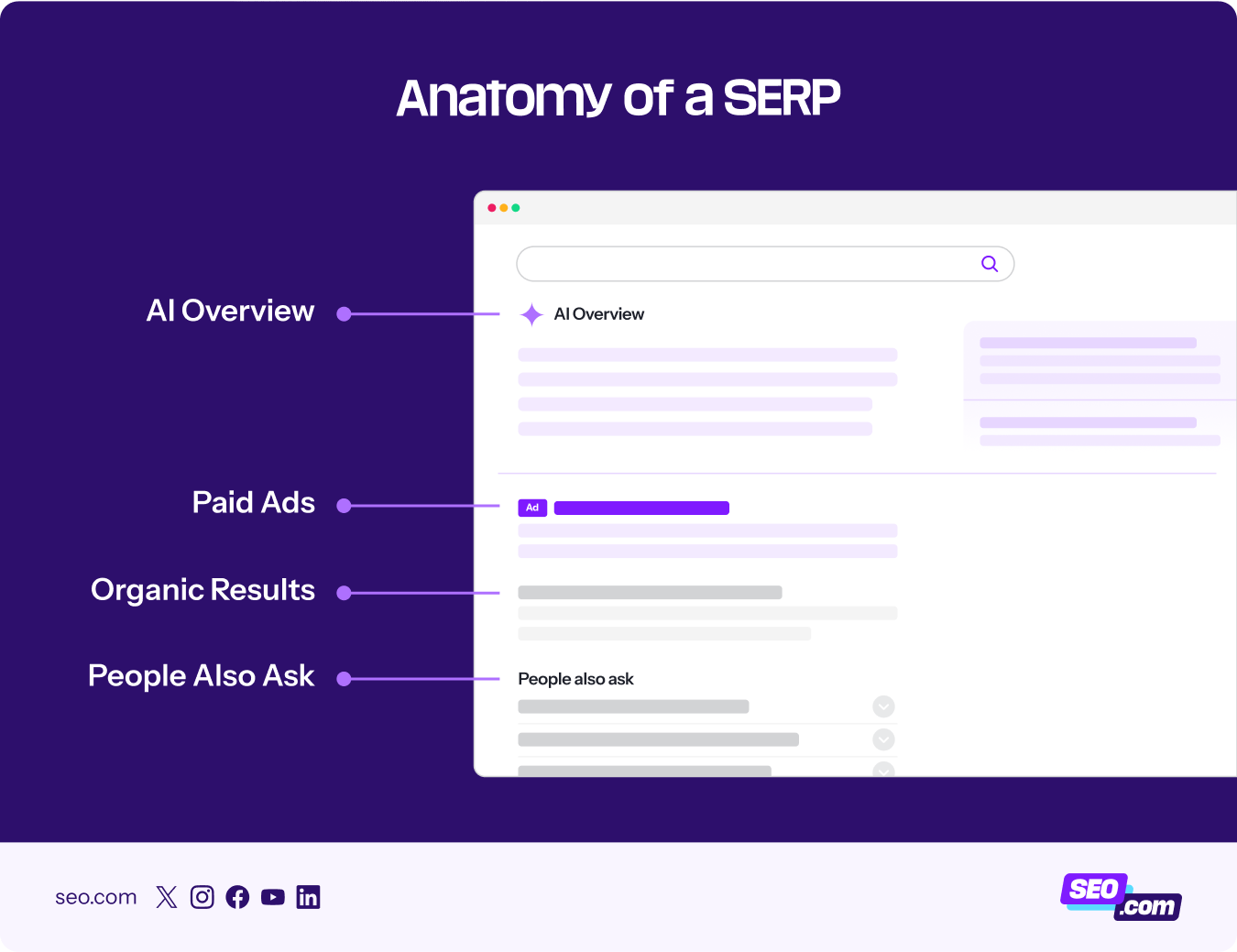
⚙️ How it works: Ranking happens in milliseconds and starts when a user enters a search query. Search engines respond by browsing their index. They look for the most relevant and high-quality content based on user and content factors, like the user’s device and the content’s title tag, and then generate results.
Ranking tools
The most common tools for ranking include:
| Tool | Purpose |
|---|---|
| Screaming Frog | Identify and prioritize SEO issues or opportunities |
| Google PageSpeed Insights | Identify opportunities for improving page speed |
| Keywords Everywhere | Research keyword targeting opportunities |
Ranking optimization
Webmasters can optimize their site through different types of search engine optimization (SEO) and their best practices, which include:
- Target specific search queries: Including relevant search queries in your content, like in your title tag, header tags, and written content, can help search engines gauge your content’s relevancy. Practicing keyword research can help you discover the most relevant queries to target.
- Optimize for geographic areas: A user’s location also influences content relevancy. For localized searches, like “los angeles restaurants” or “seo companies los angeles“, content focused on that topic and location will likely rank higher in search results. If this scenario applies to your site, target location-based queries.
- Write for search intent: Use the content ranking for your targeted search queries to find ways to improve your content. For example, answering additional questions or restructuring content based on a user’s most important to least important needs can help create a user-focused URL.
- Review search ranking factors: Search engines don’t publish their ranking factors, but they have confirmed several, like HTTPS, page speed, and content helpfulness, which you can use to optimize your content — our full ranking factors guide can help you get started.
Crawling and indexing optimizations are also critical here for SEO, so check and optimize your:
- Robots.txt file
- Sitemap
- Canonical tags
- Internal linking
- Meta tags
- Header tags
- Multimedia
- Content quality
- Website usability
Learn more about these SEO optimizations in-depth with our free SEO checklist!
Troubleshooting ranking issues
If you’re experiencing issues with ranking, try these troubleshooting tips:
- Evaluate search intent: Search intent (or what users seek when searching for something) can change over time. Compare your targeted query’s search results against your content and see if the intent has changed and made your content irrelevant.
- Investigate keyword metrics: Like search intent, search volume can also change. A free tool like Google Trends can help you see a keyword’s popularity over time and its potential impact on search results. A spike in popularity, for instance, can result in more competitive search results.
Crawling and indexing troubleshooting steps like the following are also relevant here:
- Audit your robots.txt file
- Fix your HTTP network errors
- Resolve your server errors
- Check your site for duplicate content
- Analyze your content’s quality
- Test your content’s usability
With the above troubleshooting tips, you can discover potential ranking issues.
4. Penalties
📚 Definition: Penalties are when search engines demote or remove a site from its index. Search engines penalize sites when they detect indexed content that violates the search engine’s spam policies or attempts to manipulate its index. Penalties are like a librarian removing a book from their library.
💡 Importance: Penalties are important because they help search engines maintain a reputable index, plus serve relevant and high-quality search results. Without penalties, search engines waste resources on crawling, indexing, and serving sites that manipulate their index or violate their policies.
⚙️ How it works: Search engines use automated systems, specialized team members, and search quality user reports to detect content that violates the search engine’s policies). If detected, search engines will issue a manual action against the site and/or serve the affected content lower or not at all in results.
Tools to search penalties
The most common tools for search penalties include:
| Tool | Purpose |
|---|---|
| Google Search Console | Understand a penalty and submit resolutions (for Google penalties) |
| Bing Webmaster Tools | Verify, understand, and submit resolution requests (for Bing penalties) |
Optimizations to avoid penalties
Webmasters can optimize their websites to prevent penalties by avoiding the following:
- Cloaking: Cloaking is when you present different content to search engines than to users. If you personalize your site, this spam practice does not apply to personalization because you have to cloak with the intent to manipulate search engines and users.
- Hidden text: Hidden text is when you add text search engines can see (but users can’t), like by having white text on a white background. Some webmasters use this black-hat SEO tactic to over-optimize content with keywords or internal links.
- Keyword stuffing: Keyword stuffing is when you insert keywords to the point of affecting readability. Proofread your content (or use a tool like Grammarly) to catch and remove keyword-stuffing instances.
- Link spam: Link spam is when you purchase external backlinks to your site. Build links to your website naturally by producing helpful content that speaks to the reader’s unique pain points and needs.
Review Google’s full spam policies to learn what not to do when working with search engines.
Troubleshooting penalties
If you’re experiencing issues with penalties, check out these troubleshooting tips:
- For confirmed penalties: Review the penalty’s provided documentation to understand why the penalty happened and how to fix it. If you receive a Google penalty, view Google Search Console (and its Manual Actions report) to begin the resolution process.
- For unconfirmed penalties: Evaluate your content with the earlier troubleshooting steps for indexing and ranking. Look for common causes of unconfirmed penalties, like keyword stuffing or purchased backlinks.
In extreme cases, your website can get banned from a search engine’s index, which you can’t fix. If you’re unfamiliar with troubleshooting and resolving penalties, consider investing in professional SEO services that specialize in handling them.
Achieve top rankings on search engines with SEO.com
Navigating the complexities of crawling, indexing, and ranking can be overwhelming. Let our team of SEO experts provide the knowledge, tools, and support you need to optimize your site. Contact us online today to get started!

SEO Services That Aren’t Cookie Cutter
Get an SEO strategy that’s tailored for your business, industry, and revenue goals.