At least 35 killed, 134 injured after 7.8-magnitude quake strikes southern Philippines (original) (raw)
Follow our live coverage here.
MANILA – A 7.8-magnitude earthquake struck southern Philippines on June 8, killing at least 35 people, collapsing buildings and sparking tsunami warnings across the region.
The quake struck south of General Santos, a city of about 720,000 near the southern tip of the Philippines, early in the morning, as schools were reopening after a long break.
It is the most powerful to rock the Philippines since 1976, and the strongest globally in 2026, based on data from the United States Geological Survey.
A series of powerful aftershocks rocked the country’s central and southern regions about two hours after the first quake, with the largest measuring 6.5 on the Richter scale.
Tremors were felt strongly in a dozen provinces and 420km away in the city of Manado on the Indonesian island of Sulawesi.
The Philippines mobilised military and disaster response teams, and the authorities were verifying preliminary reports of 35 people killed and 134 injured across the southern island of Mindanao, mostly from falling debris and landslides.
Videos posted to social media and verified by AFP showed a shopping centre with a Jollibee fast-food restaurant collapsing into rubble in General Santos City, in South Cotabato province, while a school building that officials said was unoccupied crumpled in another.
“Lord, it has really collapsed!... The building has really collapsed!” someone could be heard shouting as the school structure toppled.
In another video verified by AFP, young schoolchildren could be seen screaming in the arms of their teachers as the quake violently swayed them back and forth on the ground.
A flimsy metal structure could be seen collapsing in the background as the video uploaded to the school’s official Facebook page ended.
An accompanying caption said no one was under the structure when it fell.
Tsunami warnings were cancelled after more than six hours in southern Philippines, northern Indonesia and the Malaysian state of Sabah on Borneo island.
“They decided this because, while there were reports, the height of the tsunami wasn’t high enough to cause damage,” said Teresito Bacolcol, head of the Philippines’ seismology agency.
He said the highest wave measured was at 1.48m off the coast of Kiamba town, Sarangani province.
Philippine President Ferdinand Marcos Jr suspended classes across Mindanao island on what was to have been the first day of school, while calling on residents in coastal areas to evacuate immediately.
“Move to higher ground now. Do not wait,” he said. “Your life is more important than anything left behind.”
In Kiamba, a coastal town near the epicentre, about 50,000 residents had already done so.
“As of now, 80 per cent of the population has moved to higher ground,” Agripino Dacera, the regional disaster chief said. “All the villages along the coast were instructed to proceed to evacuation centres.”
The Philippines’ Education Ministry suspended classes in nearly 6,000 schools across the affected areas.
Local carriers Philippine Airlines and Cebu Pacific cancelled at least 17 flights on routes connecting the capital Manila and the central and southern cities of Cebu, Iloilo and General Santos.
The June 8 quake triggered evacuation warnings for coastal areas of neighbouring Indonesia and Malaysia, with both countries subsequently lifting their alerts.
The Japanese authorities issued a tsunami advisory for swathes of its Pacific coast, though waves that reached the country’s coast were reported to be no higher than 20cm.
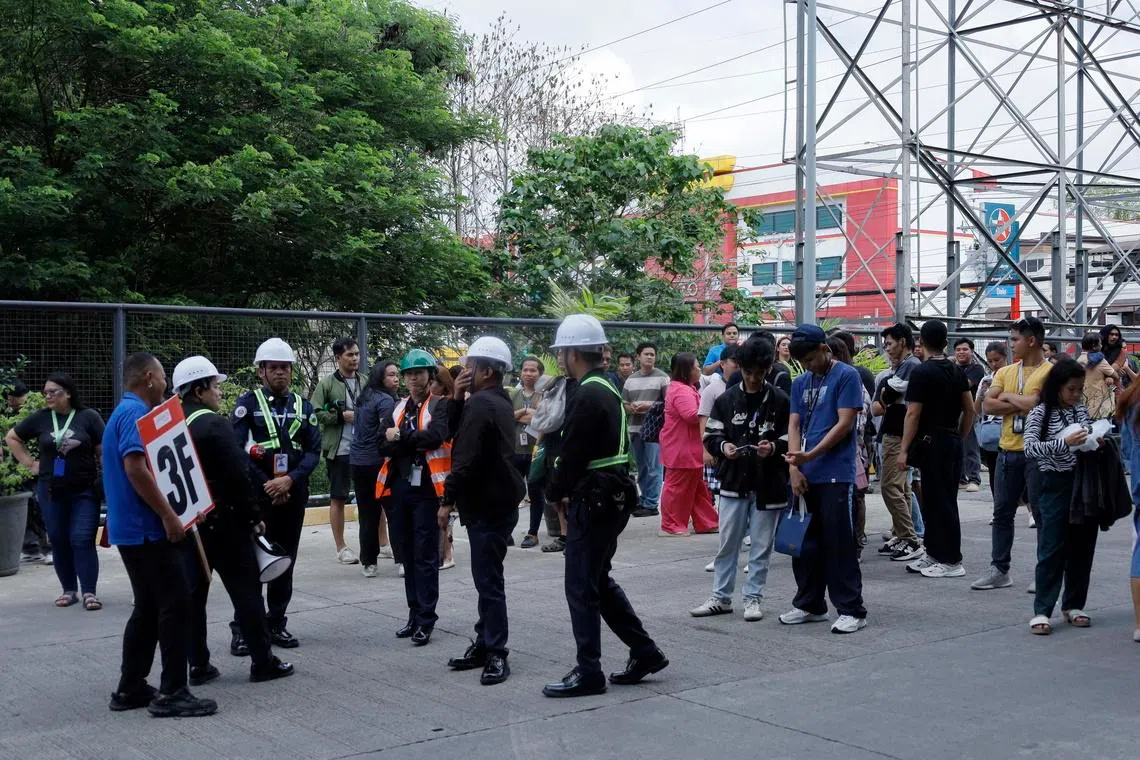
People gathering at an open space outside a commercial complex after an earthquake in Davao City, southern Philippines, on June 8.
PHOTO: EPA
Earthquakes are a near-daily occurrence in the Philippines, which is situated on the Pacific “Ring of Fire”, an arc of intense seismic activity stretching from Japan through South-east Asia and across the Pacific basin.
Eastern Mindanao was rocked by a pair of earthquakes of 7.4 and 6.7 magnitude in October 2025 that killed at least eight people.
These followed a 6.9-magnitude quake days earlier that killed 76 people and destroyed or damaged 72,000 houses in Cebu province in central Philippines, according to government figures. AFP