How to Audit Your Topical Authority (and What It Reveals About Your AI Citation Readiness) - The HOTH (original) (raw)
Most businesses with a few years of SEO behind them have more content than authority.
You can see it in the data: dozens of posts published, decent domain metrics, but rankings that plateau on anything competitive. The site is not failing, but it is not compounding either. Google is not treating it as the authority in the niche, even though it has covered the topic extensively.
The reason is almost always structural. Not quantity, but coherence. Topics covered shallowly. Clusters that point nowhere. Old posts that once supported a clear theme but have since drifted into adjacent territory. The foundation looks solid until you map it, and then the gaps are obvious.
What makes a topical authority audit worth doing right now, beyond the traditional SEO argument, is that the same audit reveals exactly where you stand on AI citation readiness. The gaps that prevent Google from treating you as a topical authority are the same gaps that prevent ChatGPT and Perplexity from citing you when someone asks a question in your category. One diagnostic, two channels improved.
This guide walks through the four-step process, including one step most audits miss entirely.
Why the Same Gaps Hurt You in Search and AI
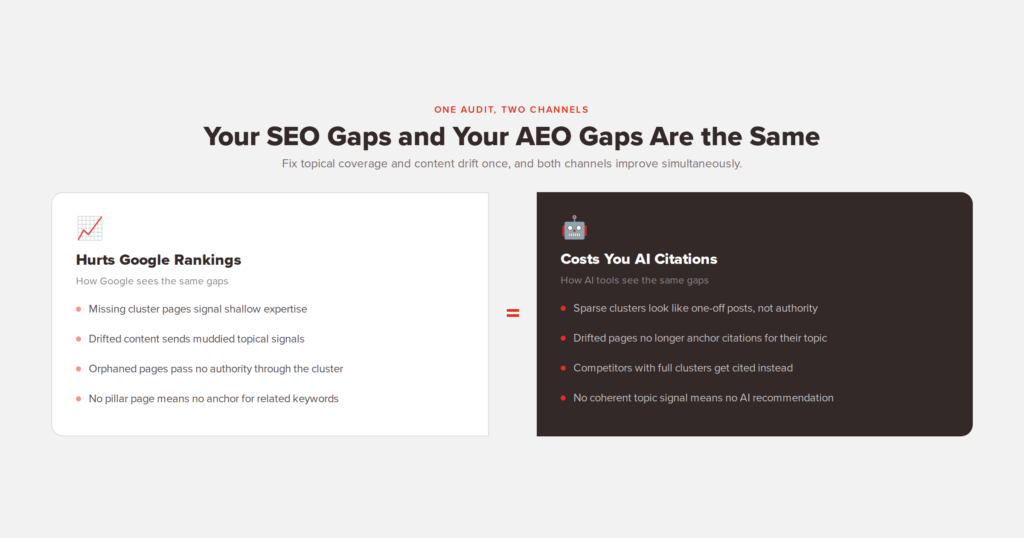
Google evaluates topical authority by looking at whether your site covers a subject with consistent depth, whether your content pieces connect logically to each other, and whether credible external sources have validated your expertise through backlinks and mentions. When those signals are in place, Google ranks you for related terms automatically, including ones you have not directly targeted.
AI tools use a nearly identical evaluation. When ChatGPT or Perplexity synthesizes an answer about a topic in your category, they look for sources that demonstrate coherent, sustained expertise. A site with one strong post on a topic looks like a coincidence. A site with a structured cluster that covers the topic from multiple angles looks like a genuine authority worth citing.
This parallel is not incidental. According to BrightEdge research, websites with author schema are 3x more likely to appear in AI answers, and pages updated within 60 days are 1.9x more likely to be cited. But none of those on-page signals matter much if the underlying topic coverage is fragmented. Freshness and schema amplify authority. They do not create it.
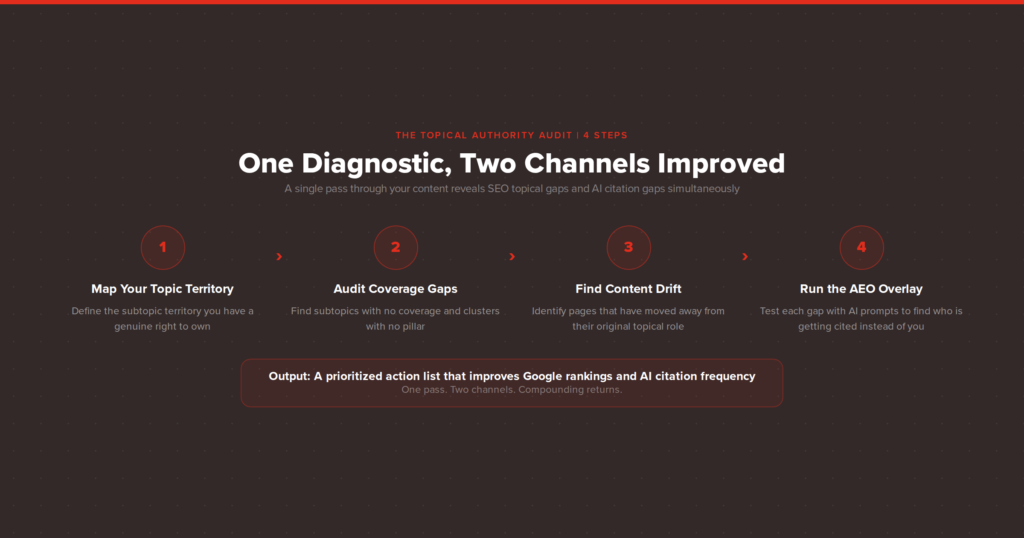
The four steps below identify where your coverage is coherent and where it is not. The findings apply directly to both channels.
Step 1: Map Your Topic Territory
Before you can audit your topical authority, you need a map of what you are actually trying to own. Most teams skip this and go straight to a keyword gap report, which is why their audits produce to-do lists instead of strategy.
Start by identifying 3 to 5 core topic areas your business has a genuine right to be authoritative on. Not every keyword with decent search volume: the subjects where your expertise is real and where your products or services are the natural outcome of a reader becoming well-informed.
For each core topic, sketch the subtopic territory: the supporting concepts, the related questions, the adjacent angles a thorough treatment would need to cover. This becomes your topic map: the full shape of what a true authority on this subject would have published.
You can build this manually using Search Console queries, People Also Ask boxes, and competitor content inventories. Or use a tool like the Ahrefs Content Gap, Semrush Topic Research, or keyword clustering software to accelerate the mapping. The output you want is a list of subtopics, not just keywords: the conceptual territory you are trying to own, not just the terms you want to rank for.
Step 2: Audit Your Coverage Gaps
With your topic map in hand, the next step is straightforward: inventory what you have and compare it to what the map says you should have.
Go through your existing content and tag each piece to a subtopic from your map. Look for two things: subtopics with no coverage at all, and subtopics covered by a single thin post that does not go deep enough to establish expertise.
Pay particular attention to structural gaps: missing pillar pages (broad, high-depth overviews that anchor a cluster), cluster pages that have no internal links connecting them to a pillar, and subtopics that exist on your site but are siloed from each other. A piece of content that does not link to anything related is not contributing to your topical authority, regardless of how well-written it is.
One of the clearest signals of a coverage gap is what the content gap analysis process reveals: competitor pages that rank well for subtopics in your category while your site has nothing targeting that angle. Those competitor rankings are a direct signal that Google has awarded topical authority in that area to someone else. In AI terms, that competitor is the one getting cited when those subtopics come up in prompts.
Step 3: Find Your Content Drift (the Gap Most Audits Miss)
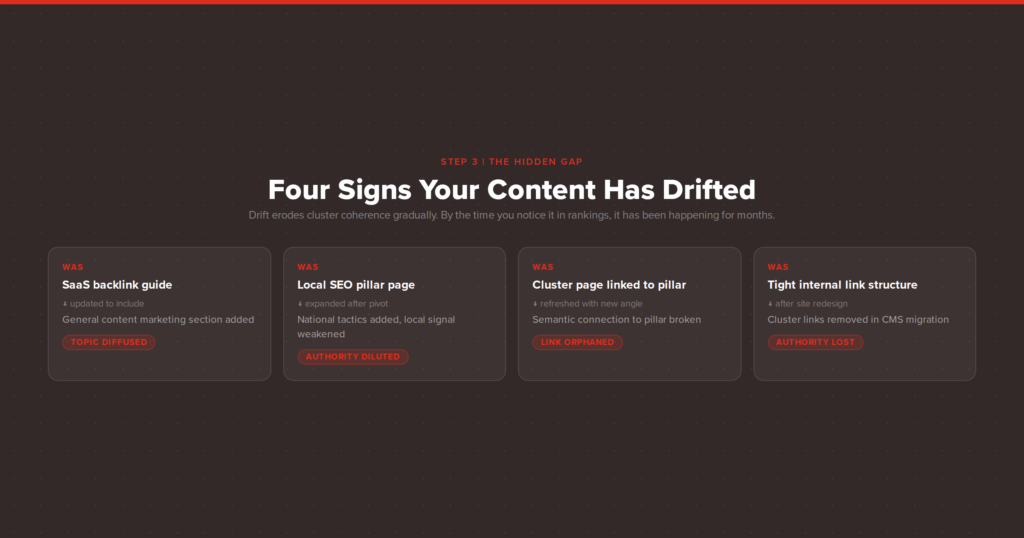
Coverage gaps are the obvious problem: topics your site should cover that it does not. Content drift is the hidden problem: topics your site used to cover coherently, but no longer does.
Content drift happens gradually. A pillar post gets updated by a new writer who adds sections on adjacent topics. A cluster page gets refreshed with new examples that pull it in a different direction. Product messaging shifts and the content gets updated to match, subtly changing what topic the page is actually about. None of these changes feel significant in isolation. Cumulatively, they erode the semantic coherence of the cluster.
From a search engine or AI perspective, a page that was once a strong topical signal for your cluster starts sending a muddier signal. It no longer reinforces the same semantic territory. The cluster loses some of the coherence that made it authoritative, and you often will not notice until rankings have already softened.
What content drift looks like in practice
- A post about “how to build backlinks for SaaS” gets updated to include a general section on content marketing, diffusing its topical focus
- A pillar page covering local SEO gets expanded with national tactics after a product pivot, weakening its role as a local-specific authority signal
- An older cluster page that linked tightly to your pillar gets refreshed with a new angle that no longer connects semantically to the pillar theme
- Internal links connecting your cluster get removed during a site redesign or CMS migration, orphaning pages that had built authority
To audit for drift manually, pull the original intent of each major page in your cluster (what topic was it clearly optimized for when first published?) and compare it to what the page actually covers today. Where there is significant divergence, drift has occurred.
For teams managing large or fast-growing content libraries, catching drift manually between quarterly audits is difficult. This is the problem that NextNet.AI is built to solve continuously. The platform’s real-time drift alerts monitor your content’s semantic vector alignment over time, flagging when a page starts moving away from the topical territory that made it an authority signal. Rather than discovering drift months later during an audit, you get alerted when it starts happening, which is the difference between a quick fix and a months-long recovery.
Step 4: Run the AEO Overlay
Once you have mapped your coverage gaps and identified your drift, the final step is to run the same findings through an AI citation lens. This is where the dual-channel value of the audit pays off.
For each coverage gap from Step 2, ask: if someone asked ChatGPT or Perplexity about this subtopic right now, who would get cited? Run the prompt and find out. Note which competitors appear. That is your AI share of voice gap on that subtopic, and it will persist until you close the content gap.
For each drift case from Step 3, ask: is the original topic intent still legible to an AI tool reviewing this page? A drifted page that no longer clearly signals its topical role will not anchor AI citations any better than it anchors search rankings. Restoring the original topical focus is not just an SEO fix: it is an AEO fix too.
The practical output of this overlay is a prioritized action list. Coverage gaps in topics where competitors are actively winning AI citations should move to the top. Drift cases on pillar pages should be addressed before cluster pages, since pillar drift cascades through the whole cluster. You can track progress using the framework from our post on how to measure SEO and AEO success in 2026, particularly the branded search lift and AI citation frequency metrics.
What Closing These Gaps Produces
Building topical authority, and keeping it coherent over time, produces compounding returns. One of The HOTH’s ecommerce clients came in with a solid internal content strategy already in place, but fragmented authority signals across the cluster. By supplementing their existing content with structured link outreach targeted at the authority gaps the audit revealed, they grew from 100 to 2,300 monthly visitors in seven months. The content was already there. The missing piece was the structural authority work that made Google treat the cluster as a coherent topical signal rather than a collection of individual posts.
The same principle applies to AI citations. AI tools do not cite individual pages in isolation. They cite sources that have demonstrated consistent, validated expertise across a topic. Closing coverage gaps and reversing content drift are how you become that source.
Getting Help With the Audit and the Gaps
A full topical authority audit takes time, and closing the gaps it reveals takes more. If you are running managed SEO with The HOTH, your campaign includes the content and link-building work that topical authority requires, with ongoing strategy to keep your clusters coherent as your site grows.
For the AI citation layer, AI Discover includes the Atlas dashboard for tracking where you are being cited and where competitors are winning citations you should be earning. Together, they cover both sides of the gap: the work to build topical authority, and the visibility data to confirm it is translating into AI citations.
If you want to start with a picture of where you currently stand, book a free AI Visibility Assessment. We will map your current position in AI search and identify which topical gaps are costing you the most citations.
The Bottom Line
A topical authority audit is not about finding more things to write. It is about identifying where your existing content is fragmented, where it has drifted from its original purpose, and where those structural weaknesses are costing you both search rankings and AI citations.
The four steps above, mapping your topic territory, auditing coverage gaps, finding content drift, and running the AEO overlay, give you a single diagnostic that improves visibility in both channels. Start with whatever slice of your content you can audit this quarter. The gaps are almost always visible once you are looking for them.
If you would like help turning your audit findings into an action plan, get in touch with our team.