China’s Digital Wallets Offer a Glimpse at the Future of Payments (original) (raw)
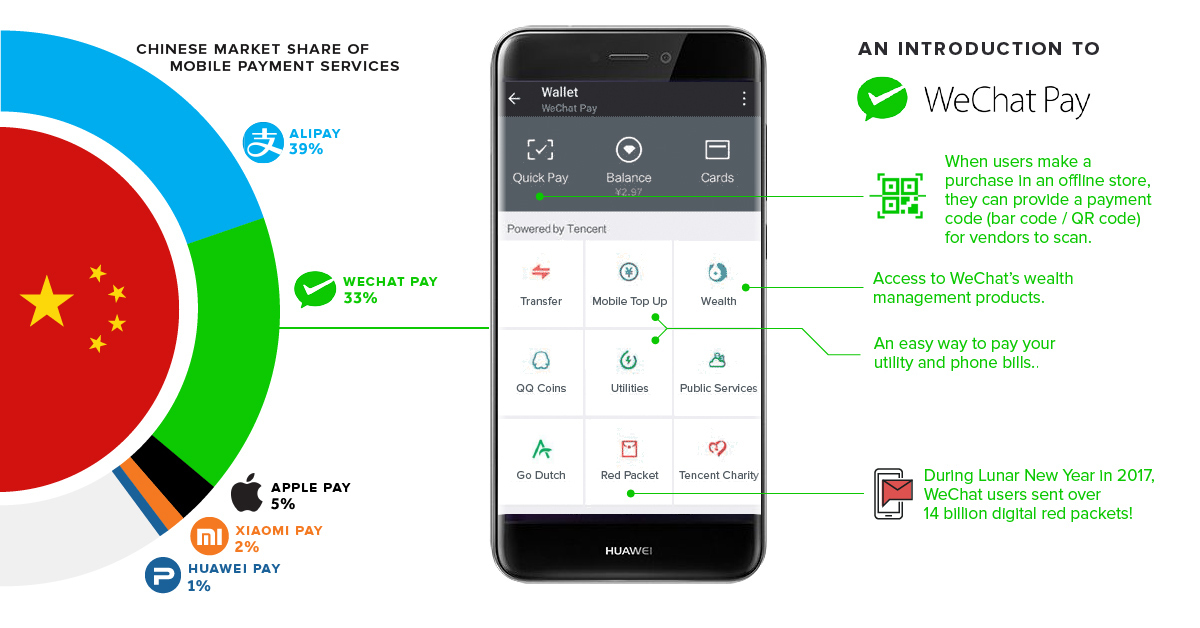
Chinese consumers conduct 11 times more mobile payments than their counterparts in the United States, so as we look to the future of digital wallets, China is a natural place to start.

Forecasts for mobile payment adoption in the United States remain flat for now; however, two major brands – WeChat and AliPay – offer a glimpse of what the future may eventually hold for mobile payments in North America.
Digging Through WeChat’s Wallet
WeChat, a platform owned by Tencent, is a force to be reckoned with. It’s fast closing in on one billion monthly active users (MAUs), and the average user spends over an hour on the app each day.
WeChat users aren’t just unusually chatty – there’s actually a high level of utility to the platform that North American apps have yet to match. WeChat’s wallet alone is packed with features ranging from mobile payments to ride hailing. Below is a look at just some of the features.
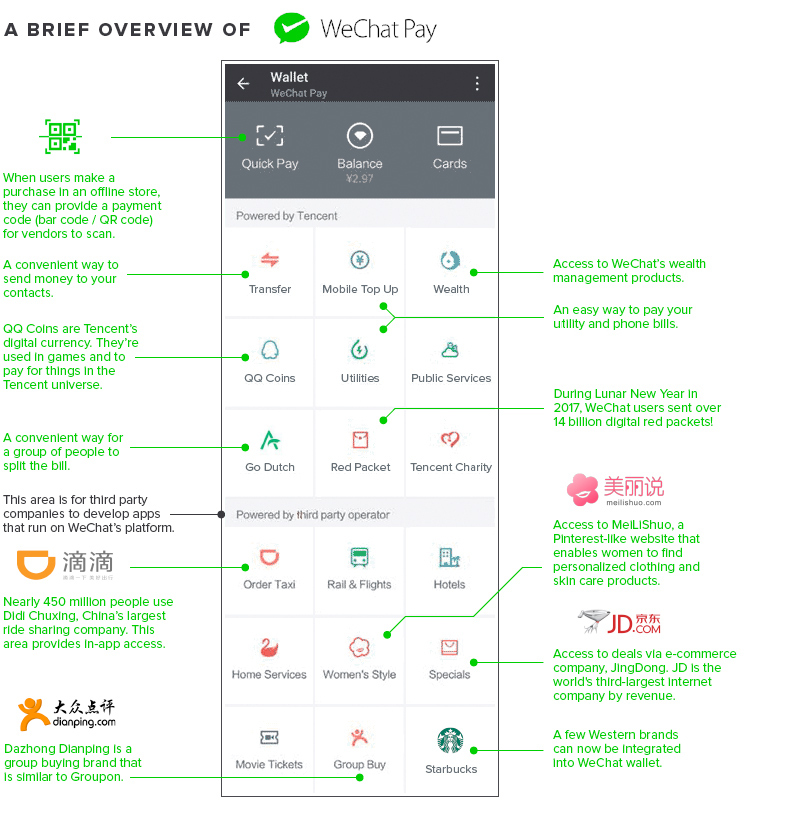
WeChat’s wallet is packed with features that are constantly evolving, but here are some current features worth noting:
Payments in the real world
“Scan-and-pay” is widely popular in China, particularly in big cities where it’s hard to find a product or a service that cannot be purchased with a mobile device. According to China Channel, over 90% of Chinese consumers have adopted WeChat as a method of payment in offline purchases. That compares with a 32% adoption rate for debit and credit cards.
Red Packets
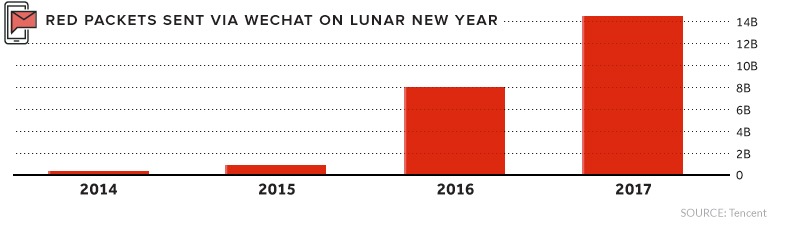
WeChat has seen tremendous growth of its wallet by capitalizing on China’s tradition of gifting cash-filled red envelopes (known as hongbao). In fact, the volume of digital red packets sent has skyrocketed from 16 million to 14.2 billion in only three years.
Digital Tip Jar
WeChat also offers a glimpse at a new avenue for content creators to monetize their hard work online. WeChat’s Tip Jar feature allows users to send micro-payments to writers, musicians, artists, and more.
Go Dutch
Splitting the bill in a busy restaurant or pub setting can be major hassle. “Go Dutch” is a feature that allows WeChat users to divvy up a bill and pay using the app. Features like Go Dutch make digital payments an appealing option because they solve a real world problem.
Third-Party Apps
WeChat has robust third-party integration within its wallet. Functionality is so deep that users can order anything from transportation to home cleaning services with the push of a button. China’s largest e-commerce, group buy, and ride hailing companies are already on these platforms, but Western brands like Starbucks are getting in on the action too.
Going Head-To-Head
The mobile payments sector is becoming increasingly binary as WeChat and AliPay dogfight for market share. AliPay – Ant Financial’s payment brand – was once the undisputed leader in mobile payments, but the company has recently seen its market share eroded by an increasingly scrappy WeChat. WeChat has smartly leveraged its popularity and massive user base to get people using it as a payment tool as well.
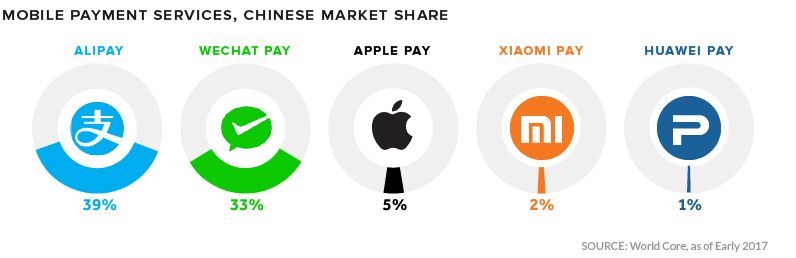
ApplePay, which had high hopes for the Chinese market, continues to lag far behind domestic brands.
Growing Pains for Digital Wallets
China’s central bank recently imposed tougher rules regarding scan-and-go payments, a move that Ant Financial and Tencent are publicly praising, but that may dampen the meteoric growth trajectory of mobile payments. The new regulations take aim at aggressive tactics used to capture market share from competitors, and set limits on how much consumers can spend daily using barcode-based payments.
Despite growing pains, mobile payments and digital wallets will continue to be a dominant part of the Chinese economy. The only question is, when will the rest of the world follow suit?
apps
Ranked: The Biggest Social Media Platforms in 2026
Billions of people use social media today. The biggest three platforms, however, are all owned by just one company.


Published
1 week ago
on
May 11, 2026

Ranked: The Biggest Social Media Platforms in 2026
See visuals like this from many other data creators on our Voronoi app. Download it for free on iOS or Android and discover incredible data-driven charts from a variety of trusted sources.
Key Takeaways
- Meta owns five of the world’s 15 largest social media platforms, including Facebook, Instagram, and WhatsApp.
- Facebook remains the world’s biggest social network with 3.1 billion monthly active users.
- Chinese-owned platforms TikTok, WeChat, and Douyin collectively reach over 4 billion users worldwide.
The world’s largest social media platforms now rival countries in scale, with several apps serving more than one billion monthly users.
This graphic highlights the world’s most popular social media platforms using 2026 data from Salesforce, which counts the number of monthly active users for each platform.
Facebook remains the world’s biggest social media platform with more than 3.1 billion monthly users, reflecting roughly 40% of the global population.
Meta Controls the World’s Largest Social Platforms
Facebook, created in 2004, is owned by Meta (formerly Facebook Inc.), one of the world’s largest companies by market capitalization.
Yet Meta’s dominance extends well beyond Facebook, as it also owns runners-up Instagram and WhatsApp (both 3 billion). Meta acquired Instagram for just $1 billion in 2012, and acquired WhatsApp two years later for nearly $20 billion.
The table below lists the 15 most popular social media platforms worldwide alongside their owners and monthly active users.
| Rank | Platform | Owner | Label |
|---|---|---|---|
| 1 | 🇺🇸 Meta | 3.1B | |
| 2 | 🇺🇸 Meta | 3B | |
| 3 | 🇺🇸 Meta | 3B | |
| 4 | YouTube | 2.5B | |
| 5 | TikTok | 🇨🇳 ByteDance | 2B |
| 6 | 🇨🇳 Tencent | 1.4B | |
| 7 | Messenger | 🇺🇸 Meta | 1B |
| 8 | Telegram | 🇦🇪 Telegram | 1B |
| 9 | Snapchat | 🇺🇸 Snap Inc. | 900M |
| 10 | 🇺🇸 Reddit Inc. | 850M | |
| 11 | Douyin | 🇨🇳 ByteDance | 755M |
| 12 | X (Twitter) | 🇺🇸 X Corp. | 650M |
| 13 | 🇺🇸 Pinterest Inc. | 578M | |
| 14 | Threads | 🇺🇸 Meta | 400M |
| 15 | 🇺🇸 Microsoft | 310M |
While Facebook is popular with people of all ages, Instagram has become especially popular among young adults and millennials. Meanwhile, WhatsApp has become the world’s most widely used messaging app and is essential for communication in countries like Brazil and India.
Beyond the Big 3, Meta also owns Messenger (1 billion), another popular messaging app integrated with Facebook, as well as Threads (400 million), an Instagram offshoot designed to compete with X and its roughly 650 million users.
China’s Emergence in Social Media
While most of the world’s top social media platforms have historically been American, Chinese companies have rapidly expanded their influence in recent years.
Within China itself, Tencent’s WeChat (1.4 billion) has become the country’s primary digital platform, extending beyond messaging to include payments, shopping, and gaming.
Then there’s ByteDance, which has reshaped the global social media landscape. The company created Douyin (755 million) for the Chinese market and its international counterpart TikTok (2 billion), which has become one of the world’s fastest-growing social platforms.
TikTok’s widespread popularity, especially among younger users, has also triggered regulatory scrutiny and restrictions in countries including India and the United States.
Following growing U.S. restrictions on TikTok, ByteDance agreed to enter a joint venture with American companies in 2025.
Social Media Has Expanded Beyond Networking
When social media first originated in the 2000s, it was designed for young adults to stay connected. Facebook famously wanted to put the entire college experience online. However, since then social media has extended far beyond its initial purpose.
YouTube (2.5 billion) is the largest video-sharing site in the world, while Reddit (850 million) has become a massive online forum for people to congregate around shared interests.
Finally, there’s LinkedIn (310 million). The social networking platform was acquired by Microsoft for over $26 billion in 2016 and is today a central hub for working professionals in various sectors to connect, network, and find or advertise jobs.
Learn More on the Voronoi App 
Is there a generational component? Find out with What are Gen Z’s Favorite Social Media Platforms? on Voronoi.Use This Visualization
Millennials
Mapped: Europe’s Social Media Gap by Country
An overwhelming majority of Europeans are on social media today. Germans and Italians, however, are more reluctant.

Published
2 weeks ago
on
May 2, 2026

Mapped: Europe’s Social Media Gap by Country
See visuals like this from many other data creators on our Voronoi app. Download it for free on iOS or Android and discover incredible data-driven charts from a variety of trusted sources.
Key Takeaways
- Social media use in Europe ranges from 56% in Italy to 90% in Denmark.
- Northern Europe leads adoption, with several countries above 80%.
- Germany (59%) and Italy (56%) trail the European average of 74%.
Social media use across Europe varies sharply by country, creating a clear gap between the continent’s most and least connected populations.
This map shows the share of adults active on social networking sites across Europe, based on 2025 data from Eurostat and Ofcom. Being “active” in this case involves creating a profile, posting messages, sharing, commenting, or otherwise contributing to a social networking site.
While adoption exceeds 80% in several northern countries, it drops to 56% in Italy and 59% in Germany, two of Europe’s largest economies. Overall, the European average sits at 74%, masking these wide differences in usage.
Northern Europe’s Social Media Craze
Northern Europe stands out as the region with the highest social media adoption rates.
Denmark leads the continent in social media use (90%), followed closely by Norway (89%). Sweden and the Baltic states of Estonia, Latvia, and Lithuania trail slightly behind in the 70–79% range.
This data table shows social media usage rates across European countries.
| Rank | Country | Social Media Use (% of Adults) |
|---|---|---|
| 1 | 🇩🇰 Denmark | 90 |
| 2 | 🇬🇧 UK | 89 |
| 3 | 🇳🇴 Norway | 89 |
| 4 | 🇨🇾 Cyprus | 87 |
| 5 | 🇲🇪 Montenegro | 84 |
| 6 | 🇲🇹 Malta | 82 |
| 7 | 🇫🇮 Finland | 81 |
| 8 | 🇳🇱 Netherlands | 81 |
| 9 | 🇹🇷 Turkey | 80 |
| 10 | 🇮🇪 Ireland | 80 |
| 11 | 🇷🇴 Romania | 80 |
| 12 | 🇱🇻 Latvia | 79 |
| 13 | 🇭🇺 Hungary | 79 |
| 14 | 🇲🇰 North Macedonia | 78 |
| 15 | 🇷🇸 Serbia | 76 |
| 16 | 🇸🇪 Sweden | 75 |
| 17 | 🇨🇭 Switzerland | 74 |
| 18 | 🇬🇷 Greece | 73 |
| 19 | 🇪🇪 Estonia | 73 |
| 20 | 🇧🇬 Bulgaria | 71 |
| 21 | 🇫🇷 France | 71 |
| 22 | 🇵🇹 Portugal | 71 |
| 23 | 🇱🇹 Lithuania | 70 |
| 24 | 🇨🇿 Czechia | 70 |
| 25 | 🇪🇸 Spain | 70 |
| 26 | 🇦🇹 Austria | 68 |
| 27 | 🇧🇪 Belgium | 68 |
| 28 | 🇱🇺 Luxembourg | 67 |
| 29 | 🇸🇮 Slovenia | 65 |
| 30 | 🇵🇱 Poland | 63 |
| 31 | 🇸🇰 Slovakia | 62 |
| 32 | 🇭🇷 Croatia | 62 |
| 33 | 🇩🇪 Germany | 59 |
| 34 | 🇮🇹 Italy | 56 |
Northern Europe’s high usage reflects early and widespread adoption of digital technologies.
Estonia, for example, has earned the moniker “e-Estonia” due to its tech-savvy society and government, while companies ranging from Finland’s Nokia to Sweden’s Spotify rank among Europe’s leading digital success stories.
Even with this reputation, some Scandinavian governments are considering social media bans for children. Denmark, as the continental leader in online activity, is weighing a ban on children’s creation of social media profiles before age 15, or 13–14 with parental consent.
Social Media in Western Europe
Western Europe has long included some of the continent’s most globalized countries. In 2005, university students in the United Kingdom were the first outside North America to join Facebook. Today, 89% of UK adults are active on social media.
However, beyond the UK, social media activity is more limited than in the Nordics. France counts 71% of its adult population on social networking sites, just ahead of Spain and Portugal (both 70%).
For their part, the Benelux countries show an interesting contrast: 81% of Dutch adults use social media, compared to 67–68% in Belgium and Luxembourg.
Italians: The Least Online Europeans
Italy has the lowest social media usage rate in Europe, with just 56% of adults active on social networks. This represents a gap of more than 30 percentage points compared to countries like Denmark, Norway, or the UK.
The contrast also appears generational, as over three-quarters of Italian teens self-report being addicted to their phones.
Germany (59%) is the only country near Italy’s low rate of social media usage. German society appears more divided on the benefits and drawbacks of social networking sites, with nearly half of surveyed Germans in 2025 saying they would rather live in a world without social media.
Learn More on the Voronoi App
To learn more about this topic, check out the What are Gen Z’s Favorite Social Media Platforms? on Voronoi.