The Boroughs’s Clarke Peters on Art’s Search and Crow Friend (original) (raw)
_The Boroughs_’s Clarke Peters Wants Art to Keep Seeking Answers (and Mushrooms)
By ,a Vulture TV critic who also covers film and pop culture. She is a juror for the Peabody Awards.
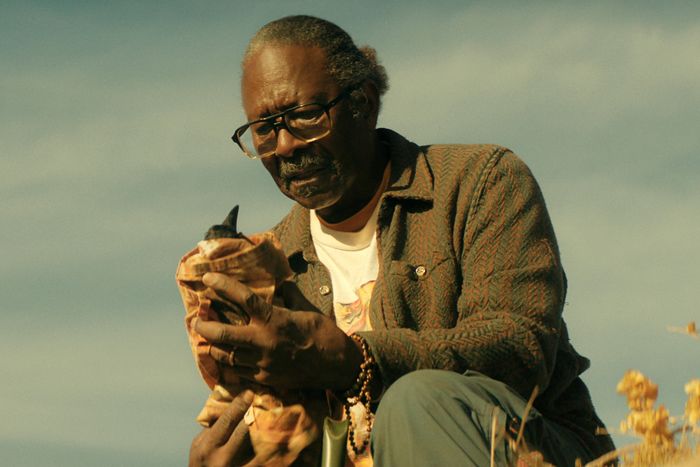
“I don’t think that Art is finished,” says Clarke Peters of a possible second season of The Boroughs. “What he saw with the crows and what he’s just experienced has whetted his appetite even more.”Photo: Netflix
Spoilers follow for all eight episodes of The Boroughs_, which premiered on Netflix on May 21._
When Clarke Peters talks about Art Daniels, the former radical, current drug enthusiast and spiritual seeker he plays on The Boroughs, he tends to slip into the third person. He’ll talk about how Clarke relates to Art, or what Clarke and Art have in common, and it’s a reveal of how personal this role became for the longtime actor. At first, Peters turned The Boroughs down: “Someone had likened it to Stranger Things, and having seen a little bit of Stranger Things, I thought, At my age, I don’t want to be chasing monsters for the next five years,” Peters says with a laugh. But then the scripts started coming in. “What attracted me to Art was his outlook and his exploration into the psyche, the mysteries of life. That resonates with Clarke,” Peters says. “I knew I could at least bring some truth to his dialogue and to his experience. And when we started shooting and I was introduced to a crow, I thought, Oh man, I’m on my way now, and I don’t mind chasing monsters until I’m 80.”
Peters has been a fixture on the big and small screens for nearly 50 years and was a particular standout in his collaborations with David Simon (The Wire and Treme) and Spike Lee (Red Hook Summer and Da 5 Bloods). He’s adept at playing characters who are proud, persistent, curious, and a little rascally, and Peters brings all that to Art, a roguish, well-read philosopher who grows his own strains of marijuana and mushrooms and is often the sounding board for his friends’ problems. But at home, there’s distance between Art and his wife, Judy (Alfre Woodard), who’s secretly having an affair with their next-door neighbor Jack (Bill Pullman), and the tension between the pair drives their arc over the season’s eight episodes. So, too, does the fact that Art keeps having odd experiences: He watches thousands of crows organize themselves into a murmuration, then kill themselves by flying into the ground; he eats a peach that temporarily restores his health and erases years of his life; and he glimpses the decayed face of the villainous Anneliese Shaw (Alice Kremelberg), the woman who owns the Boroughs community with her husband.
The Shaws have for decades kept captive a mysterious creature they named Mother (Nancy Daly), allowing its children to drink the brain fluid of their senior-citizen residents in order to help extend their own unnaturally long lives. When Art and his friends, including new neighbor Sam (Alfred Molina), realize what the Shaws are up to, they come together to save Mother and destroy the Shaws. The Boroughs hasn’t yet been renewed, but Art’s knowledge about the crows and the peach tree remain useful for a potential season two, Peters says. “In the last episode, there was a little glitch as Alfie was looking at something. I’d like to know where that little glitch is going to lead us to,” he adds. “I don’t think I can go much further than that without breaching some NDA.”
Tell me about how Art’s questioning of the world around him resonated with you.
I’ve always been inquisitive. My mother was telling me that when I was a child, I was always asking questions, and I needed to have some answers. I would get upset if I didn’t get them. I think that that certainly followed me into adolescence and being part of American society and looking at what was happening in the African American community. And when I say “African American community,” I think I need to redefine that into, “the community of melanated peoples in America.” When we say “African Americans,” we’re forgetting about all the other dark-skinned people who were indigenous to this country. All of that is still very much a part of me. And I think that is also what Art is looking at in his exploration of his mushrooms and everything else, and why I think he can accept the journey that he’s about to go on, because it appears to answer some questions that Clark has probably had in his life for the past 70 some odd years.
Art is friends with a crow named Brooksy. Tell me everything about working with Brooksy. Crows are very intelligent, right?
They are very intelligent. There were two Brooksys, and they did different things. One was good at retrieving, and the other was good at swooping down and getting close to you. At the end of meeting them and playing with them for a day, I figured if I’m gonna have a pet, it should definitely be a bird. You’re a bit wary at the beginning because that beak can be a weapon — and I did not know how smart this bird was. I don’t want him landing on my head or putting his claws into my shoulders. But their trainer was well aware of what they could do. And there’s something about working with animals, again, that satisfies my curiosity as well as Art’s. We’ve moved so far away from nature, and yet birds are around us every day. We have no relationship with them, except maybe [when we] throw some crumbs, or tell them to get away from the table, or hear them laughing, like seagulls. So meeting and spending a little time with this bird, about 20 minutes, it still resonates with me. There’s something about a crow that I like.
There’s one version of who Art is with Judy, and a version of Art with Brooksy, to whom he shares his thoughts about his marriage and about his life.
I think we’re all like that naturally. There’s a part of you that walks through consciousness, and then there’s a part of you that is conscious. As we move through life, if one is observant, you see that those who are just walking through consciousness, without being aware of themselves being conscious, you have a different relationship with. Those who might go to church every Sunday or meditate or find time to walk through nature, you have a different relationship with them; you vibrate differently with people like that. So the delineation that happens is, my wife has been with me through thick and thin, and I have not been totally in her world. I have accepted that she is moving through consciousness without being conscious herself, and that’s where she’s decided to go off and have the affair. That aspect of her was not being satisfied or addressed. This is something we all do. If you have children, your relationship with your children is different from the relationship with your partner. And that relationship with your partner is different from your relationship with your parents. We are multifaceted in that respect, and I think that Clark brings that to Art in trying to understand him.
Midway through the season, Art finds a peach tree growing in an abandoned mine. When he touches the peach, its juice heals a wound on his hand, which is why he decides to take a larger bite, but I was like, You just found this random tree buried in a mine!
I was saying the same thing, believe me. I was saying, “Wait a second. After all this man’s gone through, he sees this, and he’s just gonna put it in his mouth? Oh no.”
Then there’s an entertaining montage of all the things Art is now able to do post-peach. He stops a robbery, he’s dancing, he’s excelling at golf, he’s swimming. How did you change your performance physically to convey what Art is going through?
One of the choices was made for us, which was to change the makeup. The other choice was to make sure that I was more active, or that my mannerisms were more energized than anything else. I have to say, Roxana, that at this age, it’s sometimes hard to get energized on take four. [Laughs.] But those were the choices; the hair, being lighter in the body, making sure that the eyes are open and not wearing the glasses or the hearing aids.
Was there a part of the montage that was easiest for you to get energized about?
Swimming. And fortunately, a lot of that is on the cutting-room floor, so to speak, because I was really clowning around underwater. And then I thought, Okay, that’s enough. [Laughs.]
We need the extended cut. Art goes through a de-aging process after eating the peach. And although earlier, he wanted to share his otherworldly experiences with someone, when Anneliese starts questioning him, he immediately lies to her. He instinctively doesn’t trust her. Tell me about that.
There’s something about Anneliese that just does not feel right. In the script, that’s quite legitimate — for Art to remain guarded. And it’s only then that I begin to chase a monster. “Where’s my wife?” The first thing he asks for is his wife. He’s extremely vulnerable and scared, which is why he wants to get the hell out of there. The person who finds the extra layer of life might broadcast it immediately but then might figure, Wait a second, why are all these people coming to me? We’ve already seen, in our short lives, the amount of people who’ve come up with wonderful scientific discoveries that could serve humanity, who are no longer here, who have disappeared. The one that’s probably most in the collective consciousness is Nikola Tesla. This isn’t news. The man offered something to the world, and then when he died, all of his information and findings disappeared. Art is aware of the road he’s walking.
At the end of the season, Mother has healed Judy. Do you see Art and Judy as staying together?
I’m hoping there will be a healing, because all the cards are on the table now. He has had an epiphany of seeing something other that has broadened his perspective. And hopefully Judy, having gone through what she’s gone through, will understand that. He’s a bigger person at the end, and with what he has experienced is able to accommodate and support someone who is just finding out that there’s other dimensions to life than meets the eye.
If there were a season two, what would you like to see Art get up to? Is he going to harvest the mushrooms? Is he going to make another crow friend?
I wouldn’t mind going back to the mushrooms, and one reason is because now we are beginning to use mushrooms in society as medicine. I would like to continue that conversation, and I would like to explore deeper the relationship between Art and his wife and follow how that unfolds. Something that I put to our showrunners was, when Anneliese swallows the whole seed, and then she regurgitated it, what happened to the seed? I would like to explore that. I don’t think that Art is finished. What he saw with the crows and what he’s just experienced has whetted his appetite even more.
Peters says he also took the job to work with Molina again, after they first worked together 35 years ago on the crime series El C.I.D.: “I haven’t seen Alfredo for a while.
_The Boroughs_’s Clarke Peters Wants Art to Keep Searching https://pyxis.nymag.com/v1/imgs/415/0c8/bbfe0d017f02c6cd9b32167874ca75e487-clarkesilo.png Your product is saved! You’ll receive emails when your saved products go on sale. Manage preferences.