The Ansoff Matrix: A Strategic Framework for Business Growth (original) (raw)
Every growth decision a leadership team makes sits somewhere on two axes: familiar versus new markets, familiar versus new products. The Ansoff Matrix makes that grid explicit, and attaches a risk profile to each quadrant before you commit.
That's the value of this strategic planning framework. Not as a planning template, but as a forcing function. It stops leadership teams from defaulting to the growth strategy they're most comfortable with and asks: given what we know about our capabilities, our markets, and our risk tolerance, which growth path actually makes sense?
The four strategies and what they cost you
The Ansoff Matrix is built on two axes: products (existing or new) and markets (existing or new). The four combinations produce four growth strategies, each with a meaningfully different risk profile.
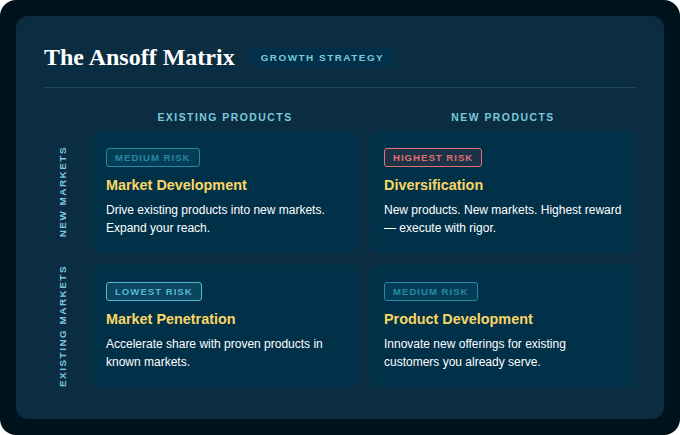
Market penetration (lowest risk)
More of what you already do, sold to the people who already buy from you. Increased marketing spend, better pricing, improved retention, expanded distribution. The risk is low because you're operating on known ground. The ceiling is also lower because you're not creating new demand, you're capturing more of what already exists.
Market development (moderate risk)
Your existing product or service, taken to a new customer segment or geography. The product works. What you don't yet know is whether it works for a different buyer, in a different context, with different distribution requirements. The execution challenge is significant and the upside is real.
Product development (moderate to high risk)
New offerings for your existing customer base. You know the market. You don't yet know if the new product will land. R&D costs, time to market, and the ever-present risk that customers who trust you for one thing may not follow you into another.
Diversification (highest risk)
New products for new markets. Both the customer and the product are unfamiliar. This is the strategic bet that requires the most rigorous pressure-testing before commitment, because there's no existing relationship or capability base to fall back on if the bet goes wrong.
The matrix doesn't tell you which strategy to pursue. It tells you what you're taking on when you choose one.
When the Ansoff Matrix earns its place
Use it when growth has plateaued and leadership needs a structured conversation about which direction to move.
Use it when you're evaluating a new market entry or product launch and need to be honest about the risk level before resources are committed.
Use it when you're allocating across multiple growth initiatives and need a common language for comparing risk-reward trade-offs.
And use it when the board or investors are asking about growth strategy. The four quadrants give you a clear, defensible framework for explaining the logic behind your choices.
In practice: Unilever's growth strategy across all four quadrants
Unilever is one of the world's largest consumer goods companies, with leading brands across home care, personal care, and nutrition. It has explicitly used Ansoff logic to manage its global portfolio across all four quadrants simultaneously, while executing their strategy with WorkBoardAI. It's one of the clearest real-world examples of what disciplined, multi-quadrant growth strategy looks like when it's actually working.
Market penetration
In Europe and North America, Unilever's market penetration play has been consistent: optimize distribution, drop underperforming SKUs, expand in-stock positions in key grocery and e-commerce channels, and introduce value-pack and refill formats to drive higher volume per household in detergents, personal care, and food. The products are proven, the supply chain exists, and the retail relationships are in place. Low risk, bounded upside, but it generates the cash that funds everything else.
Market development
The market development bet is emerging markets, particularly India, Indonesia, Nigeria, and Kenya. Hindustan Unilever's Project Shakti is the most documented example: micro-entrepreneurs were embedded in rural communities to distribute small-pack sizes of soap, shampoo, and detergent, reaching households that traditional retail infrastructure never could.
Similar distribution-partnership models followed across Sub-Saharan Africa. The core products were unchanged. The entire strategic challenge was operational: adapting supply chain, pricing, and go-to-market for lower-income households and fragmented retail environments.
Moderate risk but Unilever wasn't reinventing what it sold, only how it reached new buyers.
Product development
On product development, Unilever's health-and-wellness repositioning is the clearest example. Household care brands like OMO and Sunlight were reformulated around eco-friendly ingredients, reduced plastic, and concentrated formulas. These are premium variants targeted at the same loyal base.
Nutrition lines expanded into plant-based products: Hellmann's plant-based mayo, plant-based ice cream, and healthier condiment variants. The company knew these customers. The open question was always whether its brand equity transferred into the new health-conscious positioning, and whether the innovation pace could match the speed at which consumer behavior was moving.
Moderate to high risk: the brand is an asset but not a guarantee.
Diversification
The diversification bets sit in functional nutrition: personalized nutrition, gut-health products, and scientifically-backed wellness claims like probiotics and weight-management offerings. These categories grow faster than traditional FMCG but require new R&D capabilities, different regulatory pathways, and retail relationships in pharmacies, online health channels, and specialty stores.
Unilever treats each move here as a considered bet with defined investment thresholds and minimum revenue and margin targets before full-scale commitment. The highest-risk quadrant gets the most scrutiny, because diversification without discipline is precisely where large organizations tend to destroy value.
The result of applying Ansoff explicitly: Unilever's leadership allocates resources across all four quadrants because each has a different risk-return profile that can be compared directly. That discipline prevents two failure modes:
- Over-concentrating in safe, mature-market moves at the expense of future growth
- Chasing high-growth adjacencies without a threshold for pulling back
How to run an Ansoff analysis
1. Map your current position honestly
Before evaluating growth options, build a clear picture of where you actually stand — which products are gaining, which are mature, which markets you own and which you're underperforming in. Growth strategy built on an inflated view of current position will consistently underdeliver.
2. Assess each quadrant against your real capabilities
The Ansoff Matrix's risk levels are averages. Your actual risk in any quadrant depends on what you bring to it — brand equity, supply chain capability, customer relationships, technological advantage. A market development move is low risk for a company with strong international infrastructure and high risk for one without it. Be specific about what you have and what you'd need to build.
3. Translate the chosen strategy into measurable commitments
The output of an Ansoff analysis should be a set of decisions about where to invest, what outcomes to expect, and how you'll know whether it's working. Each growth path needs OKRs attached: specific key results, clear ownership, and a quarterly cadence for assessing whether the bet is paying off.