What Is a Balanced Scorecard? A Strategic Framework to Drive Organizational Performance (original) (raw)
Financial results are lagging indicators. By the time they show up in your quarterly report, the decisions that caused them were made months ago. The Balanced Scorecard is built on exactly that insight: Managing a business by financial metrics alone is like driving by looking in the rearview mirror.
Developed by Robert Kaplan and David Norton in the early 1990s, the Balanced Scorecard is a strategic planning framework that gives leadership teams a structured way to manage performance across four perspectives simultaneously: financial outcomes, customer impact, internal process efficiency, and the organizational capability that makes all three possible. The financial results follow. But you have to manage the drivers first.
The four perspectives and their connection
The Balanced Scorecard is a one integrated view of how an organization creates value over time. Each perspective feeds the next.
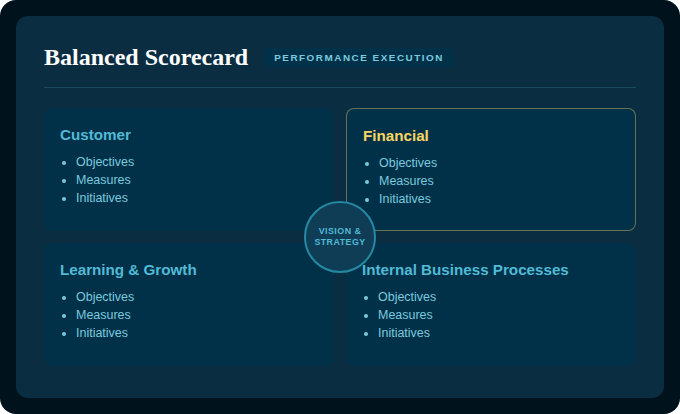
Financial
Revenue growth, profitability, return on investment, margin performance. These are the outcomes shareholders and boards care about most. They are also the lagging indicators that reflect every other decision the organization makes. The BSC doesn't minimize financial performance. It clarifies what has to happen upstream to sustain it.
Customer
How customers perceive your organization, measured in satisfaction scores, retention rates, net promoter score, and market share. Customer outcomes drive financial outcomes. If customer perception is deteriorating, financial results will follow. That will show usually in the next one to three quarters.
Internal processes
The operational capabilities that deliver value to customers like quality, cycle time, innovation rate, regulatory compliance, delivery efficiency. Process performance determines whether your customer-facing promises are actually kept. It's the execution layer between intent and outcome.
Learning and growth
Employee capability, engagement, and the organizational capacity to change. This is the foundation of everything above it. Organizations that underinvest in capability development eventually find their internal processes degrading, their customer outcomes declining, and their financial performance following suit. The BSC makes this investment visible and accountable.
Within each perspective, the BSC uses three components: objectives (what you're trying to achieve), measures (how you'll know if it's working), and initiatives (the specific actions driving improvement).
When the Balanced Scorecard is the right framework
The BSC earns its place in organizations where lagging financial metrics alone have proven insufficient. When the leadership knows something upstream is breaking down but can't see it clearly enough to act.
Use it when you need to translate a long-term strategy into measurable quarterly performance across multiple dimensions.
Use it when organizational alignment is weak, resulting in different functions optimizing for different outcomes, with no shared understanding for what the organization is actually trying to achieve.
Use it when non-financial drivers of performance are being systematically neglected like customer satisfaction drifting, employee capability not keeping pace with the strategy, operational quality eroding.
And use it when board and investor reporting demands a more complete performance picture than financial statements provide.
What the BSC is not: a substitute for execution discipline. It tells you what to measure. Strategy execution software is what keeps those measurements connected to the operating cadence that drives them.
In practice: AXA's shift from product sales to advisory model
AXA is one of the world's largest insurance groups. The company made a strategic bet that long-term value required moving away from commission-driven product sales toward a fee-based, advice-led model in markets like France, Germany, and the UK. The financial case was clear. The organizational change required to get there was not captured in any financial metric. The Balanced Scorecard is what made the transition legible and manageable.
Financial perspective
AXA set explicit targets to increase fee-based and recurring-premium revenue while reducing reliance on one-off commission sales. Incentive structures were rewritten so advisors earned more from ongoing management fees than from product commissions. The financial outcomes like shifting revenue mix and improving margin, were the consequence of the change, not the starting point. Tracking them as the only measure of progress would have told leadership nothing useful for the first two years of the transition.
Customer perspective
Moving from transactional to advisory required a fundamentally different client relationship. AXA tracked NPS, retention rates, and average premium per household — a proxy for relationship depth. In Germany and France, advisors were rewarded for completing holistic financial-protection plans rather than policies sold. Early data showed higher NPS and lower churn in branches that adopted advisory norms. All that before any revenue shift was visible.
These were the leading indicators that the strategy was landing.
Internal processes perspective
The operational transformation required advisors to behave differently: more planning sessions, longer conversations, scenario-based thinking rather than product brochures. AXA tracked the share of clients with completed financial and life-planning files, time from client acquisition to first advisory recommendation, and cross-product penetration. These were used as indicators of whether relationships were deepening, or not.
New digital tools were rolled out so advisors could run income, longevity, and healthcare cost projections in client conversations. These process metrics became the leading indicators of whether the strategy was actually changing behavior at the branch level.
Learning and growth perspective
AXA's advisor base had been trained for commission-driven product sales. The advisory model demanded a different skillset: needs analysis, listening, behavioral coaching, digital tool proficiency. AXA built structured certification tracks aligned to an advisory competency model, tracking training completion rates, simulated advisory-session scores, and engagement levels in advisory roles.
Where capability development was strong, advisors reported higher satisfaction and lower burnout. They felt like consultants, not like salespeople. Where it lagged, revenue-mix targets stalled. The causal relationship was visible and direct: capability investment preceded every other performance improvement.
The result: AXA's experience makes the BSC causal chain concrete.
- Invest in advisor capability.
- Change daily client interactions.
- Improve trust and retention.
- Shift the revenue mix.
Leadership could see, for example, that in regions where training completion and financial-planning coverage rates were strong, NPS and fee-based revenue targets followed two years later. In regions that lagged on capability, teams kept falling back into product-pushing mode, regardless of how clearly the strategy had been communicated.
How to build and use a Balanced Scorecard
1. Define objectives across all four perspectives
Start with your strategy and work backwards. What financial outcomes does it require? What customer outcomes make those financial outcomes possible? What internal processes need to work for customers to have those outcomes? What capability investments are required to sustain those processes?
Each perspective's objectives should be traceable to the ones above and below it.
2. Assign measures and set targets
For each objective, identify the specific metric that will tell you whether you're on track, and the target that defines what "on track" means. Resist the temptation to over-measure. The power of the BSC is focus: a small number of high-signal metrics per perspective, reviewed consistently, is far more useful than a comprehensive dashboard nobody acts on.
3. Connect measures to initiatives and owners
Each measure needs a clear improvement initiative behind it and an owner accountable for driving it. A BSC without ownership is just a reporting exercise. The initiatives are what make the scorecard an operating tool rather than a presentation layer. And they should connect directly to the OKRs your teams are executing against every quarter.