Ndebele speaking countries (original) (raw)

Spread of the Ndebele language
Ndebele is one of eleven official languages in South Africa and is also spoken by parts of the population in the surrounding countries.
With a distribution of 16% and 2.7 million people, it has its largest share in Zimbabwe. In total, Ndebele has around 4.1 million first-language speakers.
Origin and development of the language
The Ndebele language is also known as "isiNdebele" or "Sindebele" and belongs to the Nguni languages in the group of Bantu languages. Ndebele originated during the migration of peoples in the early 19th century through the separation of the Nguni peoples from present-day South Africa. Around 1830, Mzilikazi, a former general of the Zulu king Shaka, led his followers away from Zulu territories to what is now Zimbabwe to escape the conflicts and dominance of the Zulu. This marked the geographical and cultural separation that contributed to the development of the Ndebele language as we know it today. During this migration, the Ndebele intermarried with other peoples living in the region, which contributed to linguistic diversification.
In Zimbabwe, the language continued to develop independently and became a central feature of Ndebele cultural identity. In South Africa, the language is spoken by the Ndebele people in the provinces of Limpopo, Mpumalanga and Gauteng. In both countries, however, it has adopted different dialects and influences. In Zimbabwe in particular, it has retained influences from other Shona dialects.
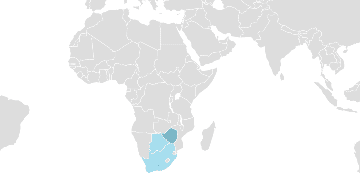
Unless otherwise described in the text, this page is about native speakers — not the total number of speakers. How many people understand or speak Ndebele as a subsequently learned language is not the subject of this page. Countries where native speakers make up only a few thousand, or even a few hundred people, or countries with a percentage well below 1% are unlikely to be listed here.
Official language, national language or lingua franca: explanation of frequently used terms