Debugging C++ Coroutines — Clang 22.0.0git documentation (original) (raw)
- Introduction
- Debugging generators
- Async stack traces
- Known issues & workarounds for older LLDB versions
- Toolchain Implementation Details
- Resources
Introduction
Coroutines in C++ were introduced in C++20, and the user experience for debugging them can still be challenging. This document guides you on how to most efficiently debug coroutines and how to navigate existing shortcomings in debuggers and compilers.
Coroutines are generally used either as generators or for asynchronous programming. In this document, we will discuss both use cases. Even if you are using coroutines for asynchronous programming, you should still read the generators section, as it introduces foundational debugging techniques also applicable to the debugging of asynchronous programs.
Both compilers (clang, gcc, …) and debuggers (lldb, gdb, …) are still improving their support for coroutines. As such, we recommend using the latest available version of your toolchain.
This document focuses on clang and lldb. The screenshots showlldb-dapin combination with VS Code. The same techniques can also be used in other IDEs.
Debugging clang-compiled binaries with gdb is possible, but requires more scripting. This guide comes with a basic GDB script for coroutine debugging.
This guide will first showcase the more polished, bleeding-edge experience, but will also show you how to debug coroutines with older toolchains. In general, the older your toolchain, the deeper you will have to dive into the implementation details of coroutines (such as their ABI). The further down you go in this document, the more low-level, technical the content will become. If you are on an up-to-date toolchain, you will hopefully be able to stop reading earlier.
Debugging generators
One of the two major use cases for coroutines in C++ is generators, i.e., functions which can produce values via co_yield. Values are produced lazily, on-demand. For this purpose, every time a new value is requested, the coroutine gets resumed. As soon as it reaches a co_yield and thereby returns the requested value, the coroutine is suspended again.
This logic is encapsulated in a generator type similar to this one:
// generator.hpp #include
// generator is a stripped down, minimal generator type.
template
struct generator {
struct promise_type {
T current_value{};
auto get_return_object() {
  return std::coroutine_handle<promise_type>::from_promise(*this);
}
auto initial_suspend() { return std::suspend_always(); }
auto final_suspend() noexcept { return std::suspend_always(); }
auto return_void() { return std::suspend_always(); }
void unhandled_exception() { __builtin_unreachable(); }
auto yield_value(T v) {
  current_value = v;
  return std::suspend_always();
}
};
generator(std::coroutine_handle h) : hdl(h) { hdl.resume(); } ~generator() { hdl.destroy(); }
generator& operator++() { hdl.resume(); return this; } // resume the coroutine T operator() const { return hdl.promise().current_value; }
private: std::coroutine_handle hdl; };
We can then use this generator class to print the Fibonacci sequence:
#include "generator.hpp" #include
generator fibonacci() { co_yield 0; int prev = 0; co_yield 1; int current = 1; while (true) { int next = current + prev; co_yield next; prev = current; current = next; } }
template void print10Elements(generator& gen) { for (unsigned i = 0; i < 10; ++i) { std::cerr << *gen << "\n"; ++gen; } }
int main() { std::cerr << "Fibonacci sequence - here we go\n"; generator fib = fibonacci(); for (unsigned i = 0; i < 5; ++i) { ++fib; } print10Elements(fib); }
To compile this code, use clang++ --std=c++23 generator-example.cpp -g.
Breakpoints inside the generators
We can set breakpoints inside coroutines just as we set them in regular functions. For VS Code, that means clicking next the line number in the editor. In the lldb CLI or in gdb, you can use b to set a breakpoint.
Inspecting variables in a coroutine
If you hit a breakpoint inside the fibonacci function, you should be able to inspect all local variables (prev, current, next) just like in a regular function.
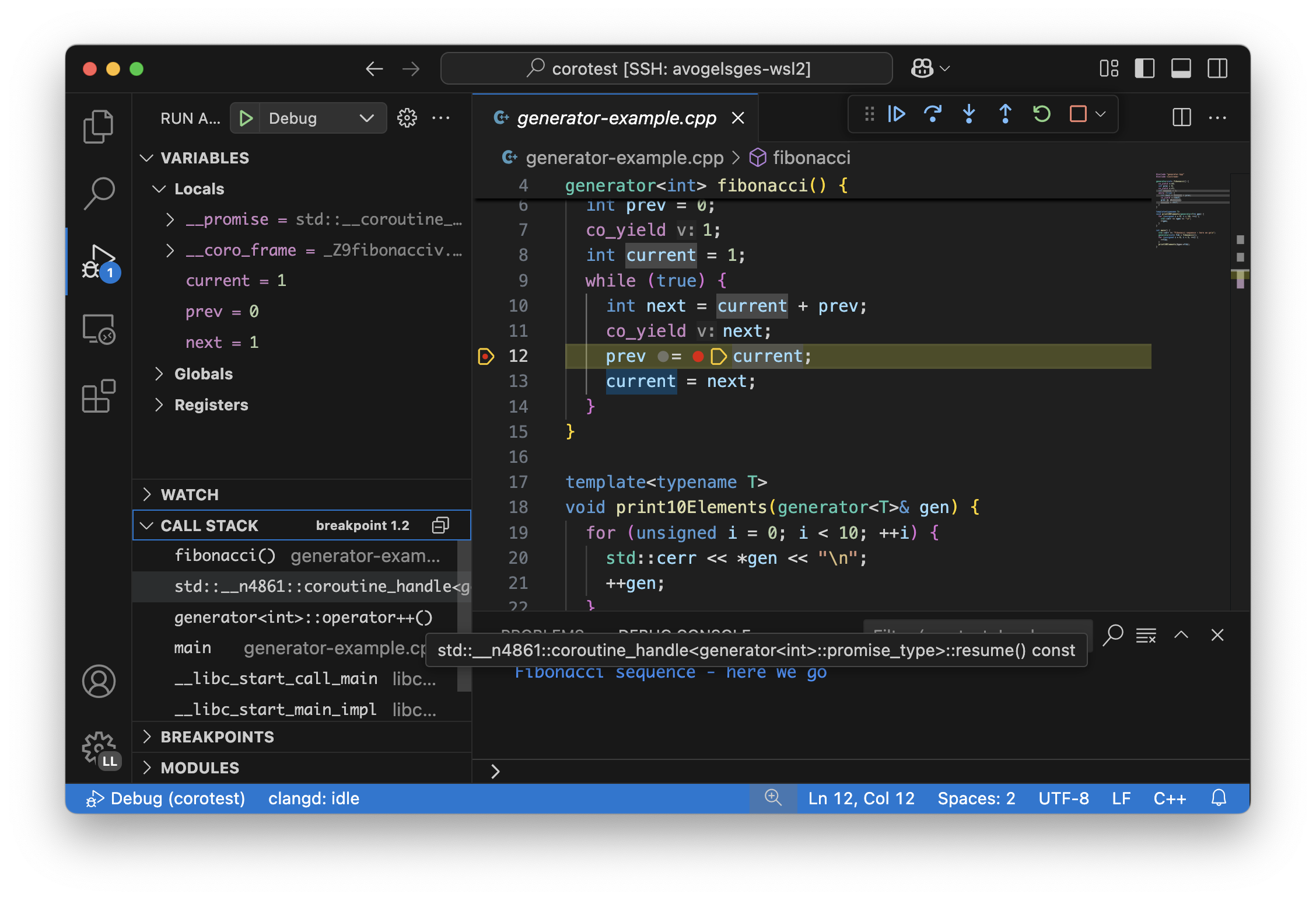
Note the two additional variables __promise and __coro_frame. Those show the internal state of the coroutine. They are not relevant for our generator example but will be relevant for asynchronous programming described in the next section.
Stepping out of a coroutine
When single-stepping, you will notice that the debugger will leave thefibonacci function as soon as you hit a co_yield statement. You might find yourself inside some standard library code. After stepping out of the library code, you will be back in the main function.
Stepping into a coroutine
If you stop at ++fib and try to step into the generator, you will first find yourself inside operator++. Stepping into the handle.resume() will not work by default.
This is because lldb does not step into functions from the standard library by default. To make this work, you first need to run settings set target.process.thread.step-avoid-regexp "". You can do so from the “Debug Console” towards the bottom of the screen. With that setting change, you can step through coroutine_handle::resume and into your generator.
You might find yourself at the top of the coroutine at first, instead of at your previous suspension point. In that case, single-step and you will arrive at the previously suspended co_yield statement.
Inspecting a suspended coroutine
The print10Elements function receives an opaque generator type. Let’s assume we are suspended at the ++gen; line and want to inspect the generator and its internal state.
To do so, we can simply look into the gen.hdl variable. LLDB comes with a pretty printer for std::coroutine_handle which will show us the internal state of the coroutine. For GDB, the pretty printer is provided by a script, see GDB Debugger Script for setup instructions.
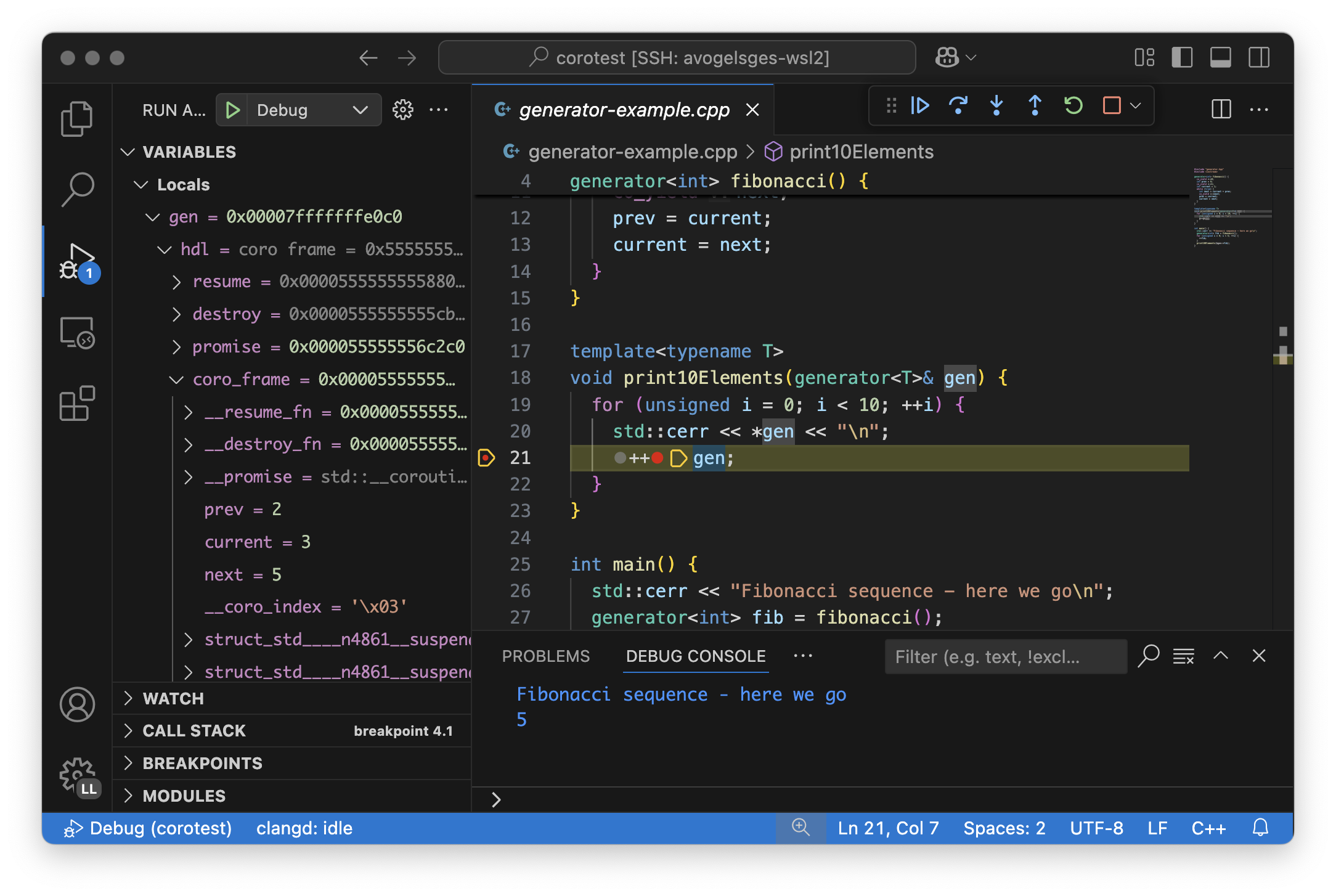
We can see two function pointers resume and destroy. These pointers point to the resume / destroy functions. By inspecting those function pointers, we can see that our generator is actually backed by our fibonaccicoroutine. When using VS Code + lldb-dap, you can Cmd+Click on the function address (0x555... in the screenshot) to jump directly to the function definition backing your coroutine handle.
Next, we see the promise. In our case, this reveals the current value of our generator.
The coro_frame member represents the internal state of the coroutine. It contains our internal coroutine state prev, current, next. Furthermore, it contains many internal, compiler-specific members, which are named based on their type. These represent temporary values which the compiler decided to spill across suspension points, but which were not declared in our original source code and hence have no proper user-provided name.
Tracking the exact suspension point
Among the compiler-generated members, the __coro_index is particularly important. This member identifies the suspension point at which the coroutine is currently suspended. However, it is non-trivial to map this number back to a source code location.
For GDB, the provided GDB Debugger Script already takes care of this and provides the exact line number of the suspension point as part of the coroutine handle’s summary string. Unfortunately, LLDB’s pretty-printer does not support this, yet. Furthermore, those labels are only emitted starting with clang 21.0.
When debugging with LLDB or when using older clang versions, we will have to use a different approach.
For simple cases, you might still be able to guess the suspension point correctly. Alternatively, you might also want to modify your coroutine library to store the line number of the current suspension point in the promise:
// For all promise_types we need a new _coro_return_address variable:
class promise_type {
...
void* _coro_return_address = nullptr;
};
// For all the awaiter types we need: class awaiter { ... template attribute((noinline)) auto await_suspend(std::coroutine_handle handle) { ... handle.promise()._coro_return_address = __builtin_return_address(0); } };
This stores the return address of await_suspend within the promise. Thereby, we can read it back from the promise of a suspended coroutine and map it to an exact source code location. For a complete example, see the tasktype used below for asynchronous programming.
Alternatively, we can modify the C++ code to store the line number in the promise type. We can use std::source_location to get the line number of the await and store it inside the promise_type. In the debugger, we can then read the line number from the promise of the suspended coroutine.
// For all the awaiter types we need: class awaiter { ... template void await_suspend(std::coroutine_handle handle, std::source_location sl = std::source_location::current()) { ... handle.promise().line_number = sl.line(); } };
The downside of both approaches is that they come at the price of additional runtime cost. In particular, the second approach increases binary size, since it requires additional std::source_location objects, and those source locations are not stripped by split-dwarf. Whether the first approach is worth the additional runtime cost is a trade-off you need to make yourself.
Async stack traces
Besides generators, the second common use case for coroutines in C++ is asynchronous programming, usually involving libraries such as stdexec, folly, cppcoro, boost::asio, or similar libraries. Some of those libraries already provide custom debugging support, so in addition to this guide, you might want to check out their documentation.
When using coroutines for asynchronous programming, your library usually provides you with some task type. This type usually looks similar to this:
// async-task-library.hpp #include #include
struct task { struct promise_type { task get_return_object() { return std::coroutine_handle::from_promise(*this); } auto initial_suspend() { return std::suspend_always{}; }
void unhandled_exception() noexcept {}

auto final_suspend() noexcept {
  struct FinalSuspend {
    std::coroutine_handle<> continuation;
    auto await_ready() noexcept { return false; }
    auto await_suspend(std::coroutine_handle<> handle) noexcept {
      return continuation;
    }
    void await_resume() noexcept {}
  };
  return FinalSuspend{continuation};
}

void return_value(int res) { result = res; }

std::coroutine_handle<> continuation = std::noop_coroutine();
int result = 0;
#ifndef NDEBUG
void* _coro_suspension_point_addr = nullptr;
#endif
};
task(std::coroutine_handle handle) : handle(handle) {} ~task() { if (handle) handle.destroy(); }
struct Awaiter { std::coroutine_handle handle; auto await_ready() { return false; }
template <typename P>
#ifndef NDEBUG
__attribute__((noinline))
#endif
auto await_suspend(std::coroutine_handle<P> continuation) {
  handle.promise().continuation = continuation;
  #ifndef NDEBUG
  continuation.promise()._coro_suspension_point_addr = __builtin_return_address(0);
  #endif
  return handle;
}
int await_resume() {
  return handle.promise().result;
}
};
auto operator co_await() { return Awaiter{handle}; }
int syncStart() { handle.resume(); return handle.promise().result; }
private: std::coroutine_handle handle; };
Note how the task::promise_type has a member variablestd::coroutine_handle<> continuation. This is the handle of the coroutine that will be resumed when the current coroutine is finished executing (seefinal_suspend). In a sense, this is the “return address” of the coroutine. It is set inside operator co_await when another coroutine calls our generator and awaits for the next value to be produced.
The result value is returned via the int result member. It is written inreturn_value and read by Awaiter::await_resume. Usually, the result type of a task is a template argument. For simplicity’s sake, we hard-coded theint type in this example.
Stack traces of in-flight coroutines
Let’s assume you have the following program and set a breakpoint inside thewrite_output function. There are multiple call paths through which this function could have been reached. How can we find out said call path?
#include #include #include "async-task-library.hpp"
static task write_output(std::string_view contents) { std::cout << contents << "\n"; co_return contents.size(); }
static task greet() { int bytes_written = 0; bytes_written += co_await write_output("Hello"); bytes_written += co_await write_output("World"); co_return bytes_written; }
int main() { int bytes_written = greet().syncStart(); std::cout << "Bytes written: " << bytes_written << "\n"; return 0; }
To do so, let’s break inside write_output. We can understand our call-stack by looking into the special __promise variable. This artificial variable is generated by the compiler and points to the promise_type instance corresponding to the currently in-flight coroutine. In this case, the__promise variable contains the continuation which points to our caller. That caller again contains a promise with a continuation which points to our caller’s caller.
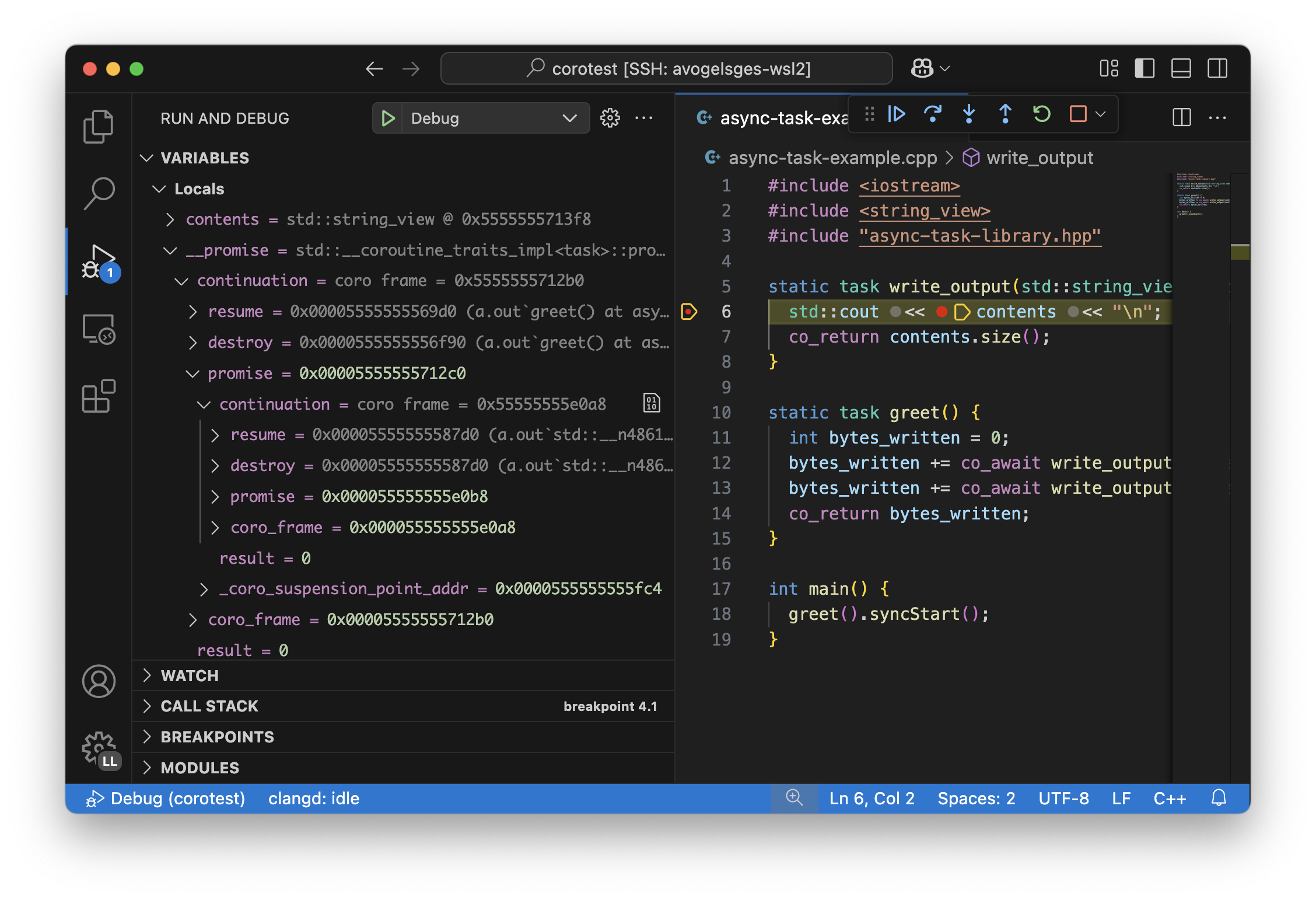
We can figure out the involved coroutine functions and their current suspension points as discussed above in the “Inspecting a suspended coroutine” section.
When using LLDB’s CLI, the command p --ptr-depth 4 __promise might also be useful to automatically dereference all the pointers up to the given depth.
To get a flat representation of that call stack, we can use a debugger script, such as the one shown in the LLDB Debugger Script section. With that script, we can run coro bt to get the following stack trace:
(lldb) coro bt frame #0: write_output(std::basic_string_view<char, std::char_traits>) at /home/avogelsgesang/Documents/corotest/async-task-example.cpp:6:16 [async] frame #1: greet() at /home/avogelsgesang/Documents/corotest/async-task-example.cpp:12:20 [async] frame #2: std::__n4861::coroutine_handlestd::__n4861::noop_coroutine_promise::__frame::__dummy_resume_destroy() at /usr/include/c++/14/coroutine:298, suspension point unknown frame #3: std::__n4861::coroutine_handletask::promise_type::resume() const at /usr/include/c++/14/coroutine:242:29 frame #4: task::syncStart() at /home/avogelsgesang/Documents/corotest/async-task-library.hpp:78:14 frame #5: main at /home/avogelsgesang/Documents/corotest/async-task-example.cpp🔞11 frame #6: __libc_start_call_main at sysdeps/nptl/libc_start_call_main.h:58:16 frame #7: __libc_start_main_impl at csu/libc-start.c:360:3 frame #8: _start at :4294967295
Note how the frames #1 and #2 are async frames.
The coro bt command already includes logic to identify the exact suspension point of each frame based on the _coro_suspension_point_addr stored inside the promise.
Stack traces of suspended coroutines
Usually, while a coroutine is waiting for, e.g., an in-flight network request, the suspended coroutine_handle is stored within the work queues inside the IO scheduler. As soon as we get hold of the coroutine handle, we can backtrace it by using coro bt <coro_handle> where <coro_handle> is an expression evaluating to the coroutine handle of the suspended coroutine.
Keeping track of all existing coroutines
Usually, we should be able to get hold of all currently suspended coroutines by inspecting the worker queues of the IO scheduler. In cases where this is not possible, we can use the following approach to keep track of all currently suspended coroutines.
One such solution is to store the list of in-flight coroutines in a collection:
inline std::unordered_set<std::coroutine_handle> inflight_coroutines; inline std::mutex inflight_coroutines_mutex;
class promise_type { public: promise_type() { std::unique_lockstd::mutex lock(inflight_coroutines_mutex); inflight_coroutines.insert(std::coroutine_handle::from_promise(*this)); } ~promise_type() { std::unique_lockstd::mutex lock(inflight_coroutines_mutex); inflight_coroutines.erase(std::coroutine_handle::from_promise(*this)); } };
With this in place, it is possible to inspect inflight_coroutines from the debugger and rely on LLDB’s std::coroutine_handle pretty-printer to inspect the coroutines.
This technique will track all coroutines, also the ones which are currently awaiting another coroutine, though. To identify just the “roots” of our in-flight coroutines, we can use the coro in-flight inflight_coroutinescommand provided by the LLDB Debugger Script.
Please note that the above is expensive from a runtime performance perspective, and requires locking to prevent data races. As such, it is not recommended to use this approach in production code.
Known issues & workarounds for older LLDB versions
LLDB before 21.0 did not yet show the __coro_frame insidecoroutine_handle. To inspect the coroutine frame, you had to use the approach described in the Devirtualization of coroutine handles section.
LLDB before 18.0 hid the __promise and __coro_framevariables by default. The variables are still present, but they need to be explicitly added to the “watch” pane in VS Code or requested viaprint __promise and print __coro_frame from the debugger console.
LLDB before 16.0 did not yet provide a pretty-printer forstd::coroutine_handle. To inspect the coroutine handle, you had to manually use the approach described in the Devirtualization of coroutine handlessection.
Toolchain Implementation Details
This section covers the ABI as well as additional compiler-specific behavior. The ABI is followed by all compilers, on all major systems, including Windows, Linux, and macOS. Different compilers emit different debug information, though.
Ramp, resume and destroy functions
Every coroutine is split into three parts:
- The ramp function allocates the coroutine frame and initializes it, usually copying over all variables into the coroutine frame
- The resume function continues the coroutine from its previous suspension point
- The destroy function destroys and deallocates the coroutine frame
- The cleanup function destroys the coroutine frame but does not deallocate it. It is used when the coroutine’s allocation was elided thanks toHeap Allocation Elision (HALO)
The ramp function is called by the coroutine’s caller, and available under the original function name used in the C++ source code. The resume function is called via std::coroutine_handle::resume. The destroy function is called via std::coroutine_handle::destroy.
Information between the three functions is passed via the coroutine frame, a compiler-synthesized struct that contains all necessary internal state. The resume function knows where to resume execution by reading the suspension point index from the coroutine frame. Similarly, the destroy function relies on the suspension point index to know which variables are currently in scope and need to be destructed.
Usually, the destroy function calls all destructors and deallocates the coroutine frame. When a coroutine frame was elided thanks to HALO, only the destructors need to be called, but the coroutine frame must not be deallocated. In those cases, the cleanup function is used instead of the destroy function.
For coroutines allocated with [[clang::coro_await_elidable]], clang also generates a .noalloc variant of the ramp function, which does not allocate the coroutine frame by itself, but instead expects the caller to allocate the coroutine frame and pass it to the ramp function.
When trying to intercept all creations of new coroutines in the debugger, you hence might have to set breakpoints in the ramp function and its .noallocvariant.
Artificial __promise and __coro_frame variables
Inside all coroutine functions, clang / LLVM synthesize a __promise and__coro_frame variable. These variables are used to store the coroutine’s state. When inside the coroutine function, those can be used to directly inspect the promise and the coroutine frame of the own function.
The ABI of a coroutine
A std::coroutine_handle essentially only holds a pointer to a coroutine frame. It resembles the following struct:
template struct coroutine_handle { void* __coroutine_frame = nullptr; };
The structure of coroutine frames is defined as
struct my_coroutine_frame {
void (__resume)(coroutine_frame); // function pointer to the resume function
void (__destroy)(coroutine_frame); // function pointer to the destroy function
promise_type promise; // the corresponding promise_type
... // Internal coroutine state
}
For each coroutine, the compiler synthesizes a different coroutine type, storing all necessary internal state. The actual coroutine type is type-erased behind the std::coroutine_handle.
However, all coroutine frames always contain the resume and destroyfunctions as their first two members. As such, we can read the function pointers from the coroutine frame and then obtain the function’s name from its address.
The promise is guaranteed to be at a 16-byte offset from the coroutine frame. If we have a coroutine handle at address 0x416eb0, we can hence reinterpret-cast the promise as follows:
print (task::promise_type)*(0x416eb0+16)
Implementation in clang / LLVM
The C++ Coroutines feature in the Clang compiler is implemented in two parts of the compiler. Semantic analysis is performed in Clang, and coroutine construction and optimization take place in the LLVM middle-end.
For each coroutine function, the frontend generates a single corresponding LLVM-IR function. This function uses special llvm.coro.suspend intrinsics to mark the suspension points of the coroutine. The middle end first optimizes this function and applies, e.g., constant propagation across the whole, non-split coroutine.
CoroSplit then splits the function into ramp, resume and destroy functions. This pass also moves stack-local variables which are alive across suspension points into the coroutine frame. Most of the heavy lifting to preserve debugging information is done in this pass. This pass needs to rewrite all variable locations to point into the coroutine frame.
Afterwards, a couple of additional optimizations are applied before code gets emitted, but none of them are really interesting regarding debugging information.
For more details on the IR representation of coroutines and the relevant optimization passes, see Coroutines in LLVM.
Emitting debug information inside CoroSplit forces us to generate insufficient debugging information. Usually, the compiler generates debug information in the frontend, as debug information is highly language specific. However, this is not possible for coroutine frames because the frames are constructed in the LLVM middle-end.
To mitigate this problem, the LLVM middle end attempts to generate some debug information, which is unfortunately incomplete, since much of the language-specific information is missing in the middle end.
Devirtualization of coroutine handles
Figuring out the promise type and the coroutine frame type of a coroutine handle requires inspecting the resume and destroy function pointers. There are two possible approaches to do so:
- clang always names the type by appending
.coro_frame_tyto the linkage name of the ramp function. - Both clang and GCC add the function-local
__promiseand__coro_framevariables to the resume and destroy functions. We can lookup their types and thereby get the types of promise and coroutine frame.
In general, the second approach is preferred, as it is more portable.
To do so, we look up the types in the destroy function and not the resume function because the resume function pointer will be set to a nullptr as soon as a coroutine reaches its final suspension point. If we used the resume function, devirtualization would hence fail for all coroutines that have reached their final suspension point.
LLDB comes with devirtualization support out of the box, as part of the pretty-printer for std::coroutine_handle. For GDB, a similar pretty-printer is provided by the GDB Debugger Script.
Interpreting the coroutine frame in optimized builds
The __coro_frame variable usually refers to the coroutine frame of an_in-flight_ coroutine. This means the coroutine is currently executing. However, the compiler only guarantees the coroutine frame to be in a consistent state while the coroutine is suspended. As such, the variables inside the__coro_frame variable might be outdated, particularly when optimizations are enabled.
Furthermore, when optimizations are enabled, the compiler will layout the coroutine frame more aggressively. Unused values are optimized out, and the state will usually contain only the minimal information required to reconstruct the coroutine’s state.
clang / LLVM usually use variables like __int_32_0 to represent this optimized storage. Those values usually do not directly correspond to variables in the source code.
When compiling the program
static task coro_task(int v) { int a = v; co_await some_other_task(); a++; // __int_32_0 is 43 here std::cout << a << "\n"; a++; // __int_32_0 is still 43 here std::cout << a << "\n"; a++; // __int_32_0 is still 43 here! std::cout << a << "\n"; co_await some_other_task(); a++; // __int_32_0 is still 43 here!! std::cout << a << "\n"; a++; // Why is __int_32_0 still 43 here? std::cout << a << "\n"; }
clang creates a single entry __int_32_0 in the coroutine state.
Intuitively, one might assume that __int_32_0 represents the value of the local variable a. However, inspecting __int_32_0 in the debugger while single-stepping will reveal that the value of __int_32_0 stays constant, despite a being frequently incremented.
While this might be surprising, this is a result of the optimizer recognizing that it can eliminate most of the load/store operations. The above code is optimized to the equivalent of:
static task coro_task(int v) { store v into __int_32_0 in the frame co_await await_counter{}; a = load __int_32_0 std::cout << a+1 << "\n"; std::cout << a+2 << "\n"; std::cout << a+3 << "\n"; co_await await_counter{}; a = load __int_32_0 std::cout << a+4 << "\n"; std::cout << a+5 << "\n"; }
It should now be obvious why the value of __int_32_0 remains unchanged throughout the function. It is important to recognize that __int_32_0 does not directly correspond to a, but is instead a variable generated to assist the compiler in code generation. The variables in an optimized coroutine frame should not be thought of as directly representing the variables in the C++ source.
Mapping suspension point indices to source code locations
To aid in mapping a __coro_index back to a source code location, clang 21.0 and newer emit special, compiler-generated labels for the suspension points.
In gdb, we can use the info line command to get the source code location of the suspension point.
(gdb) info line -function coro_task -label __coro_resume_2 Line 45 of "llvm-example.cpp" starts at address 0x1b1b <_ZL9coro_taski.resume+555> and ends at 0x1b46 <_ZL9coro_taski.resume+598>. Line 45 of "llvm-example.cpp" starts at address 0x201b <_ZL9coro_taski.destroy+555> and ends at 0x2046 <_ZL9coro_taski.destroy+598>. Line 45 of "llvm-example.cpp" starts at address 0x253b <_ZL9coro_taski.cleanup+555> and ends at 0x2566 <_ZL9coro_taski.cleanup+598>.
LLDB does not support looking up labels, yet. For this reason, LLDB’s pretty-printer does not show the exact line number of the suspension point.
Resources
LLDB Debugger Script
The following script provides the coro bt and coro in-flight commands discussed above. It can be loaded into LLDB using command script import lldb_coro_debugging.py. To load this by default, add this command to your~/.lldbinit file.
Note that this script requires LLDB 21.0 or newer.
lldb_coro_debugging.py
import lldb from lldb.plugins.parsed_cmd import ParsedCommand
def _get_first_var_path(v, paths):
"""
Tries multiple variable paths via GetValueForExpressionPath
and returns the first one that succeeds, or None if none succeed.
"""
for path in paths:
var = v.GetValueForExpressionPath(path)
if var.error.Success():
return var
return None
def _print_async_bt(coro_hdl, result, *, curr_idx, start, limit, continuation_paths, prefix=""):
"""
Prints a backtrace for an async coroutine stack starting from coro_hdl,
using the given continuation_paths to get the next coroutine from the promise.
"""
target = coro_hdl.GetTarget()
while curr_idx < limit and coro_hdl is not None and coro_hdl.error.Success():
# Print the stack frame, if in range
if curr_idx >= start:
# Figure out the function name
destroy_func_var = coro_hdl.GetValueForExpressionPath(".destroy")
destroy_addr = target.ResolveLoadAddress(destroy_func_var.GetValueAsAddress())
func_name = destroy_addr.function.name
# Figure out the line entry to show
suspension_addr_var = coro_hdl.GetValueForExpressionPath(".promise._coro_suspension_point_addr")
if suspension_addr_var.error.Success():
line_entry = target.ResolveLoadAddress(suspension_addr_var.GetValueAsAddress()).line_entry
print(f"{prefix} frame #{curr_idx}: {func_name} at {line_entry}", file=result)
else:
# We don't know the exact line, print the suspension point ID, so we at least show
# the id of the current suspension point
suspension_point_var = coro_hdl.GetValueForExpressionPath(".coro_frame.__coro_index")
if suspension_point_var.error.Success():
suspension_point = suspension_point_var.GetValueAsUnsigned()
else:
suspension_point = "unknown"
line_entry = destroy_addr.line_entry
print(f"{prefix} frame #{curr_idx}: {func_name} at {line_entry}, suspension point {suspension_point}", file=result)
# Move to the next stack frame
curr_idx += 1
promise_var = coro_hdl.GetChildMemberWithName("promise")
coro_hdl = _get_first_var_path(promise_var, continuation_paths)
return curr_idx
def _print_combined_bt(frame, result, *, unfiltered, curr_idx, start, limit, continuation_paths):
"""
Prints a backtrace starting from frame, interleaving async coroutine frames
with regular frames.
"""
while curr_idx < limit and frame.IsValid():
if curr_idx >= start and (unfiltered or not frame.IsHidden()):
print(f"frame #{curr_idx}: {frame.name} at {frame.line_entry}", file=result)
curr_idx += 1
coro_var = _get_first_var_path(frame.GetValueForVariablePath("__promise"), continuation_paths)
if coro_var:
curr_idx = _print_async_bt(coro_var, result,
curr_idx=curr_idx, start=start, limit=limit,
continuation_paths=continuation_paths, prefix="[async]")
frame = frame.parent
class CoroBacktraceCommand(ParsedCommand): def get_short_help(self): return "Create a backtrace for C++-20 coroutines"
def get_flags(self):
    return lldb.eCommandRequiresFrame | lldb.eCommandProcessMustBePaused

def setup_command_definition(self):
    ov_parser = self.get_parser()
    ov_parser.add_option(
        "e",
        "continuation-expr",
        help = (
            "Semi-colon-separated list of expressions evaluated against the promise object"
            "to get the next coroutine (e.g. `.continuation;.coro_parent`)"
        ),
        value_type = lldb.eArgTypeNone,
        dest = "continuation_expr_arg",
        default = ".continuation",
    )
    ov_parser.add_option(
        "c",
        "count",
        help = "How many frames to display (0 for all)",
        value_type = lldb.eArgTypeCount,
        dest = "count_arg",
        default = 20,
    )
    ov_parser.add_option(
        "s",
        "start",
        help = "Frame in which to start the backtrace",
        value_type = lldb.eArgTypeIndex,
        dest = "frame_index_arg",
        default = 0,
    )
    ov_parser.add_option(
        "u",
        "unfiltered",
        help = "Do not filter out frames according to installed frame recognizers",
        value_type = lldb.eArgTypeBoolean,
        dest = "unfiltered_arg",
        default = False,
    )
    ov_parser.add_argument_set([
        ov_parser.make_argument_element(
            lldb.eArgTypeExpression,
            repeat="optional"
        )
    ])

def __call__(self, debugger, args_array, exe_ctx, result):
    ov_parser = self.get_parser()
    continuation_paths = ov_parser.continuation_expr_arg.split(";")
    count = ov_parser.count_arg
    if count == 0:
        count = 99999
    frame_index = ov_parser.frame_index_arg
    unfiltered = ov_parser.unfiltered_arg

    frame = exe_ctx.GetFrame()
    if not frame.IsValid():
        result.SetError("invalid frame")
        return

    if len(args_array) > 1:
        result.SetError("At most one expression expected")
        return
    elif len(args_array) == 1:
        expr = args_array.GetItemAtIndex(0).GetStringValue(9999)
        coro_hdl = frame.EvaluateExpression(expr)
        if not coro_hdl.error.Success():
            result.AppendMessage(
                f'error: expression failed {expr} => {coro_hdl.error}'
            )
            result.SetError(f"Expression `{expr}` failed to evaluate")
            return
        _print_async_bt(coro_hdl, result,
            curr_idx = 0, start = frame_index, limit = frame_index + count,
            continuation_paths = continuation_paths)
    else:
        _print_combined_bt(frame, result, unfiltered=unfiltered,
            curr_idx = 0, start = frame_index, limit = frame_index + count,
            continuation_paths = continuation_paths)
class CoroInflightCommand(ParsedCommand): def get_short_help(self): return "Identify all in-flight coroutines"
def get_flags(self):
    return lldb.eCommandRequiresTarget | lldb.eCommandProcessMustBePaused

def setup_command_definition(self):
    ov_parser = self.get_parser()
    ov_parser.add_option(
        "e",
        "continuation-expr",
        help = (
            "Semi-colon-separated list of expressions evaluated against the promise object"
            "to get the next coroutine (e.g. `.continuation;.coro_parent`)"
        ),
        value_type = lldb.eArgTypeNone,
        dest = "continuation_expr_arg",
        default = ".continuation",
    )
    ov_parser.add_option(
        "c",
        "count",
        help = "How many frames to display (0 for all)",
        value_type = lldb.eArgTypeCount,
        dest = "count_arg",
        default = 5,
    )
    ov_parser.add_argument_set([
        ov_parser.make_argument_element(
            lldb.eArgTypeExpression,
            repeat="plus"
        )
    ])

def __call__(self, debugger, args_array, exe_ctx, result):
    ov_parser = self.get_parser()
    continuation_paths = ov_parser.continuation_expr_arg.split(";")
    count = ov_parser.count_arg

    # Collect all coroutine_handles from the provided containers
    all_coros = []
    for entry in args_array:
        expr = entry.GetStringValue(9999)
        if exe_ctx.frame.IsValid():
            coro_container = exe_ctx.frame.EvaluateExpression(expr)
        else:
            coro_container = exe_ctx.target.EvaluateExpression(expr)
        if not coro_container.error.Success():
            result.AppendMessage(
                f'error: expression failed {expr} => {coro_container.error}'
            )
            result.SetError(f"Expression `{expr}` failed to evaluate")
            return
        for entry in coro_container.children:
            if "coroutine_handle" not in entry.GetType().name:
                result.SetError(f"Found entry of type {entry.GetType().name} in {expr},"
                                "  expected a coroutine handle")
                return
            all_coros.append(entry)

    # Remove all coroutines that are currently waiting for other coroutines to finish
    coro_roots = {c.GetChildMemberWithName("coro_frame").GetValueAsAddress(): c for c in all_coros}
    for coro_hdl in all_coros:
        parent_coro = _get_first_var_path(coro_hdl.GetChildMemberWithName("promise"), continuation_paths)
        parent_addr = parent_coro.GetChildMemberWithName("coro_frame").GetValueAsAddress()
        if parent_addr in coro_roots:
            del coro_roots[parent_addr]

    # Print all remaining coroutines
    for addr, root_hdl in coro_roots.items():
        print(f"coroutine root 0x{addr:x}", file=result)
        _print_async_bt(root_hdl, result,
                        curr_idx=0, start=0, limit=count,
                        continuation_paths=continuation_paths, prefix="    ")
def __lldb_init_module(debugger, internal_dict):
debugger.HandleCommand("command container add -h 'Debugging utilities for C++20 coroutines' coro")
debugger.HandleCommand(f"command script add -o -p -c {name}.CoroBacktraceCommand coro bt")
debugger.HandleCommand(f"command script add -o -p -c {name}.CoroInflightCommand coro in-flight")
print("Coro debugging utilities installed. Use help coro to see available commands.")
if name == 'main':
print("This script should be loaded from LLDB using command script import <filename>")
GDB Debugger Script
The following script provides:
- a pretty-printer for coroutine handles
- a frame filter to add coroutine frames to the built-in
btcommand - the
get_coro_frameandget_coro_promisefunctions to be used in expressions, e.g.p get_coro_promise(fib.coro_hdl)->current_state
It can be loaded into GDB using source gdb_coro_debugging.py. To load this by default, add this command to your ~/.gdbinit file.
gdb_coro_debugging.py
import gdb from gdb.FrameDecorator import FrameDecorator
import typing import re
def _load_pointer_at(addr: int): return gdb.Value(addr).reinterpret_cast(gdb.lookup_type('void').pointer().pointer()).dereference()
""" Devirtualized coroutine frame.
Devirtualizes the promise and frame pointer types by inspecting the destroy function.
Implements to_string and children to be used by gdb.printing.PrettyPrinter.
Base class for CoroutineHandlePrinter.
"""
class DevirtualizedCoroFrame:
def init(self, frame_ptr_raw: int, val: gdb.Value | None = None):
self.val = val
self.frame_ptr_raw = frame_ptr_raw
    # Get the resume and destroy pointers.
    if frame_ptr_raw == 0:
        self.resume_ptr = None
        self.destroy_ptr = None
        self.promise_ptr = None
        self.frame_ptr = gdb.Value(frame_ptr_raw).reinterpret_cast(gdb.lookup_type("void").pointer())
        return

    # Get the resume and destroy pointers.
    self.resume_ptr = _load_pointer_at(frame_ptr_raw)
    self.destroy_ptr = _load_pointer_at(frame_ptr_raw + 8)

    # Devirtualize the promise and frame pointer types.
    frame_type = gdb.lookup_type("void")
    promise_type = gdb.lookup_type("void")
    self.destroy_func = gdb.block_for_pc(int(self.destroy_ptr))
    if self.destroy_func is not None:
        frame_var = gdb.lookup_symbol("__coro_frame", self.destroy_func, gdb.SYMBOL_VAR_DOMAIN)[0]
        if frame_var is not None:
            frame_type = frame_var.type
        promise_var = gdb.lookup_symbol("__promise", self.destroy_func, gdb.SYMBOL_VAR_DOMAIN)[0]
        if promise_var is not None:
            promise_type = promise_var.type.strip_typedefs()

    # If the type has a template argument, prefer it over the devirtualized type.
    if self.val is not None:
        promise_type_template_arg = self.val.type.template_argument(0)
        if promise_type_template_arg is not None and promise_type_template_arg.code != gdb.TYPE_CODE_VOID:
            promise_type = promise_type_template_arg

    self.promise_ptr = gdb.Value(frame_ptr_raw + 16).reinterpret_cast(promise_type.pointer())
    self.frame_ptr = gdb.Value(frame_ptr_raw).reinterpret_cast(frame_type.pointer())

    # Try to get the suspension point index and look up the exact line entry.
    self.suspension_point_index = int(self.frame_ptr.dereference()["__coro_index"]) if frame_type.code == gdb.TYPE_CODE_STRUCT else None
    self.resume_func = gdb.block_for_pc(int(self.resume_ptr))
    self.resume_label = None
    if self.resume_func is not None and self.suspension_point_index is not None:
        label_name = f"__coro_resume_{self.suspension_point_index}"
        self.resume_label = gdb.lookup_symbol(label_name, self.resume_func, gdb.SYMBOL_LABEL_DOMAIN)[0]

def get_function_name(self):
    if self.destroy_func is None:
        return None
    name = self.destroy_func.function.name
    # Strip the "clone" suffix if it exists.
    if "() [clone " in name:
        name = name[:name.index("() [clone ")]
    return name

def to_string(self):
    result = "coro(" + str(self.frame_ptr_raw) + ")"
    if self.destroy_func is not None:
        result += ": " + self.get_function_name()
    if self.resume_label is not None:
        result += ", line " + str(self.resume_label.line)
    if self.suspension_point_index is not None:
        result += ", suspension point " + str(self.suspension_point_index)
    return result

def children(self):
    if self.resume_ptr is None:
        return [
            ("coro_frame", self.frame_ptr),
        ]
    else:
        return [
            ("resume", self.resume_ptr),
            ("destroy", self.destroy_ptr),
            ("promise", self.promise_ptr),
            ("coro_frame", self.frame_ptr)
        ]
Works for both libc++ and libstdc++.
libcxx_corohdl_regex = re.compile('^std::__[A-Za-z0-9]+::coroutine_handle<.+>$|^std::coroutine_handle<.+>(( )?&)?$')
def _extract_coro_frame_ptr_from_handle(val: gdb.Value): if libcxx_corohdl_regex.match(val.type.strip_typedefs().name) is None: raise ValueError("Expected a std::coroutine_handle, got %s" % val.type.strip_typedefs().name)
# We expect the coroutine handle to have a single field, which is the frame pointer.
# This heuristic works for both libc++ and libstdc++.
fields = val.type.fields()
if len(fields) != 1:
    raise ValueError("Expected 1 field, got %d" % len(fields))
return int(val[fields[0]])
"""
Pretty printer for std::coroutine_handle<T>
Works for both libc++ and libstdc++.
It prints the coroutine handle as a struct with the following fields:
- resume: the resume function pointer
- destroy: the destroy function pointer
- promise: the promise pointer
- coro_frame: the coroutine frame pointer
Most of the functionality is implemented in DevirtualizedCoroFrame.
"""
class CoroutineHandlePrinter(DevirtualizedCoroFrame):
def init(self, val : gdb.Value):
frame_ptr_raw = _extract_coro_frame_ptr_from_handle(val)
super(CoroutineHandlePrinter, self).init(frame_ptr_raw, val)
def build_pretty_printer(): pp = gdb.printing.RegexpCollectionPrettyPrinter("coroutine") pp.add_printer('std::coroutine_handle', libcxx_corohdl_regex, CoroutineHandlePrinter) return pp
gdb.printing.register_pretty_printer( gdb.current_objfile(), build_pretty_printer())
""" Get the coroutine frame pointer from a coroutine handle.
Usage:
p *get_coro_frame(coroutine_hdl)""" class GetCoroFrame(gdb.Function): def init(self): super(GetCoroFrame, self).init("get_coro_frame")
def invoke(self, coroutine_hdl_raw):
    return CoroutineHandlePrinter(coroutine_hdl_raw).frame_ptr
GetCoroFrame()
""" Get the coroutine frame pointer from a coroutine handle.
Usage:
p *get_coro_promise(coroutine_hdl)""" class GetCoroFrame(gdb.Function): def init(self): super(GetCoroFrame, self).init("get_coro_promise")
def invoke(self, coroutine_hdl_raw):
    return CoroutineHandlePrinter(coroutine_hdl_raw).promise_ptr
GetCoroFrame()
""" Decorator for coroutine frames.
Used by CoroutineFrameFilter to add the coroutine frames to the built-in bt command.
"""
class CoroutineFrameDecorator(FrameDecorator):
def init(self, coro_frame: DevirtualizedCoroFrame, inferior_frame: gdb.Frame):
super(CoroutineFrameDecorator, self).init(inferior_frame)
self.coro_frame = coro_frame
def function(self):
    func_name = self.coro_frame.get_function_name()
    if func_name is not None:
        return "[async] " + func_name
    return "[async] coroutine (coro_frame=" + str(self.coro_frame.frame_ptr_raw) + ")"

def address(self):
    return None

def filename(self):
    if self.coro_frame.destroy_func is not None:
        return self.coro_frame.destroy_func.function.symtab.filename
    return None

def line(self):
    if self.coro_frame.resume_label is not None:
        return self.coro_frame.resume_label.line
    return None

def frame_args(self):
    return []

def frame_locals(self):
    return []
def _get_continuation(promise: gdb.Value) -> DevirtualizedCoroFrame | None: try: # TODO: adjust this according for your coroutine framework return DevirtualizedCoroFrame(_extract_coro_frame_ptr_from_handle(promise["continuation"])) except Exception as e: return None
def _create_coroutine_frames(coro_frame: DevirtualizedCoroFrame, inferior_frame: gdb.Frame): while coro_frame is not None: yield CoroutineFrameDecorator(coro_frame, inferior_frame) coro_frame = _get_continuation(coro_frame.promise_ptr)
"""
Frame filter to add coroutine frames to the built-in bt command.
"""
class CppCoroutineFrameFilter():
def init(self):
self.name = "CppCoroutineFrameFilter"
self.priority = 50
self.enabled = True
# Register this frame filter with the global frame_filters dictionary.
gdb.frame_filters[self.name] = self
def filter(self, frame_iter: typing.Iterable[gdb.FrameDecorator]):
    for frame in frame_iter:
        yield frame
        inferior_frame = frame.inferior_frame()
        try:
            promise_ptr = inferior_frame.read_var("__promise")
        except Exception:
            continue
        parent_coro = _get_continuation(promise_ptr)
        if parent_coro is not None:
            yield from _create_coroutine_frames(parent_coro, inferior_frame)
CppCoroutineFrameFilter()
Further Reading
The authors of the Folly libraries wrote a blog post series on how they debug coroutines:
- Async stack traces in folly: Introduction
- Async stack traces in folly: Synchronous and asynchronous stack traces
- Async stack traces in folly: Forming an async stack from individual frames
- Async Stack Traces for C++ Coroutines in Folly: Walking the async stack
- Async stack traces in folly: Improving debugging in the developer lifecycle
Besides some topics also covered here (stack traces from the debugger), Folly’s blog post series also covers additional topics, such as capturing async stack traces in performance profiles via eBPF filters and printing async stack traces on crashes.