Medical Imaging Interaction Toolkit: The Architecture of MITK (original) (raw)
MITK is an open source software toolkit for medical image processing, subsequent data analysis and integration of medical hardware. It is designed with the aim of providing a modular and reusable code base to enable rapid development of new features. Following this design philosophy, MITK includes many specialized modules.
This document is aimed at giving an overview of the general structure of MITK. It will give you an introduction to the coding and design concepts behind the toolkit.
Design Overview
MITK is designed to be used either as a pure software library or as a complete application framework. Thus, a user of MITK can decide if he or she simply wants to add a new plug-in to the existing application framework or to implement an own application by using MITK as a software library. Depending on the type of use MITK uses different software libraries, which is shown in the next figure for overview.
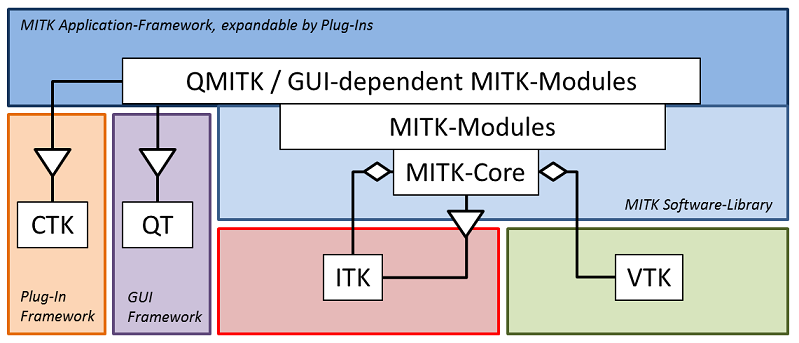
Overview of MITK
As shown above, MITK uses the following libraries.
- The Insight Toolkit (ITK), which provides registration and segmentation algorithms, but is not designed for visualization or interaction.
- The Visualization Toolkit (VTK), which provides powerful visualization capabilities and low-level support for interaction such as picking methods, rotation, movement and scaling of objects.
- The Common Toolkit (CTK), which focuses on DICOM support and a plug-in framework.
- The Qt Cross-platform application and UI framework (Qt) as a framework for UI and application support.
These are the main libraries MITK is based on. For more functionality you can optionally include other libraries as well. A list of used libraries can be found here .
Based on these libraries, MITK includes the following features:
- High level interactions with data.
- Specialized medical imaging algorithms (e.g. segmentation)
- Support of 3D + t data.
- Complete application framework, expandable by plug-ins
- Standard tools for medical imaging as default plug-ins (e.g. measurement, segmentation)
- Many specialized modules for different topics on medical imaging (e.g. image guided therapy, live image/ultrasound data processing)