numpy.arctan — NumPy v1.15 Manual (original) (raw)
numpy. arctan(x, /, out=None, *, where=True, casting='same_kind', order='K', dtype=None, _subok=True_[, signature, _extobj_]) = <ufunc 'arctan'>
Trigonometric inverse tangent, element-wise.
The inverse of tan, so that if y = tan(x) then x = arctan(y).
| Parameters: | x : array_like out : ndarray, None, or tuple of ndarray and None, optional A location into which the result is stored. If provided, it must have a shape that the inputs broadcast to. If not provided or None, a freshly-allocated array is returned. A tuple (possible only as a keyword argument) must have length equal to the number of outputs. where : array_like, optional Values of True indicate to calculate the ufunc at that position, values of False indicate to leave the value in the output alone. **kwargs For other keyword-only arguments, see theufunc docs. |
|---|---|
| Returns: | out : ndarray or scalar Out has the same shape as x. Its real part is in[-pi/2, pi/2] (arctan(+/-inf) returns +/-pi/2). This is a scalar if x is a scalar. |
See also
The “four quadrant” arctan of the angle formed by (x, y) and the positive _x_-axis.
Argument of complex values.
Notes
arctan is a multi-valued function: for each x there are infinitely many numbers z such that tan(z) = x. The convention is to return the angle z whose real part lies in [-pi/2, pi/2].
For real-valued input data types, arctan always returns real output. For each value that cannot be expressed as a real number or infinity, it yields nan and sets the invalid floating point error flag.
For complex-valued input, arctan is a complex analytic function that has [_1j, infj_] and [_-1j, -infj_] as branch cuts, and is continuous from the left on the former and from the right on the latter.
The inverse tangent is also known as atan or tan^{-1}.
References
Abramowitz, M. and Stegun, I. A., Handbook of Mathematical Functions, 10th printing, New York: Dover, 1964, pp. 79.http://www.math.sfu.ca/~cbm/aands/
Examples
We expect the arctan of 0 to be 0, and of 1 to be pi/4:
np.arctan([0, 1]) array([ 0. , 0.78539816])
np.pi/4 0.78539816339744828
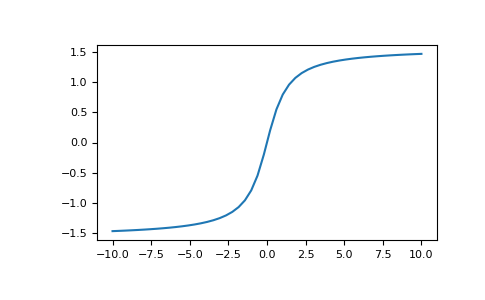
Plot arctan:
import matplotlib.pyplot as plt x = np.linspace(-10, 10) plt.plot(x, np.arctan(x)) plt.axis('tight') plt.show()