gaussian_kde — SciPy v1.16.2 Manual (original) (raw)
scipy.stats.
class scipy.stats.gaussian_kde(dataset, bw_method=None, weights=None)[source]#
Representation of a kernel-density estimate using Gaussian kernels.
Kernel density estimation is a way to estimate the probability density function (PDF) of a random variable in a non-parametric way.gaussian_kde works for both uni-variate and multi-variate data. It includes automatic bandwidth determination. The estimation works best for a unimodal distribution; bimodal or multi-modal distributions tend to be oversmoothed.
Parameters:
datasetarray_like
Datapoints to estimate from. In case of univariate data this is a 1-D array, otherwise a 2-D array with shape (# of dims, # of data).
bw_methodstr, scalar or callable, optional
The method used to calculate the bandwidth factor. This can be ‘scott’, ‘silverman’, a scalar constant or a callable. If a scalar, this will be used directly as factor. If a callable, it should take a gaussian_kde instance as only parameter and return a scalar. If None (default), ‘scott’ is used. See Notes for more details.
weightsarray_like, optional
weights of datapoints. This must be the same shape as dataset. If None (default), the samples are assumed to be equally weighted
Attributes:
datasetndarray
The dataset with which gaussian_kde was initialized.
dint
Number of dimensions.
nint
Number of datapoints.
neffint
Effective number of datapoints.
Added in version 1.2.0.
factorfloat
The bandwidth factor obtained from covariance_factor.
covariancendarray
The kernel covariance matrix; this is the data covariance matrix multiplied by the square of the bandwidth factor, e.g.np.cov(dataset) * factor**2.
inv_covndarray
The inverse of covariance.
Methods
Notes
Bandwidth selection strongly influences the estimate obtained from the KDE (much more so than the actual shape of the kernel). Bandwidth selection can be done by a “rule of thumb”, by cross-validation, by “plug-in methods” or by other means; see [3], [4] for reviews. gaussian_kdeuses a rule of thumb, the default is Scott’s Rule.
Scott’s Rule [1], implemented as scotts_factor, is:
with n the number of data points and d the number of dimensions. In the case of unequally weighted points, scotts_factor becomes:
with neff the effective number of datapoints. Silverman’s suggestion for multivariate data [2], implemented assilverman_factor, is:
(n * (d + 2) / 4.)**(-1. / (d + 4)).
or in the case of unequally weighted points:
(neff * (d + 2) / 4.)**(-1. / (d + 4)).
Note that this is not the same as “Silverman’s rule of thumb” [6], which may be more robust in the univariate case; see documentation of theset_bandwidth method for implementing a custom bandwidth rule.
Good general descriptions of kernel density estimation can be found in [1]and [2], the mathematics for this multi-dimensional implementation can be found in [1].
With a set of weighted samples, the effective number of datapoints neffis defined by:
neff = sum(weights)^2 / sum(weights^2)
as detailed in [5].
gaussian_kde does not currently support data that lies in a lower-dimensional subspace of the space in which it is expressed. For such data, consider performing principal component analysis / dimensionality reduction and using gaussian_kde with the transformed data.
References
D.W. Scott, “Multivariate Density Estimation: Theory, Practice, and Visualization”, John Wiley & Sons, New York, Chicester, 1992.
B.W. Silverman, “Density Estimation for Statistics and Data Analysis”, Vol. 26, Monographs on Statistics and Applied Probability, Chapman and Hall, London, 1986.
[3]
B.A. Turlach, “Bandwidth Selection in Kernel Density Estimation: A Review”, CORE and Institut de Statistique, Vol. 19, pp. 1-33, 1993.
[4]
D.M. Bashtannyk and R.J. Hyndman, “Bandwidth selection for kernel conditional density estimation”, Computational Statistics & Data Analysis, Vol. 36, pp. 279-298, 2001.
[5]
Gray P. G., 1969, Journal of the Royal Statistical Society. Series A (General), 132, 272
Examples
Generate some random two-dimensional data:
import numpy as np from scipy import stats def measure(n): ... "Measurement model, return two coupled measurements." ... m1 = np.random.normal(size=n) ... m2 = np.random.normal(scale=0.5, size=n) ... return m1+m2, m1-m2
m1, m2 = measure(2000) xmin = m1.min() xmax = m1.max() ymin = m2.min() ymax = m2.max()
Perform a kernel density estimate on the data:
X, Y = np.mgrid[xmin:xmax:100j, ymin:ymax:100j] positions = np.vstack([X.ravel(), Y.ravel()]) values = np.vstack([m1, m2]) kernel = stats.gaussian_kde(values) Z = np.reshape(kernel(positions).T, X.shape)
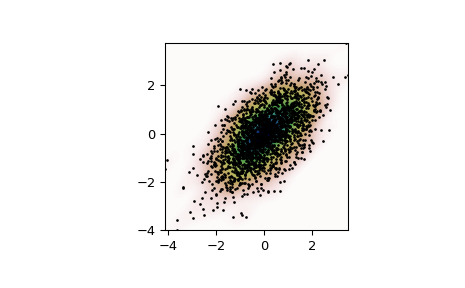
Plot the results:
import matplotlib.pyplot as plt fig, ax = plt.subplots() ax.imshow(np.rot90(Z), cmap=plt.cm.gist_earth_r, ... extent=[xmin, xmax, ymin, ymax]) ax.plot(m1, m2, 'k.', markersize=2) ax.set_xlim([xmin, xmax]) ax.set_ylim([ymin, ymax]) plt.show()
Compare against manual KDE at a point:
point = [1, 2] mean = values.T cov = kernel.factor**2 * np.cov(values) X = stats.multivariate_normal(cov=cov) res = kernel.pdf(point) ref = X.pdf(point - mean).sum() / len(mean) np.allclose(res, ref) True