Example: Line Fitting (original) (raw)

next up previous contents
Next: Example: Plane Fitting Up: The Fast Hough Transform Previous: The FHT Algorithm Contents

Example: Line Fitting

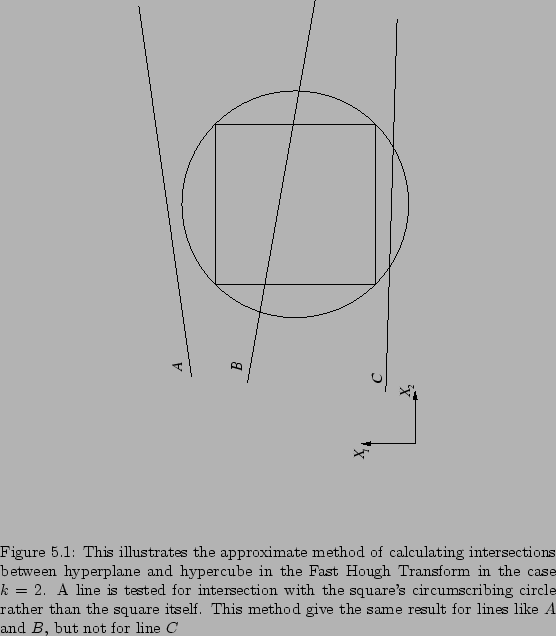
Figure 5.5shows how the FHT works for $k=2$, when parameter space is a plane, hyperplanes are straight lines and hypercubes are squares whose associated hyperspheres are circles passing through the vertices of the squares (figure 5.5).
\begin{figure}
% latex2html id marker 5668
\centerline{\psfig{file=hyper.ps,wid...
...he same result for lines like <span class="katex"><span class="katex-mathml"><math xmlns="http://www.w3.org/1998/Math/MathML"><semantics><mrow><mi>A</mi></mrow><annotation encoding="application/x-tex">A</annotation></semantics></math></span><span class="katex-html" aria-hidden="true"><span class="base"><span class="strut" style="height:0.6833em;"></span><span class="mord mathnormal">A</span></span></span></span> and <span class="katex"><span class="katex-mathml"><math xmlns="http://www.w3.org/1998/Math/MathML"><semantics><mrow><mi>B</mi></mrow><annotation encoding="application/x-tex">B</annotation></semantics></math></span><span class="katex-html" aria-hidden="true"><span class="base"><span class="strut" style="height:0.6833em;"></span><span class="mord mathnormal" style="margin-right:0.05017em;">B</span></span></span></span>, but not for line <span class="katex"><span class="katex-mathml"><math xmlns="http://www.w3.org/1998/Math/MathML"><semantics><mrow><mi>C</mi></mrow><annotation encoding="application/x-tex">C</annotation></semantics></math></span><span class="katex-html" aria-hidden="true"><span class="base"><span class="strut" style="height:0.6833em;"></span><span class="mord mathnormal" style="margin-right:0.07153em;">C</span></span></span></span>}
\end{figure}

This is applicable to the problem of finding a straight line through points on a plane. If the plane has coordinates $(u,v)$ the line can be written

\begin{displaymath}
v=\alpha u + \beta
\end{displaymath}

where $\alpha$ and $\beta$ are constant. Each point$(u_j , v_j )$ votes for a line in parameter space:

\begin{displaymath}
\beta=v_j - \alpha u_j .
\end{displaymath}

Let the initial ranges of $\alpha$ and $\beta$, defining the root hypercube, be $L_{\alpha}$ and$L_{\beta}$ centred around $\alpha_0$ and $\beta_0$ respectively. Then the above equation can put in the form of equation 5.15 using the transformation

\begin{displaymath}
X_1 = \frac{\alpha}{L_\alpha} ,\;
X_2 = \frac{\beta}{L_\be...
...{1j} = \frac{L_\alpha u_j}{q} ,\;
a_{2j} = \frac{L_\beta}{q}
\end{displaymath}

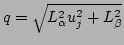
where $q = \sqrt{L_\alpha^2 u_j^2 + L_\beta^2}$.


2006-03-17