Sane C++ Libraries: Containers (original) (raw)
🟨 Generic containers (SC::Vector, SC::SmallVector, SC::Array etc.)
SaneCppContainers.h is a library holding some commonly used templated data structures.
While all libraries are designed to let you use your favorite externally provided string / vector classes, there is also an choice of basic containers (mainly Vector<T> incarnations), with support for inline buffer and custom scoped allocators provided by Memory library.
Note
See Tests/InteropSTL/*.cpp for an example of externally provided Container classes.
Dependencies
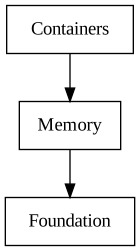
- Dependencies: Memory
- All dependencies: Foundation, Memory
Features
| Class | Description |
|---|---|
| SC::Vector | A contiguous sequence of heap allocated elements. |
| SC::Array | A contiguous sequence of elements kept inside its inline storage. |
| SC::SmallVector | A Vector that can hold up to N elements inline and > N on heap. |
| SC::VectorMap | A map holding VectorMapItem key-value pairs in an unsorted Vector. |
| SC::VectorSet | A set built on an unsorted Vector, ensuring no item duplication. |
| SC::ArenaMap | A sparse vector keeping objects at a stable memory location. |
Status
🟨 MVP
All classes defined in the library should be reasonably stable and safe to use.
Description
Generic data structures are a fundamental building blocks for almost every application.
These are some of commonly used ones for common tasks, and the library will grow adding what's needed.
SC::Vector is the king of all generic containers for this library, being in many case the main backend storage for other containers.
SC::Array mimics all methods of SC::Vector but it's guaranteed never to allocate on heap.
All methods are designed to fail with a [[nodiscard]] return value when the container is full.
SC::SmallVector is the middle ground between SC::Array and SC::Vector.
It's a vector with inline storage for N elements, deriving from SC::Vector and it's designed to be passed everywhere a reference to SC::Vector is needed. This allows the caller to get rid of temporary heap allocations if an estimate of the space required is already known or if it's possible providing a reasonable default.
If this estimation is wrong, heap allocation will happen.
Blog
Some relevant blog posts are:
Vector
A contiguous sequence of heap allocated elements.
Template Parameters
| T | Type of single vector element |
|---|
All methods of SC::Vector that can fail, return a [[nodiscard]] bool (example SC::Vector::push_back).
Assignment and Copy / move construct operators will just assert as they can't return a failure code.memcpy is used to optimize copies when T is a memcpy-able object.
Note
Use SC::SmallVector everywhere a SC::Vector reference is needed if the upper bound size of required elements is known to get rid of unnecessary heap allocations.
SC_TRY(myVector.reserve(10));
SC_TRY(myVector.push_back(1));
console.print("[0]={}", myVector[0]);
SC_TRY(myVector.push_back(2));
SC_TRY(myVector.pop_back());
SC_TRY(myVector.pop_front());
console.print("Vector is {}", myVector.isEmpty() ? "empty" : "not empty");
Array
A contiguous sequence of elements kept inside its inline storage.
Template Parameters
| T | Type of single element of the Array |
|---|---|
| N | Number of elements contained inside this Array inline storage |
SC::Array is like a SC::Vector but it will only allow up to N elements in the array, using inline storage, without resorting to heap allocation.
Trying to push or insert more than N elements will fail.
Only up to SC::Array::size elements are valid (and N - size() are initialized).
SC_TRY(myVector.push_back(1));
SC_TRY(myVector.push_back(2));
SC_TRY(myVector.push_back(3));
(void)myVector.push_back(4);
SC_TRY(myVector.pop_back());
SC_TRY(myVector.pop_front());
SC_TRY(myVector.pop_front());
(void)myVector.pop_front();
console.print("Array<int, 3> is {}", myVector.isEmpty() ? "empty" : "not empty");
SmallVector
A Vector that can hold up to N elements inline and > N on heap.
Template Parameters
| T | Type of single vector element |
|---|---|
| N | Number of elements kept inline to avoid heap allocation |
SC::SmallVector is like SC::Vector but it will do heap allocation once more than N elements are needed.
When the size() becomes less than N the container will switch back using memory coming from inline storage.
Note
SC::SmallVector derives from SC::Vector and it can be passed everywhere a reference to SC::Vector is needed. It can be used to get rid of unnecessary allocations where the upper bound of required elements is known or it can be predicted.
auto pushThreeIntegers = [](Vector& myVector) -> bool
{
SC_TRY(myVector.push_back(1));
SC_TRY(myVector.push_back(2));
SC_TRY(myVector.push_back(3));
return true;
};
SC_TRY(pushThreeIntegers(mySmallVector));
SC_TRY(mySmallVector.push_back(4));
SC_TRY(mySmallVector.pop_back());
VectorMap
A map holding VectorMapItem key-value pairs in an unsorted Vector.
Template Parameters
| Key | Type of the key (must support == comparison) |
|---|---|
| Value | Value type associated with Key |
| Container | Container used for the Map |
VectorSet
A set built on an unsorted Vector, ensuring no item duplication.
Template Parameters
| Value | The contained value |
|---|---|
| Container | The underlying container used |
for (auto& item : setOfStrings)
{
}
ArenaMap
A sparse vector keeping objects at a stable memory location.
Template Parameters
| T | Type of items kept in this Arena |
|---|
SC::ArenaMap is a container used to keep objects memory location stable.
Internally it hold sparse objects inside of a SC::Vector and for this reason it can only be SC::ArenaMap::resize-d when it's empty.
Objects can be inserted up to the SC::ArenaMap::size and insertion returns handle keys allowing to retrieve the inserted object in constant time.
SC_TRY(not map.insert("ASD").isValid());
keys[0] = map.insert("ASD");
keys[1] = map.insert("DSA");
keys[2] = map.insert("BDA");
SC_TRY(not map.insert("123").isValid());
SC_TRY(map.get(keys[0])->view() == "ASD");
SC_TRY(map.get(keys[1])->view() == "DSA");
SC_TRY(map.get(keys[2])->view() == "BDA");
Details
- SC::Segment is the class representing a variable and contiguous slice of bytes or objects backing both SC::Vector, SC::SmallVector, SC::Array, SC::Buffer and SC::SmallBuffer.
- Memory layout of a segment is a SC::SegmentHeader holding size and capacity of the segment followed by the actual elements.
- SC::SegmentHeader is aligned to
uint64_t.
Roadmap
🟩 Usable Features:
- Add option to let user disable heap allocations in SC::SmallVector
- Explicit control on Segment / Vector allocators
HashMap<T>Map<K, V>
🟦 Complete Features:
- More specific data structures
💡 Unplanned Features:
- None
Statistics
| Type | Lines Of Code | Comments | Sum |
|---|---|---|---|
| Headers | 873 | 418 | 1291 |
| Sources | 0 | 0 | 0 |
| Sum | 873 | 418 | 1291 |