Hilbert Transform | Spectral Audio Signal Processing (original) (raw)
Hilbert Transform
The Hilbert transform  of a real, continuous-time signal
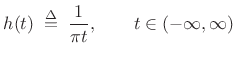
  may be expressed as the convolution of
  with the_Hilbert transform kernel_:
 |
(5.17) |
|---|
That is, the Hilbert transform of is given by
 |
(5.18) |
|---|
Thus, the Hilbert transform is a non-causal linear time-invariant filter.
The complex analytic signal  corresponding to the real signal is then given by
To show this last equality (note the lower limit of 0 instead of the usual  ), it is easiest to apply (4.16) in the frequency domain:
Thus, the negative-frequency components of  are canceled, while the positive-frequency components are doubled. This occurs because, as discussed above, the Hilbert transform is an allpass filter that provides a
  degree phase shift at all negative frequencies, and a**
 ** degree phase shift at all positive frequencies, as indicated in (4.16). The use of the Hilbert transform to create an analytic signal from a real signal is one of its main applications. However, as the preceding sections make clear, a Hilbert transform in practice is far from ideal because it must be made finite-duration in some way.
Next Section:
Matlab, Continued
Previous Section:
Comparison to the Optimal Chebyshev FIR Bandpass Filter