Denmark - Country Profile - Nations Online Project (original) (raw)
Background:
Once the seat of Viking raiders and later a major north European power, from the 17th through the 20th centuries Denmark and the former political union of Denmark–Norway ran a colonial empire that encompassed posessions in North America (Greenland), the Baltic and Scandinavian region, France, the United Kingdom, Iceland and northern Germany.
Denmark emerged from its colonial experience with one of the highest standards of living in Europe, with a comparatively liberal attitude towards immigration. The country has evolved into a modern, prosperous nation that is participating in the political and economic integration of Europe. The kingdom has a well developed social welfare system and as a nation is committed to development and to the protection of the environment.
So far, however, the country has opted out of some aspects of the European Union's Maastricht Treaty, including the economic and monetary system (EMU) and issues concerning certain internal affairs.
Related countries/dependencies: Faroe Islands, Greenland
Official Name:
Kongeriget Danmark
short form: Danmark
int'l long form: Kingdom of Denmark
int'l short form: Denmark
ISO Country Code: dk, DNK
Time:
Time Zone: Central European Time (CET)
Local Time = UTC+1h
Actual Time: Thu-May-14 22:23
Daylight Saving Time (DST) March - October (UTC +2)
Country Calling Code: +45
Capital City: Copenhagen (pop. 0.5 million in Copenhagen and 1.8 million in the Copenhagen region)
Other Cities:
Aarhus (289 000), Odense (184 000), Aalborg (162 000).
Government:
Type: Constitutional Monarchy.
Constitution: 5 June 1953.
Geography:
Location: Northern Europe, bordering the Baltic Sea and the North Sea, on a peninsula north of Germany (Jutland); also includes two major islands (Sjaelland and Fyn)
Area: 43,094 km² (16,638 sq. mi.)
Terrain: Low and flat or slightly rolling hills; highest elevation is 173 m. (568 ft.).
Climate: Temperate. The terrain, location, and prevailing westerly winds make the weather changeable.
People:
Nationality: Noun--Dane(s). Adjective--Danish.
Population: 5.6 million (2015)
Ethnic groups: Scandinavian, German, Inuit, (Greenland) Faroese.
Religion: Evangelical Lutheran 84.3%. Catholics, Jews, other Protestant denominations, and Muslims account for approximately 5%.
Languages: Danish, some German, Faroese, Greenlandic. English is the predominant second language.
Literacy: 100%
Natural resources: Petroleum, natural gas, fish, salt, limestone, chalk, stone, gravel and sand.
Agriculture products: Barley, wheat, potatoes, sugar beets; pork, dairy products; fish.
Industries: Iron, steel, nonferrous metals, chemicals, food processing, machinery and transportation equipment, textiles and clothing, electronics, construction, furniture and other wood products, shipbuilding and refurbishment, windmills.
Exports - commodities: machinery and instruments, meat and meat products, dairy products, fish, pharmaceuticals, furniture, windmills.
Exports partners: Germany 17.8%, Sweden 11.6%, US 8.4%, Norway 6.3%, UK 6.3%, Netherlands 4.4%, China 4.2% (2015)
Imports - commodities: machinery and equipment, raw materials and semimanufactures for industry, chemicals, grain and foodstuffs, consumer goods.
Imports partners: Germany 20.4%, Sweden 12.3%, Netherlands 8.1%, China 7.3%, Norway 6.1%, UK 4.4% (2015)
Currency: Danish Krone (DKK)
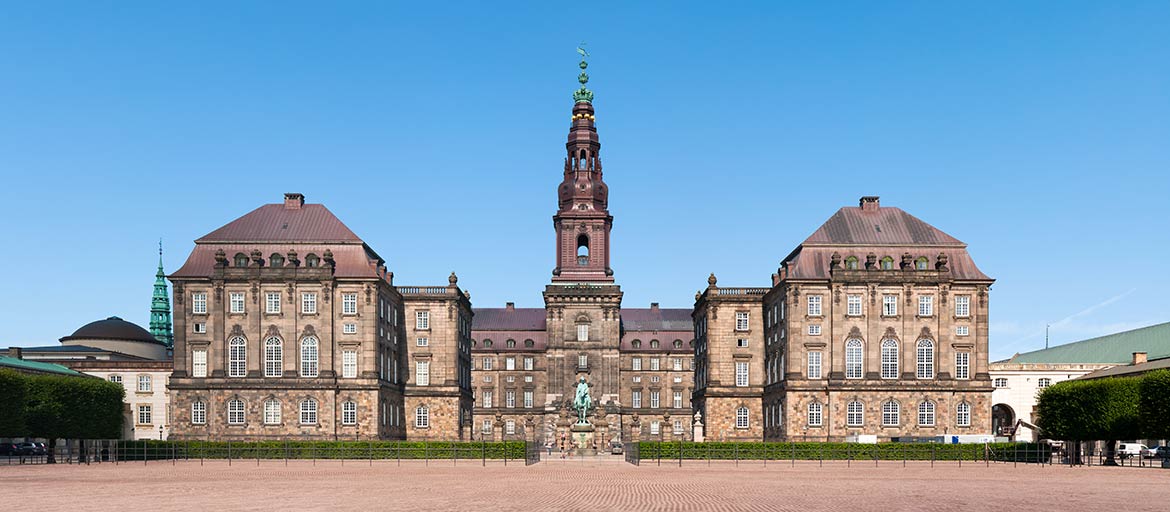
Christiansborg Palace in central Copenhagen, the Neo-baroque style building was formerly the principal residence of the Danish kings, today it is the seat of the Danish Parliament (Folketinget) and houses also the Royal Reception Rooms, the Prime Minister's Office and the Supreme Court of Denmark.
Image: Julian Herzog
Political system
Denmark's political system is that of a constitutional monarchy, where the monarch formally appoints a representative to preside over the creation of a coalition government following a parliamentary election. Chief of state is Queen Margrethe II of Denmark (since 14 January 1972), in theory the source of all executive and legislative power. But de facto the Danish constitutions of 1849, and the most recent of 1953, ended the absolute monarchy and introduced parliamentary democracy.
Head of government is the prime minister, he presides over the cabinet. The parliament of Denmark, the Folketinget is the supreme and ultimate legislative body in the country.
Official Sites of Denmark
Note: External links will open in a new browser window.
 Kongehuset
The Danish Royal Family.
Denmark
Denmark's Official Website, the online portal to everything about Denmark.
Folketinget
The Danish Parliament.
Statsministeriet
Official website of the Prime Minister's Office.
Udenrigsministeriet
Royal Danish Ministry of Foreign Affairs.
Diplomatic Missions
Permanent Mission of Denmark to the UN in New York
Denmark's Permanent Mission to the United Nations.
Royal Danish Embassy in the U.S.
Danish Embassy in Washington D.C.
Denmarks Missions Abroad
Address list of Denmarks Diplomatic Missions Abroad.
Consular Services
Information about Danish visa rules, short stay visas and residence and/or work permits.
The Copenhagen Diplomatic List 2016
Foreign Embassies and Consulates in Denmark.
Statistics
Danmarks Statistik
Statistics Denmark (in Danish).
Weather
Danmarks Meteorologiske Institut (DMI)
The institute makes weather forecasts and observations for Denmark, Greenland, and the Faroe Islands.
Maps
 Map of Denmark
Political Map of Denmark.
 Google Earth Denmark
Searchable map and satellite view of Denmark. Google Earth Copenhagen
Searchable map and satellite view of Denmark's capital.
Map of the Baltic Sea Area
Political map of the Baltic Sea region. Map of Scandinavia
Political map of Scandinavia (Fennoscandia). Map of Europe
Political Map of Europe.