Sympathetic Vibratory Physics | vortex (original) (raw)
" ..vortex action is induced by differential conflict between the low and high tensions.." []
"All action in Nature is vortex motion." [, VORTEX ACTION]
Nikola Tesla
"The primary substance, thrown into infinitesimal whirls of prodigious velocity, becomes gross matter; the force subsiding, the motion ceases and matter disappears, reverting to the primary substance". [Nikola Tesla - New York American - July 6, 1930]
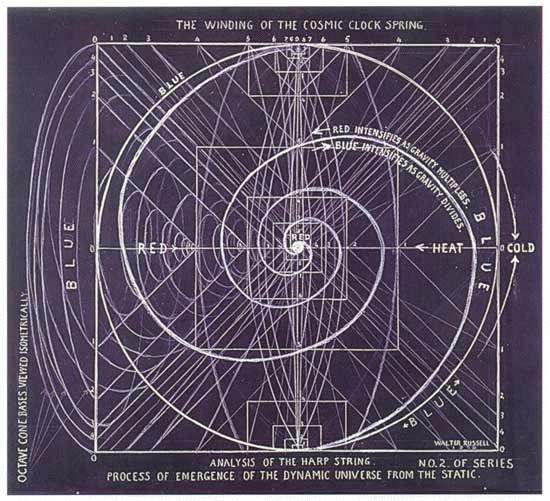
Vortex Polarities
"Certain conditions of sound produce effects and other conditions quite the opposite. In organ pipes of a certain caliber very sensitive waves occur at intervals according to the character of the sound. However, on combining a number of brass tube resonators, of nine or more in number, the induction of certain chords produces high vortex action in the air in the tubes. This also caused considerable difficulty when he was using his Generator, for the reversions would cause vortex action in his resonator tubes and repeatedly blew the resonator caps off, destroying the adjustments in his machine.
"In open atmosphere tuning forks produce alternate and rarefaction of the air, but when a fork is placed in a tube and adjusted to of the mass chord of the tube, a very different action takes place. Vibrators must be accurately adjusted to get such results; they cannot be set promiscuously in tubes and produce vortex phenomena."
"All corpuscular action in Nature is vortex motion. Progressive and intermolecular of invariably results in vortex motion of the highest , but only peripheral. This results whether induced sympathetically or otherwise." Snell Manuscript
Slow motion of forming vortex: https://svpwiki.com/videos/Slo-Mo-vortex.mp4
says "All such experiments invariably resulted in vortex motion, whether induced sympathetically or otherwise. All corpuscular action in Nature is vortex motion. The undulatory theory of light is only hypothetical. The conditions of electromagnetic radiation, on the same plane of matter as light, disprove the undulatory theory in many particulars. The vortex action induced by differential conflict between the low and high tensions shows conditions analogous to those in the dissociation of into hydrogen and oxygen - in other words, vortex action of the highest but peripheral only. Were it otherwise, the ether could not be held suspended or enclosed in the or envelopes." Snell Manuscript
[10] Tractive force: This refers to the force described hydraulically as 'Shear force' — the force that acts to 'shear off' or to and . In German the term for shear force is '', meaning 'to push, to shove' as well as 'to shear', whereas Viktor Schauberger uses the word ''. The verb '' means to , or . Viktor Schauberger's choice of '' here is quite specific, since in his view the of is due to the sucking action of fast flowing, dense cold , rather than to the mechanical impact of the coming from . In view of this subtle change in emphasis, in lieu of the hydraulically correct term 'shear force', the term 'tractive forces' will be used. This is similar to the effect of on roofs, where a roof is blown off not by force from the side, but rather by the sucking effect of vortices created on the side. -Ed. [The Energy Evolution - Harnessing Free Energy from Nature, The Biological Vacuum - The Optimal Driving Force for Machines]
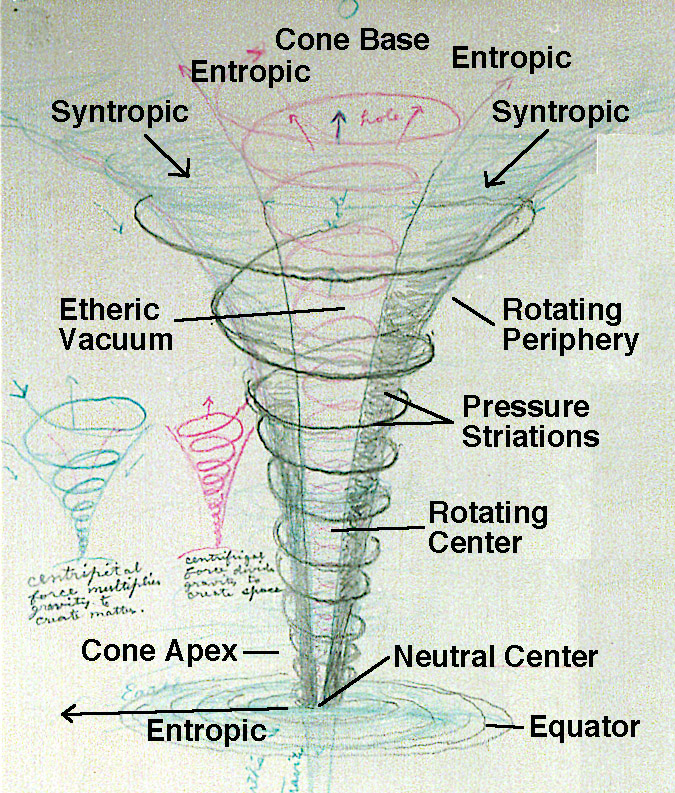
Vortex Components
James Clerk Maxwell
"When the vortex atom is once set in , all its properties are absolutely fixed and determined by the laws of of the primitive fluid, which are fully expressed in the fundamental equations." [James Clerk Maxwell]
"I have found great difficulty in conceiving of the existence of vortices in a medium, side by side, revolving in the same direction about parallel axes. The contiguous portions of consecutive vortices must be moving in opposite directions; and it is difficult to understand how the of one part of the medium can coexist with, and even produce, an opposite of a part in contact with it. In (a mechanical) mechanism, when two wheels are intended to revolve in the same direction, a wheel is placed between them so as to be in gear with both, and this wheel is called an 'idle wheel'. The hypothesis about the vortices which I have to suggest is that a layer of particles, actng as idle wheels, is interposed between each vortex and the next, so that each vortex has a tendency to make the neighbouring vortices revolve in the same direction." James Clerk Maxwell
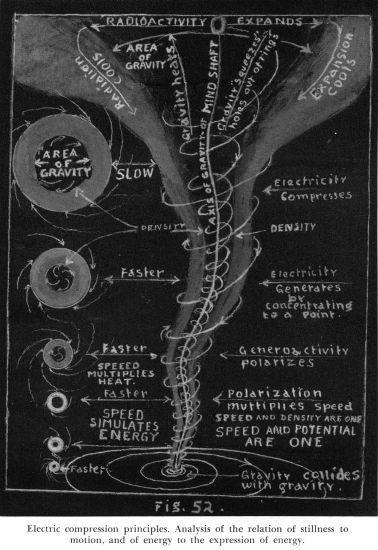
Russell - Vortex Dynamics
"The CREATED universe of matter is the result of concentration of upon the of form and then the generation of power by diverting low potential into vortices in order to hold the of into the appearance of form until form disappears through mental " [Figure 12.11 - Russells Locked Potential Full Ten Octave Gamut]
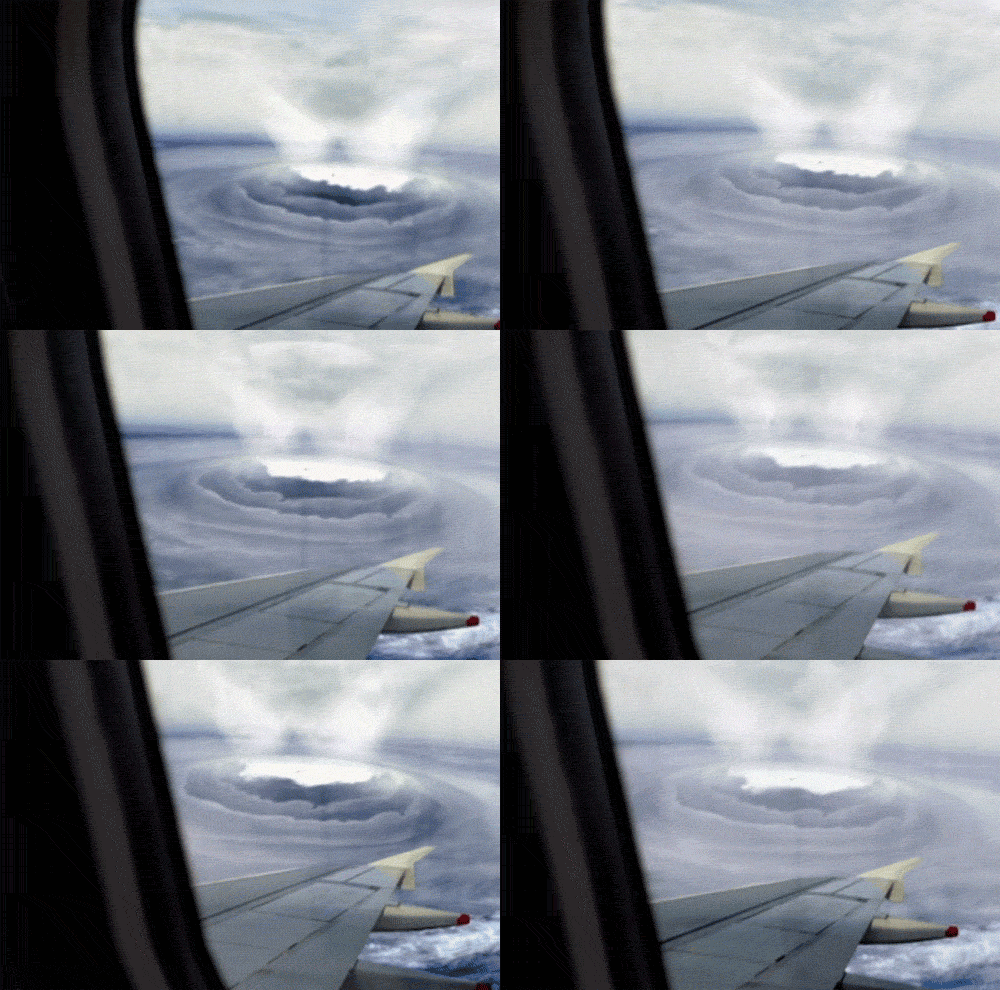
Figure 3.6.1 - Tornadoes also have a Down Draft caused by its vacuous center(click to enlarge)

"The eight radar corner receivers of thoughtmessages projected from inert gases.
Man's end of theCosmic Bridge whereMotion reaches maximum.
The cube projector, shown in Fig. 62, is repeated in the cube receiver, shown herein. Motion which has been divided into pairs and thrown out into space by the , is multiplied in the vortices of the receiver, which corresponds to the corner reflectors of radar. Forms and sounds which are born in space are thus echoed back into space." [Atomic Suicide - Fig 63]
Compound Vortex
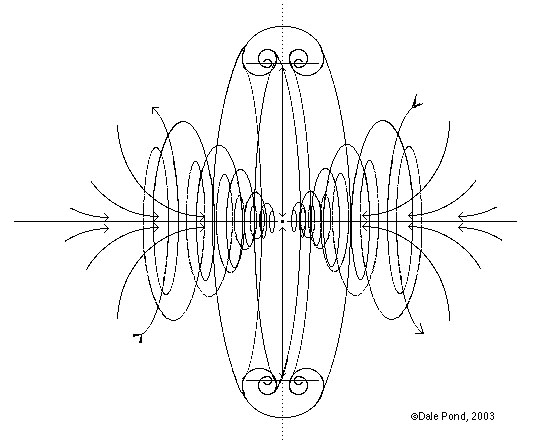
Double Vortex Motions
"MASS IS ACCUMULATED AROUND A VORTEX. A VORTEX IS FORMED BY THE CONTRACTION OF THE AXES OF TWO OPPOSING CONES OF ENERGY. THE GREATER THE CONTRACTION THE GREATER THE ACCELERATION OF MOTION WITHIN THE VORTEX." [Walter Russell, The Universal One, page 153]
"Viktor Schauberger saw life’s many processes as a part of an indivisible whole—linked by spiral movement. He identified two forms of motion in Nature: 1. Outwardly expanding (used by Nature to encourage breakdown and decomposition) and 2. Inwardly spiraling (used to build up, to create, and to energize). Vortices manage energy—gathering and dispersing it—keeping the entire universe organized and alive. A vortex is the epitome of Nature’s use of opposites in the maintenance of balance. In fact, vortical movement is a perfect example of balance through polarity. It is also Nature’s finest creative/organizing force. Double spiral Vortices are the result of a self-organizing flow where a substance rotates around its own axis with a decreasing radius. The speed of rotation increases toward the center where a sub-pressure forms. Theoretically, the speed at the center of a vortex is infinite—capable of breaking through dimensional boundaries. The vortex is a gateway between levels of energy. From a tornado to the spiraling growth of plants, the vortex is Nature’s mechanism for increasing the quality of energy from a lower to a higher level. It is believed to have interdimensional properties—both gathering input from the universe and capable of carrying thought/intent into the living field of energy. During experiments at the Institute of Technology in Stuttgart, Germany in 1952, Schauberger and Professor Franz Pöpel investigated the nature of spiraling water. Conical, straight, and spiraling pipes were studied; also pipes of different materials. Their results were very revealing. The more conical and spiraling the pipes became, the more the frictional resistance decreased. Pipes made from copper demonstrated lower resistance than those made of glass. Under certain circumstances, negative friction was reported. In other words, the water appeared to leave the walls of the pipe. The self-organizing nature of vortices is a significant factor during the creation of liquid crystalline/structured water. Vortices are thought to bring about the same type of coherent domain that exists in superfluids— with zero resistance to the transmission of energy and information. These domains exist in superconductor-based devices where vortices play a major role. The temperature at the center of a vortex is cooler than at the periphery. This is known as the Ranque-Hilsch effect. Victor demonstrated this by showing that water flowing past a rock is cooler than the water in front of the rock—due to the vortex (and the cooling effect it creates) as water spins past the rock. This is one reason moving water stays cool despite warmer ambient temperatures. When left to itself, water always spirals. Movement encourages vortices; they help to purify and energize water; they help maintain water’s perfect temperature (4°C); they bring about coherent structure; and they send/receive life-supporting information. https://www.dancingwithwater.com/vortices-natures-creative-tool/
AI Interpretations of SVP
3D printed Vortex patterns
cycloid motion
cycloid motive impulse
Crab Nebular Spectral Views
Curved Wave Universe of Motion
Duality Spiral
Double Spiral
Double Vortex
electric cyclone
electric vortices
Fibonacci Spiral
Figure 2.10 - Triple Dual Vectors - In Rotary Motion
Figure 2.13 - Swirling Vortex around Neutral Centering Shaft
Figure 3.17 - Balanced Vector Tendencies or Motions
Figure 3.18 - All Motion is Vortex Motion
Figure 3.2 - Thinking Mind Creates a Universe of Motion
Figure 3.21 - Vortex or Gyroscopic Motions as Conflicts or Antagonisms between Light and Dark
Figure 3.22 - Vortex or Gyroscopic Motions as Conflicts or Antagonisms between Light and Dark Zones
Figure 3.23 - Vortex or Gyroscopic Motions as Conflicts or Antagonisms between Light and Dark Zones
Figure 3.28 - Compression and Expansion Forces in Gyroscopic Motions
Figure 3.30 - Discrete Degrees or Steps in Gyroscopic Compression Motion
Figure 3.6 - Tornado Vacuums up Everything for Redistribution
Figure 3.6.1 - Tornadoes also have a Down Draft caused by its vacuous center
Figure 4.3 - Single Mode Electric Vector Generating Circular Motion also Shown within Triple Vectors
Figure 4.4 - Triple Vectors in Orthogonal Motions
Figure 4.5 - Compound Gyroscopic or Vortex Motions
Figure 4.6 - Triple Vectors in Motion on Triple Planes
Figure 4.7 - Triple Planes and Polar Vectors of Motion
Figure 5.13 - Babbitt Atom constructed of Compound Vortexial Motions
Figure 5.3 - Vortex or Gyroscopic Motion is Natural and occurs ubiquitously
Figure 5.4 - Vortex and Gyroscopic Motion on One Plane then on three forming Sphere
Figure 5.5 - Double Interpenetrating Vortex
Figure 6.1 - Orthogonal Vortex Motion as Structural base of Cubes
Figure 7.1 - Step 1 - Wave Vortex Crests at Maximum Polarization
Figure 7.2 - Step 2 - Vortex Formation about a Single Axis
Figure 7B.12 - Sympathetic Affinity Attraction forming Vortex
Figure 8.12 - Vibratory and Oscillatory Motions
Figure 8.13 - Vibratory and Oscillatory Motions
Figure 9.18 - Harmonized Motions
Figure 9.19 - Enharmonized Motions
Figure 11.02 - Infinite Neutral Mind Centers and Controls All Motion
Figure 12.06 - Mind Centers and Controls Motion
Figure 13.05a - Complex Vortex Rotational Dynamics
Figure 13.11 - Russells Ring of Motion Superimposed on Dynasphere Profile
Figure 14.06 - Mind and Electric Thought Rings of Motion are Closely Connected
Figure 15.06 - Thought Rings of Motion
Figure 18.15 - From One Still Mind comes all Force and Motion by Differentiation
Figures 3.31 - Vortex Orthogonal and self-contained Motions - Structure
Figures 3.32 - Vortex orthogonal and self-contained motions - cross-section
Formation of Rotating (Vortex) Rings of Air & Liquids
gravity shaft
Karman vortex street
Keelys Laws of Being
Motion Cycle
Neutral Center is Source of Continuous Motion
Polarity Creates Rotating Vortex
Russells Locked Potentials
Quantum dynamics of a single vortex
The Action of Force is Spiro-Vortex
Torus
VORTEX ACTION
vortex ring
Water Vortex
3.03 - Vortexial Motion
3.10 - Vortex Motions result in Appearance of Form
3.13 - Reciprocals and Proportions of Motions and Substance
3.14 - Vortex Theory of Atomic Motions
3.23 - Hydrodynamic Equations - Vortex Motions
4.5 - Triple Rotary or Vortex Motions
4.7 - Matter is Motion in Opposition
4.8 - Centripetal Orthogonal Motions
4.9 - Triple Contractive Motions
5.1 - Vortex Formation
5.2 - Vortex Motions in Resonators
5.3 - Vortex Motion in Ether and Atoms
5.4 - Vortices are born of Motion and Matter is concentrated Vortices
5.6 - Vortex Forming Spheres
7.1 - Matter is centralized motion
8.3 - Conventional View of Wave Motion
8.5 - Wave Motion Observables
9.31 - Oscillatory Motion creating Waveforms
9.37 - Harmonized Motions
9.38 - Enharmonized Motions
19.05.01 - From The Dynamic Theory of Life and Mind - Radiometer Motion
Continuous Motion