10 Best Napoleonic War Movies, Ranked (original) (raw)

Published Jun 13, 2024, 5:30 PM EDT
Jeremy has more than 2500 published articles on Collider to his name, and has been writing for the site since February 2022. He's an omnivore when it comes to his movie-watching diet, so will gladly watch and write about almost anything, from old Godzilla films to gangster flicks to samurai movies to classic musicals to the French New Wave to the MCU... well, maybe not the Disney+ shows.
His favorite directors include Martin Scorsese, Sergio Leone, Akira Kurosawa, Quentin Tarantino, Werner Herzog, John Woo, Bob Fosse, Fritz Lang, Guillermo del Toro, and Yoji Yamada. He's also very proud of the fact that he's seen every single Nicolas Cage movie released before 2022, even though doing so often felt like a tremendous waste of time. He's plagued by the question of whether or not The Room is genuinely terrible or some kind of accidental masterpiece, and has been for more than 12 years (and a similar number of viewings).
When he's not writing lists - and the occasional feature article - for Collider, he also likes to upload film reviews to his Letterboxd profile (username: Jeremy Urquhart) and Instagram account.
He has achieved his 2025 goal of reading all 13,467 novels written by Stephen King, and plans to spend the next year or two getting through the author's 82,756 short stories and 105,433 novellas.
The Napoleonic Wars are exactly what you’d expect them to be: a series of conflicts fought while Napoleon Bonaparte reigned as the Emperor of the French. This period is recognized as lasting between 1803 and 1815, and given the battles fought as part of the conflict all occurred before photography existed, it falls on things like artwork and cinema to recreate and depict such a time in history.
Plenty of movies have taken place during the Napoleonic Wars, some naturally focusing on Napoleon as a key character, while others avoid showing much by way of battles, instead telling more personal or character-driven stories during that time in history. This assortment of films that either use the Napoleonic Wars as a large part of the narrative or a background element are ranked below, starting with the decent and ending with the great.
10 'The Terror' (1963)
Director: Roger Corman

Jack Nicholson playing a soldier in The Terror (1963) directed by Roger Corman
Image via American International Pictures
Few producers were as prolific as Roger Corman, who produced or executive produced too many titles to count from the 1950s until his passing in 2024. For the decade and a half of his producing career, he was also the director of many of his films, with 1963’s The Terror being one of dozens, and a noteworthy one for the fact it starred a young Jack Nicholson.
It takes place in 1806, with Nicholson portraying a soldier in Napoleon’s army who becomes separated from his fellow soldiers before ending up in a strange castle plagued by supernatural occurrences. The Napoleonic War side of things is really just there as a set-up for a horror/mystery film, but The Terror is given a little extra flavor thanks to its historical setting, and isn't a bad watch as far as older low-budget horror movies go.
Lt. Andre Duvalier awakens on a beach to the sight of a strange woman who leads him to the gothic, towering castle that serves as home to an eerie baron.
9 'Désirée' (1954)
Director: Henry Koster

Marlon Brando as Napoleon
Image via 20th Century Fox
Napoleon Bonaparte was a larger-than-life historical figure, and the same could be said about Marlon Brando as an actor, so perhaps it’s fitting that the latter portrayed the former in 1954’s Désirée. The film begins approximately 20 years before the end of the Napoleonic Wars, building up to Napoleon’s eventual defeat and exile while focusing on his relationship with the titular Désirée Clary.
Clary came from a wealthy family with ties to royalty, and was at one point engaged to Napoleon Bonaparte, though the two never actually married. Désirée is more concerned with romance and melodrama than it is depicting much by way of battles and warfare, but it uses the events of the French Revolutionary Wars and then the following Napoleonic Wars as a background to explore a key relationship in Napoleon’s life.
8 'Napoleon' (2023)
Director: Ridley Scott
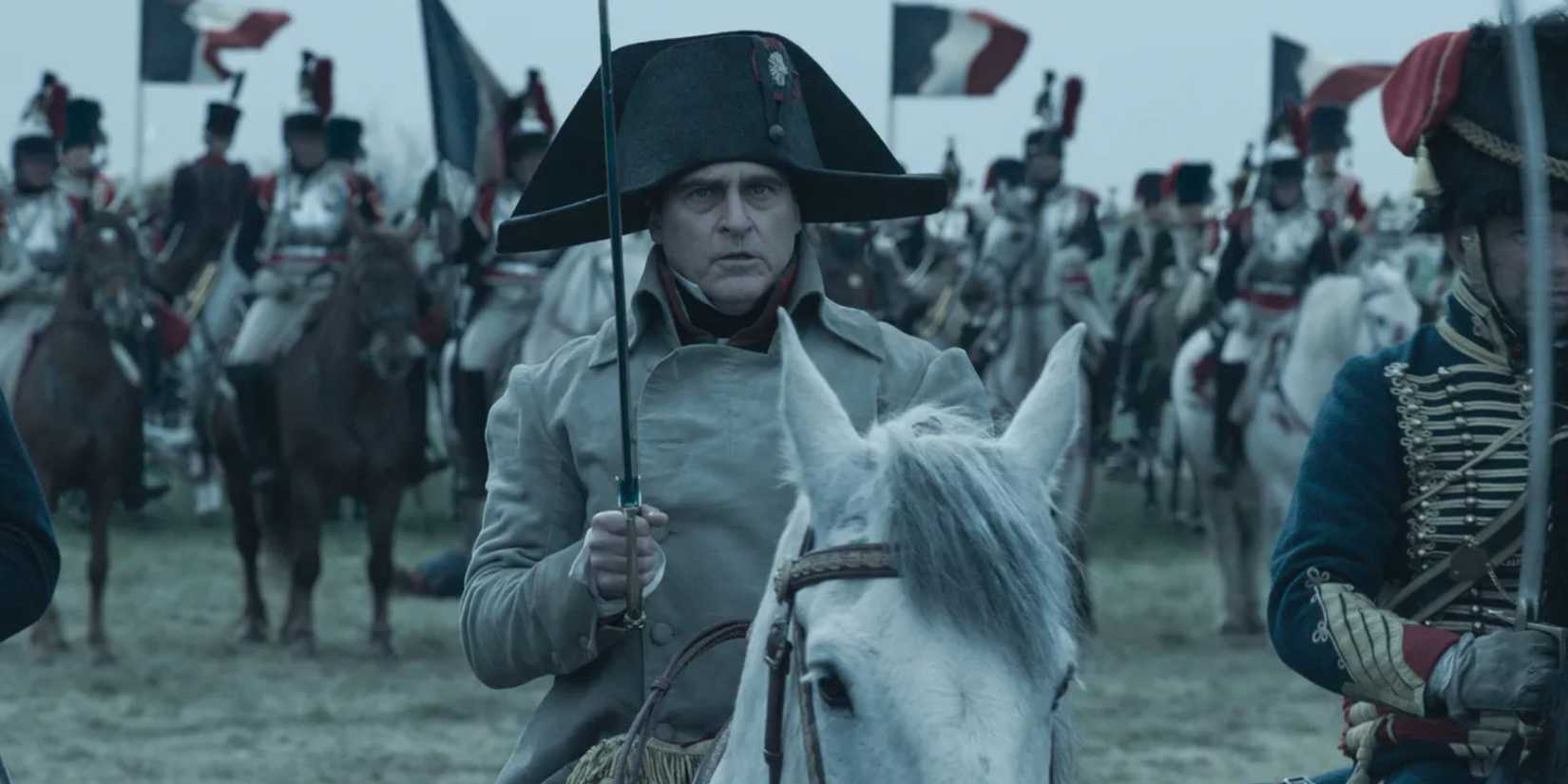
Joaquin Phoenix as Napoleon Bonaparte riding a white horse into battle in Ridley Scott's Napoleon
Image via Apple Studios
2023’s Napoleon asks the question: “What if Napoleon Bonaparte was actually kind of a loser?”, which immediately sets it up to be the kind of movie that’ll divide audiences. It’s not a full-on comedy, but there are still a good many jokes made at the titular character’s expense, painting his attempted conquest of Europe as one doomed from the start, turning his life story into a rise-and-fall narrative of sorts.
It might not always be historically accurate, but there’s also an argument to be made that any movie set before a certain point in history (maybe before things could be documented through photographs or on film) is going to struggle with historical accuracy. If one can get on board with what Napoleon is going for and not get too upset about what it’s not going for, there are things to be impressed and entertained by on offer here.
Release Date
November 22, 2023
Runtime
158 Minutes
Director
7 'Quills' (2000)
Director: Philip Kaufman
Perhaps a little like the aforementioned The Terror, Quills uses Napoleon’s reign over France as a background element, as it’s principally a biographical film about the infamous Marquis de Sade. He was a writer whose work caused controversy and tended to get labeled as blasphemous and/or pornographic, offending many high-ranking people in French society, Napoleon and his peers included.
Quills itself is also a confronting and potentially alarming film, perhaps matching the kind of energy Marquis de Sade’s works had and aiming to challenge viewers in the early 21st century, much the same way the writer’s works seemed to provoke those in the early 19th century, when Napoleon was in power. Also interesting is the fact that Joaquin Phoenix - who played Napoleon in 2023’s Napoleon - has a supporting role in this, but not as Napoleon (who is also in the movie, but instead played by an actor named Ron Cook).
6 'Love and Death' (1975)
Director: Woody Allen

Woody Allen and Diane Keaton in Love and Death - 1975
Image via United Artists
A film written and directed by Woody Allen, starring both him and Diane Keaton and released just two years before the immensely successful Annie Hall, Love and Death might well be the funniest movie set during the Napoleonic Wars. It’s intended to satirize Russian literature, and has a chaotic plot that involves a soldier and a woman taking part in an ill-fated attempt to assassinate Napoleon Bonaparte.
It’s farcical enough that even those who want historical accuracy won’t mind how surreal and out-there Love and Death gets, and it works well as a straightforward comedy even for those not familiar with the sorts of stories being parodied. Like many great comedies, it doesn’t waste a lot of time and clocks in at under 90 minutes, so it’s pretty easy to recommend.
5 'The Duellists' (1977)
Director: Ridley Scott

Harvey Keitel and Keith Carradine as Gabriel and Armand dueling in a barn in 'The Duellists' (1977)
Image via Paramount Pictures
2023’s Napoleon didn’t mark the first time Ridley Scott had a go at making a film set during Napoleon’s time, as his feature directorial debut, The Duellists, also took place during this turbulent time in history. It plays out over the first 15 or so years of the 1800s, but keeps things fairly small-scale, focusing on two rival officers (one a supporter of Napoleon), and a series of duels they fought each other in over a decade and a half.
It was a film that showed Scott’s early potential, and though he would go on to make even better films, The Duellists is still hugely impressive as far as debuts go. It’s emotionally intense and has a handful of memorable action set pieces, as you might well expect from a movie that calls itself The Duellists.
The Duellists
Release Date
January 13, 1978
Runtime
100 minutes
Director
4 'Waterloo' (1970)
Director: Sergei Bondarchuk
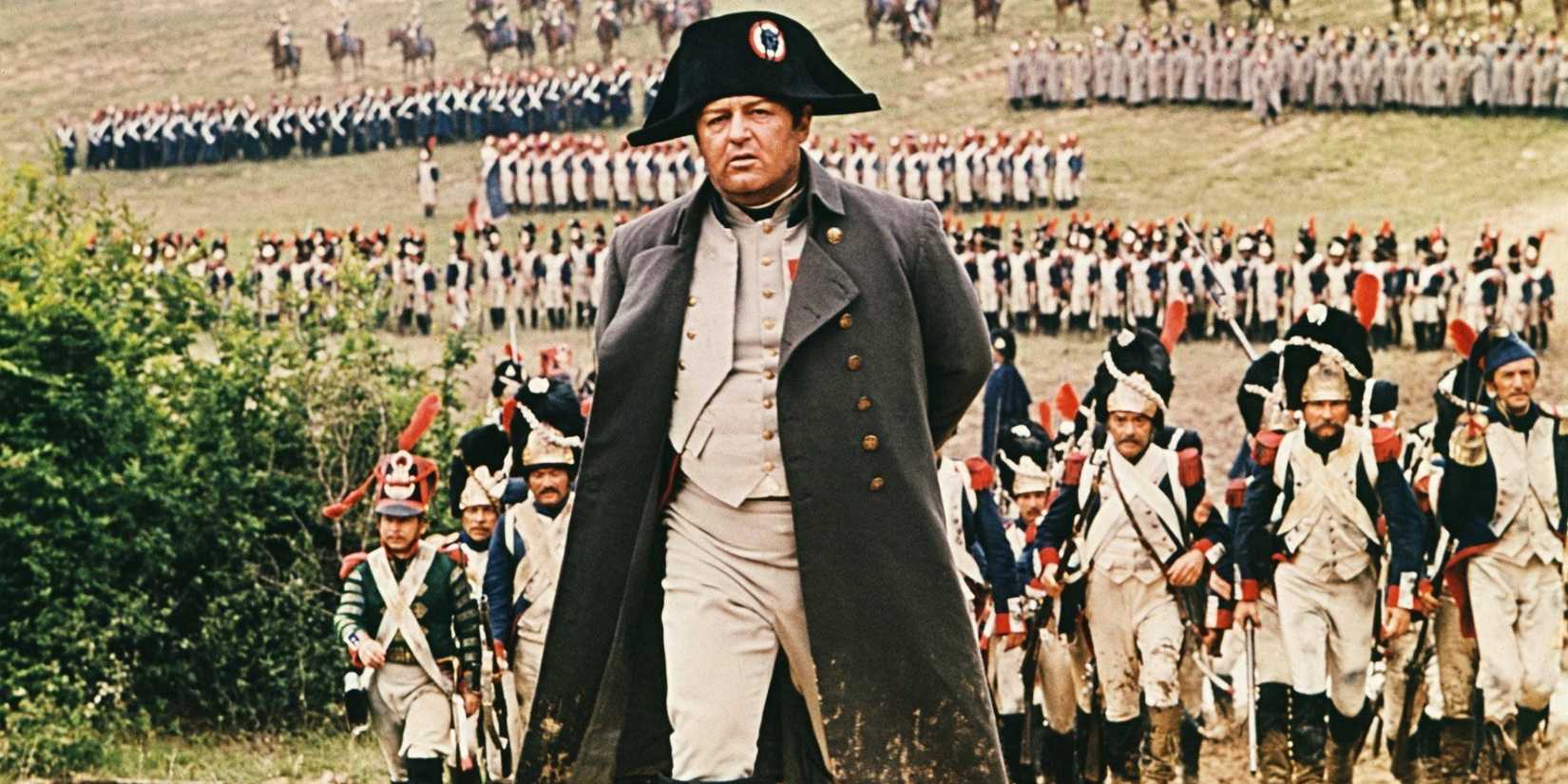
Rod Steiger in front of his troops in the 1970 Napoleon film Waterloo
Image via Columbia Pictures
Napoleon notoriously got exiled twice, with it not sticking the first time, and his attempt at a “comeback” – so to speak – involved the famed battle of Waterloo. Anyone who knows their history and/or their ABBA songs will know how 1970’s Waterloo ends, as a result, but it’s still a spectacular historical epic worth watching for anyone who appreciates battles of a massive scale playing out on screen.
Waterloo also has an impressive main cast, with Rod Steiger as Napoleon and other cast members including the likes of Christopher Plummer and Orson Welles, plus the utilization of countless extras in the battle sequences. It’s a film of immense scale, and even if its narrative is somewhat slight and told a little ordinarily, it succeeds at depicting the end of the Napoleonic Wars, and is hugely impressive from a technical perspective.
3 'Master and Commander: The Far Side of the World' (2003)
Director: Peter Weir

Russell Crowe at sea and there's a ship in the background
Image via 20th Century Fox
Master and Commander: The Far Side of the World is a sweeping and exciting film that blends the adventure and war genres to stunning effect. It’s also a Napoleonic Wars movie that isn’t told from the French perspective, and doesn’t involve Napoleon Bonaparte directly, instead focusing on a captain in the British Royal Navy, and his relentless desire to track down a French warship that previously attacked his own ship.
It's set largely at sea, and does an amazing job of transporting viewers back some 200 years and making them feel the enormity of the conflict and the madness inherent within it (and, arguably, all wars). Master and Commander: The Far Side of the World was a critical hit but not necessarily a box office one; still, it’s held in high regard to this day, and is worth tracking down (treat it like a French warship) for anyone who might’ve previously missed it.
Release Date
November 14, 2003
Runtime
138 Minutes
Director
2 'Napoleon' (1927)
Director: Abel Gance
Admittedly, the definitive Napoleon Bonaparte movie, simply called Napoleon (not to be mixed up with the one from 2023) isn’t so much about the Napoleonic Wars… at least not quite. It tells the story of Napoleon’s early years, starting with his childhood and building up to the point when he did start his military campaigns, the momentum of which carried through from the end of the 1700s into the early 1800s, which is when the Napoleonic Wars were technically fought.
There is a good deal of combat and wartime strategizing in Napoleon, though, and director Abel Gance certainly intended to cover the Napoleonic Wars specifically, but he only made one film about Napoleon Bonaparte, instead of the planned half-dozen. Still, one Napoleon might well be more than enough for some people, considering this ambitious silent epic runs for a staggering – and ultimately rewarding – five and a half hours.
1 'War and Peace' (1966-1967)
Director: Sergei Bondarchuk

Countless soldiers marching in formation in War and Peace 1966 - 1967
Image via Mosfilm
A few years before Waterloo, Sergei Bondarchuk made an even greater film that dealt with the Napoleonic Wars: War and Peace. This is quite simply one of the biggest and most daring epics of all time, with four parts totaling close to seven hours, all adding up to be a surprisingly complete/coherent film adaptation of the mammoth Leo Tolstoy novel of the same name.
War and Peace spans from 1805 to about 1812, with it all playing out during the time of the Napoleonic Wars, even though the man of the hour is only a minor character, all things considered. Still, Napoleon is by and large responsible for the war parts of War and Peace, but there’s much more to the film than just the battle scenes, with parts of the story being about love, parts being about survival, and other parts dealing with the political/social climate of Russia around the time of Napoleon’s invasion. Calling the whole thing a spectacle would be a severe understatement.
Release Date
March 14, 1966
Runtime
393 Minutes
Director
Sergey Bondarchuk