Regional and global projections of twenty-first century glacier mass changes in response to climate scenarios from global climate models (original) (raw)
Abstract
A large component of present-day sea-level rise is due to the melt of glaciers other than the ice sheets. Recent projections of their contribution to global sea-level rise for the twenty-first century range between 70 and 180 mm, but bear significant uncertainty due to poor glacier inventory and lack of hypsometric data. Here, we aim to update the projections and improve quantification of their uncertainties by using a recently released global inventory containing outlines of almost every glacier in the world. We model volume change for each glacier in response to transient spatially-differentiated temperature and precipitation projections from 14 global climate models with two emission scenarios (RCP4.5 and RCP8.5) prepared for the Fifth Assessment Report of the Intergovernmental Panel on Climate Change. The multi-model mean suggests sea-level rise of 155 ± 41 mm (RCP4.5) and 216 ± 44 mm (RCP8.5) over the period 2006–2100, reducing the current global glacier volume by 29 or 41 %. The largest contributors to projected global volume loss are the glaciers in the Canadian and Russian Arctic, Alaska, and glaciers peripheral to the Antarctic and Greenland ice sheets. Although small contributors to global volume loss, glaciers in Central Europe, low-latitude South America, Caucasus, North Asia, and Western Canada and US are projected to lose more than 80 % of their volume by 2100. However, large uncertainties in the projections remain due to the choice of global climate model and emission scenario. With a series of sensitivity tests we quantify additional uncertainties due to the calibration of our model with sparsely observed glacier mass changes. This gives an upper bound for the uncertainty range of ±84 mm sea-level rise by 2100 for each projection.
Access this article
Subscribe and save
- Starting from 10 chapters or articles per month
- Access and download chapters and articles from more than 300k books and 2,500 journals
- Cancel anytime View plans
Buy Now
Price excludes VAT (USA)
Tax calculation will be finalised during checkout.
Instant access to the full article PDF.
Fig. 1

The alternative text for this image may have been generated using AI.
Fig. 2

The alternative text for this image may have been generated using AI.
Fig. 3
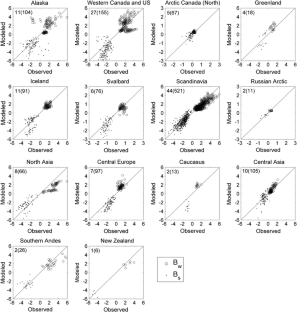
The alternative text for this image may have been generated using AI.
Fig. 4

The alternative text for this image may have been generated using AI.
Fig. 5

The alternative text for this image may have been generated using AI.
Fig. 6
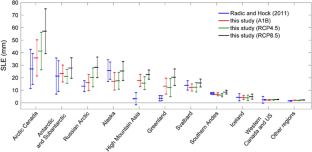
The alternative text for this image may have been generated using AI.
Fig. 7

The alternative text for this image may have been generated using AI.
Fig. 8
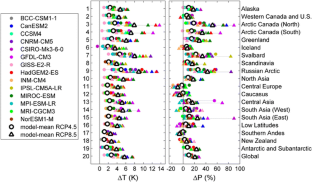
The alternative text for this image may have been generated using AI.
Fig. 9
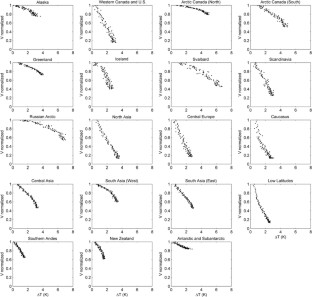
The alternative text for this image may have been generated using AI.
Fig. 10
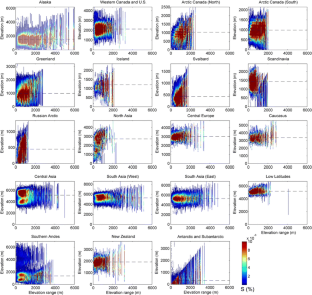
The alternative text for this image may have been generated using AI.
Fig. 11
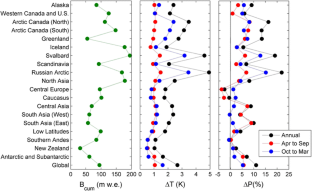
The alternative text for this image may have been generated using AI.
References
- Adhikari S, Marshall SJ (2012) Glacier volume-area relation for high-order mechanics and transient glacier states. Geophys Res Lett 39:L16505. doi:10.1029/2012GL052712
Article Google Scholar - Arendt A et al (2012) Randolph glacier inventory: a dataset of global glacier outlines version: 2.0, 11 June 2012, GLIMS Technical Report
- Bahr DB, Meier MF, Peckham SD (1997) The physical basis of glacier volume-area scaling. J Geophys Res 102(B9):20355–20362
Article Google Scholar - Beck C, Grieser J, Rudolf B (2005) A new monthly precipitation climatology for the global land areas for the period 1951 to 2000. German Weather Service, Offenbach
Google Scholar - Bevington PR (1969) Data reduction and error analysis for the physical sciences. McGraw-Hill, New York
Google Scholar - Bliss A, Hock R, Cogley JG (2013) A new inventory of mountain glaciers and ice caps for the Antarctic periphery. Ann Glaciol 54(63):191–199. doi:10.3189/2013AoG63A377
Google Scholar - Burgess D, Sharp M, Mair D, Dowdeswell J, Benham T (2005) Flow dynamics and iceberg calving rates of Devon Ice Cap, Nunavut, Canada. J Glaciol 51:219–230
Article Google Scholar - Chen J, Ohmura A (1990) Estimation of Alpine glacier water resources and their change since the 1870’s. Int Assoc Hydrol Sci Publ 193:127–135
Google Scholar - Clarke GKC, Anslow FS, Jarosch AH, Radić V, Menounos B, Bolch T, Berthier E (2012) Ice volume and subglacial topography for western Canadian glaciers from mass balance fields, thinning rates, and a bed stress model. J Climate. doi:10.1175/JCLI-D-12-00513.1
Google Scholar - Cogley JG (2009a) A more complete version of the World Glacier Inventory. Ann Glaciol 50(53):32–38
Article Google Scholar - Cogley JG (2009b) Geodetic and direct mass-balance measurements: comparison and joint analysis. Ann Glaciol 50(50):96–100
Article Google Scholar - Cogley JG et al (2011) Glossary of glacier mass balance and related terms. UNESCO-IHP
- Columbus J, Sirguey P, Tenzer R (2011) A free, fully assessed 15-m DEM for New Zealand. Survey Q 66:16–19
Google Scholar - de Woul M, Hock R (2005) Static mass balance sensitivity of Arctic glaciers and ice caps using a degree-day approach. Ann Glaciol 42:217–224
Article Google Scholar - Dowdeswell JA, Benham TJ, Strozzi T, Hagen O (2008) Iceberg calving flux and mass balance of the Austfonna ice cap on Nordaustlandet, Svalbard. J Geophys Res 113:F03022
Article Google Scholar - Dyurgerov MB (2010) Reanalysis of glacier changes: from the IGY to the IPY, 1960–2008. Data Glaciol Stud 108:1–116
Google Scholar - Dyurgerov MB, Meier MF (2005) Glaciers and the changing earth system: a 2004 snapshot. INSTARR occasional paper 58, University of Colorado, Boulder
- Gardner AS, Moholdt G, Cogley JG, Wouters B, Arendt AA, Wahr J, Berthier E, Hock R, Pfeffer WT, Kaser G, Ligtenberg SRM, Bolch T, Sharp MJ, Hagen JO, van den Broeke M, Paul F (2013) A consensus estimate of glacier contributions to sea level rise: 2003 to 2009. Science (accepted)
- Hock R, de Woul M, Radić V, Dyurgerov M (2009) Mountain glaciers and ice caps around Antarctica make a large sea-level rise contribution. Geophys Res Lett 36:L07501. doi:10.1029/2008GL037020
Article Google Scholar - Huss M (2011) Present and future contribution of glaciers to runoff from macroscale drainage basins in Europe. Water Resour Res 47:W07511. doi:10.1029/2010WR010299
Article Google Scholar - Huss M, Funk M, Ohmura A (2009) Strong Alpine melt in the 1940s due to enhanced solar radiation. Geophys Res Lett 36:L23501
Article Google Scholar - Huss M, Hock R, Bauder A, Funk M (2012) Conventional versus reference-surface mass balance. J Glaciol 58(208):278–286
Article Google Scholar - Jarvis A, Reuter HI, Nelson A, Guevara E (2008) Hole-filled seamless SRTM data V4. http://srtm.csi.cgiar.org. Accessed 29 February 2012
- Kållberg PW, Simmons AJ, Uppala SM, Fuentes M (2004) The ERA-40 Archive. ERA-40 Project Report Series 17, ECMWF, Reading
- Kaser G, Cogley JG, Dyurgerov MB, Meier MF, Ohmura A (2006) Mass balance of glaciers and ice caps: consensus estimates for 1961–2004. Geophys Res Lett 33. doi:10.1029/2006GL027511
- Kaser G, Großhauser M, Marzeion B (2010) Contribution potential of glaciers to water availability in different climate regimes. PNAS 107:20223–20227
Article Google Scholar - Liu HK, Jezek K, Li B, Zhao Z (2001) Radarsat Antarctic mapping project digital elevation model version 2, Digital media. National Snow and Ice Data Center, Boulder. http://nsidc.org/data/nsidc-0082.html
- Lüthi MP (2009) Transient response of idealized glaciers to climate change. J Glaciol 55(193):918–930
Article Google Scholar - Marzeion B, Jarosch AH, Hofer M (2012) Past and future sea-level change from the surface mass balance of glaciers. Cryosphere 6:1295–1322. doi:10.5194/tc-6-1295-2012
Article Google Scholar - Meier MF, Dyurgerov MB, Rick UK, O’Neel S, Pfeffer WT, Anderson RS, Anderson SP, Glazovsky AF (2007) Glaciers dominate eustatic sea-level rise in 21st century. Science 317:1064–1067
Article Google Scholar - Moss RH (2010) The next generation of scenarios for climate change research and assessment. Nature 463:747–756. doi:10.1038/nature08823
Article Google Scholar - Paul F, Haeberli W (2008) Spatial variability of glacier elevation changes in the Swiss Alps obtained from two digital elevation models. Geophys Res Lett 35:L21502
Article Google Scholar - Radić V, Hock R (2006) Modelling mass balance and future evolution of glaciers using ERA-40 and climate models—A sensitivity study at Storglaciären, Sweden. J Geophys Res 111:F03003
Google Scholar - Radić V, Hock R (2010) Regional and global volumes of glaciers derived from statistical upscaling of glacier inventory data. J Geophys Res 115:F01010. doi:10.1029/2009JF001373
Google Scholar - Radić V, Hock R (2011) Regionally differentiated contribution of mountain glaciers and ice caps to future sea-level rise. Nat Geosci 4:91–94. doi:10.1038/NGEO1052
Article Google Scholar - Radić V, Hock R, Oerlemans J (2007) Volume-area scaling vs flowline modelling in glacier volume projections. Ann Glaciol 46:234–240
Article Google Scholar - Radić V, Hock R, Oerlemans J (2008) Analysis of scaling methods in deriving future volume evolutions of valley glaciers. J Glaciol 54(187):601–612
Article Google Scholar - Randall DA et al (2007) Climate models and their evaluation. In: Solomon S et al (eds) IPCC climate change 2007: the physical science basis. Cambridge University Press, Cambridge
Google Scholar - Raper SBC, Braithwaite RJ (2006) Low sea level rise projections from mountain glaciers and icecaps under global warming. Nature 439:311–313. doi:10.1038/nature04448
Article Google Scholar - Rastner PN, Mölg T, Machguth H, Paul F (2012) The first complete glacier inventory for the whole of Greenland. Cryosphere 6:1483–1495. doi:10.5194/tc-6-1483-2012
Article Google Scholar - Schiefer E, Menounos B, Wheate R (2007) Recent volume loss of British Columbia glaciers, Canada. Geophys Res Lett 34:L16503
Article Google Scholar - Slangen ABA, Katsman CA, van de Wal RSW, Vermeersen LLA, Riva REM (2012) Towards regional projections of twenty-first century sea-level change based on IPCC SRES scenarios. Clim Dyn 38:1191–1209. doi:10.1007/s00382-011-1057-6
Article Google Scholar - Tachikawa T, Hato M, Kaku M, Iwasaki A (2011) The characteristics of ASTER GDEM version 2, IGARSS
- Taylor KE, Stouffer RJ, Meehl GA (2012) An overview of CMIP5 and the experiment design. Bull Am Meteorol Soc 93:485–498. doi:10.1175/BAMS-D-11-00094.1
Article Google Scholar - Woodward J, Sharp M, Arendt A (1997) The influence of superimposed-ice formation on the sensitivity of glacier mass balance to climate change. Ann Glaciol 24:186–190
Google Scholar - Zwally HJ, Schutz R, Bentley C, Bufton J, Herring T, Minster J, Spinhirne J, Thomas R (2012) GLAS/ICESat L2 Antarctic and Greenland Ice Sheet Altimetry Data V001. Boulder, CO: National Snow and Ice Data Center. Digital media
Acknowledgments
Funding was provided by NASA grant (NNH10Z1A001N and NNX11AO23G) and NSF (grant EAR-0943742). We thank the two anonymous reviewers for their comments which helped us to significantly improve the manuscript.
Author information
Authors and Affiliations
- Earth, Ocean and Atmospheric Sciences Department, University of British Columbia, 2020–2207 Main Mall, Vancouver, BC, V6T 1Z4, Canada
Valentina Radić & Evan Miles - Geophysical Institute, University of Alaska Fairbanks, 903 Koyukuk Dr., Fairbanks, AK, 99775-7320, USA
Andrew Bliss, A. Cody Beedlow & Regine Hock - Scott Polar Research Institute, University of Cambridge, Lensfield Road, Cambridge, CB2 1ER, UK
Evan Miles - Department of Geography, Trent University, Peterborough, ON, K9J 7B8, Canada
J. Graham Cogley
Authors
- Valentina Radić
- Andrew Bliss
- A. Cody Beedlow
- Regine Hock
- Evan Miles
- J. Graham Cogley
Corresponding author
Correspondence toValentina Radić.
Electronic supplementary material
Rights and permissions
About this article
Cite this article
Radić, V., Bliss, A., Beedlow, A.C. et al. Regional and global projections of twenty-first century glacier mass changes in response to climate scenarios from global climate models.Clim Dyn 42, 37–58 (2014). https://doi.org/10.1007/s00382-013-1719-7
- Received: 01 August 2012
- Accepted: 02 March 2013
- Published: 02 April 2013
- Issue date: January 2014
- DOI: https://doi.org/10.1007/s00382-013-1719-7