US energy system transitions under cumulative emissions budgets (original) (raw)
Abstract
Cumulative emissions budgets are increasingly being used by decision-makers and analysts to understand emissions reductions and associated transitions in the context of long-term goals such as limiting global mean temperature increase over the century to 1.5 or 2 °C. While previous studies have explored the implications of such budgets for the global economy, few studies have conducted regional- and national-level analyses. This paper explores budgets through 2050 consistent with the 1.5 and 2 °C long-term temperature goals in the context of the USA. We employ a state-level model of the USA embedded within a global human-Earth system model (GCAM-USA) to study the implications of such budgets for the US energy system. Our results show that achieving the stringent budgets entails accelerated deployment of energy conserving technology, almost complete decarbonization of the power sector, increased electrification of buildings and industrial end-use sectors, and decarbonization of transport employing a combination of electrification and the substitution of fossil fuels for bioenergy. We also find substantial state-level differences in the relative roles of these decarbonization strategies. Furthermore, our results highlight that increased ambition in the near term will be valuable in setting the stage for smoother transformations in the future to achieve stringent budgets.
Access this article
Subscribe and save
- Starting from 10 chapters or articles per month
- Access and download chapters and articles from more than 300k books and 2,500 journals
- Cancel anytime View plans
Buy Now
Price excludes VAT (USA)
Tax calculation will be finalised during checkout.
Instant access to the full article PDF.
Fig. 1
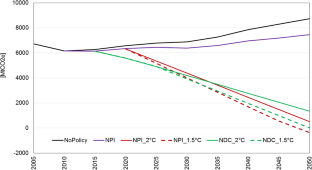
The alternative text for this image may have been generated using AI.
Fig. 2
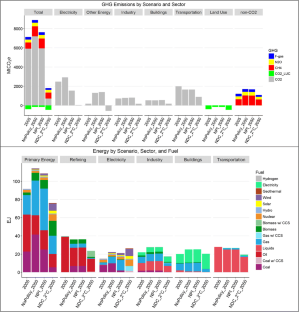
The alternative text for this image may have been generated using AI.
Fig. 3
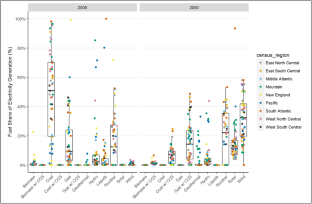
The alternative text for this image may have been generated using AI.
Fig. 4
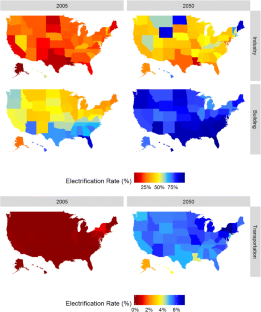
The alternative text for this image may have been generated using AI.
Notes
- For instance, a recent study shows that considering the role of non-CO2 emissions (and hence resulting radiative forcing) is important to improve the approximations of global temperature change based on cumulative emissions or emissions budget (Feijoo et al. 2019).
- At the time of this analysis, the Clean Power Plan was a final regulation undergoing court review. At the time of submission, the US Environmental Protection Agency had filed Proposal to Repeal the Clean Power Plan (16 Oct. 2017; see https://www.gpo.gov/fdsys/pkg/FR-2017-10-16/pdf/2017-22349.pdf).
- For comparison, electricity’s share of building final energy in the NoPolicy scenario is 58%.
- Electrification rate is defined as final energy consumption from electricity divided by total final energy consumption for a given sector.
- Transportation sector electrification ranges from 4.0 to 7.3% among the 48 contiguous states in 2050.
- Note that GCAM-USA considers a unique carbon price in the USA, which is imposed to all states. Electrification rates are driven by cost, and no bounds on the levels or rates of electrification have been considered in this research.
- This excludes Hawaii and DC, which are significant outliers.
References
- Calvin K et al (2019) GCAM v5.1: representing the linkages between energy, water, land, climate, and economic systems. Geosci Model Dev 12:677–698. https://doi.org/10.5194/gmd-12-677-2019
Article Google Scholar - Capros P et al (2014) European decarbonisation pathways under alternative technological and policy choices: a multi-model analysis. Energy Strat Rev 2:231–245. https://doi.org/10.1016/j.esr.2013.12.007
Article Google Scholar - Capros P, Tasios N, De Vita A, Mantzos L, Paroussos L (2012) Model-based analysis of decarbonising the EU economy in the time horizon to 2050. Energy Strat Rev 1:76–84. https://doi.org/10.1016/j.esr.2012.06.003
Article Google Scholar - CD-LINKS (2018) Linking Climate and Development Policies – Leveraging International Networks and Knowledge Sharing (CD-LINKS). http://www.cd-links.org/.
- Chen W, Yin X, Zhang H (2016) Towards low carbon development in China: a comparison of national and global models. Clim Chang 136:95–108. https://doi.org/10.1007/s10584-013-0937-7
Article Google Scholar - Clarke JF, Edmonds J (1993) Modelling energy technologies in a competitive market. Energy Econ 15:123–129
Article Google Scholar - Clarke L et al (2014) Assessing transformation pathways. In: Edenhofer O et al (eds) Climate change 2014: mitigation of climate change. Contribution of Working Group III to the Fifth Assessment Report of the Intergovernmental Panel on Climate Change. Cambridge University Press, Cambridge
Google Scholar - Creutzig F, Jochem P, Edelenbosch OY, Mattauch L, van Vuuren DP, McCollum D, Minx J (2015) Transport: a roadblock to climate change mitigation? Science 350:911–912. https://doi.org/10.1126/science.aac8033
Article Google Scholar - DDPP (2015) Deep Decarbonization pathways project (2015). Pathways to deep decarbonization 2015 REPORT, SDSN - IDDRI, http://deepdecarbonization.org/wp-content/uploads/2016/03/DDPP_2015_REPORT.pdf (accessed online on march 08 2017)
- Duscha V, Denishchenkova A, Wachsmuth J (2019) Achievability of the Paris Agreement targets in the EU: demand-side reduction potentials in a carbon budget perspective. Clim Pol 19:161–174. https://doi.org/10.1080/14693062.2018.1471385
Article Google Scholar - Environmental Protection Agency (2015a) Carbon pollution emission guidelines for existing stationary sources: electric utility generating units. Office of the Federal Register, Washington, DC
- Environmental Protection Agency (2015b) Standards of performance for greenhouse gas emissions from new, modified, and reconstructed stationary sources: electric utility generating units, 80 Federal Register 205 (23 October 2015) (40 CFR parts 60, 70, 71, and 98): 64513, 64546–64547, https://www.gpo.gov/fdsys/pkg/FR-2015-10-23/pdf/2015-22837.pdf ()
- Fawcett AA, Calvin KV, de la Chesnaye FC, Reilly JM, Weyant JP (2009) Overview of EMF 22 U.S. transition scenarios. Energy Econ 31:S198–S211. https://doi.org/10.1016/j.eneco.2009.10.015
Article Google Scholar - Fawcett AA, Clarke LE, Weyant J (2014) The EMF24 study on U.S.Technology and climate policy strategies the energy journal 35:1-7
- Fawcett AA et al (2015) Can Paris pledges avert severe climate change? Science 350:1168–1169. https://doi.org/10.1126/science.aad5761
Article Google Scholar - Feijoo F et al (2018) The future of natural gas infrastructure development in the United States. Applied Energy, 228:149–166. https://doi.org/10.1016/j.apenergy.2018.06.037
- Feijoo F, Mignone BK, Kheshgi HS, Hartin C, McJeon H, Edmonds J (2019) Climate and carbon budget implications of linked future changes in CO2 and non-CO2 forcing. Environ Res Lett 14:044007. https://doi.org/10.1088/1748-9326/ab08a9
Article Google Scholar - GCAM v4.2 Documentation. (2017) Joint Global Change Research Institute. http://jgcri.github.io/gcam-doc/v4.2/toc.html.
- Hultman N, Calhoun K (2018) Fulfilling America’s pledge: how states, cities and businesses are leading the United States to a low-carbon Future. Bloomberg Philanthropies,
- IPCC (2014) Climate change 2014: synthesis report. Contribution of working groups I, II and III to the Fifth Assessment Report of the Intergovernmental Panel on Climate Change. Intergovernmental Panel on Climate Change, Geneva
Google Scholar - Iyer G, Ledna C, Clarke L, McJeon H, Edmonds J, Wise M (2017a) GCAM-USA analysis of US electric power sector transitions. http://www.pnnl.gov/main/publications/external/technical_reports/PNNL-26174.pdf. Pacific northwest National Laboratory,
- Iyer G, Ledna C, Clarke LE, Edmonds J, McJeon H, Kyle GP, Williams JA (2017b) Measuring progress from nationally determined contributions to mid-century strategies. Nat Clim Chang 7:871–874. https://doi.org/10.1038/s41558-017-0005-9
Article Google Scholar - Iyer GC et al (2015) The contribution of Paris to limit global warming to 2°C. Environ Res Lett 10:125002
Article Google Scholar - Kim S, Edmonds J, Lurz J, Smith S, Wise M (2006) The objects framework for integrated assessment: hybrid modeling of transportation. Energy J 27:63–91
Google Scholar - Kraucunas I et al (2014) Investigating the nexus of climate, energy, water, and land at decision-relevant scales: the platform for regional integrated modeling and analysis (PRIMA). Clim Chang 129:573–588. https://doi.org/10.1007/s10584-014-1064-9
Article Google Scholar - Matthews HD, Zickfeld K, Knutti R, Allen MR (2018) Focus on cumulative emissions, global carbon budgets and the implications for climate mitigation targets. Environ Res Lett:13, 010201. https://doi.org/10.1088/1748-9326/aa98c9
- McFadden D (1980) Econometric models for probabilistic choice among products the. J Bus 53:S13–S29
Article Google Scholar - Muratori M et al (2017a) Cost of power or power of cost: a U.S. modeling perspective. Renew Sust Energ Rev 77:861–874. https://doi.org/10.1016/j.rser.2017.04.055
Article Google Scholar - Muratori M, Smith SJ, Kyle P, Link R, Mignone BK, Kheshgi HS (2017b) Role of the freight sector in future climate change mitigation scenarios. Environ Sci Technol 51:3526–3533. https://doi.org/10.1021/acs.est.6b04515
Article Google Scholar - Pan X, Wang H, Wang L, Chen W (2018) Decarbonization of China’s transportation sector. In: Light of national mitigation toward the Paris Agreement goals, vol 155. https://doi.org/10.1016/j.energy.2018.04.144
Chapter Google Scholar - Peters GP (2018) Beyond carbon budgets. Nat Geosci 11:378–380. https://doi.org/10.1038/s41561-018-0142-4
Article Google Scholar - Riahi K et al (2015) Locked into Copenhagen pledges — implications of short-term emission targets for the cost and feasibility of long-term climate goals. Technol Forecast Soc Chang 90(part a):8–23. https://doi.org/10.1016/j.techfore.2013.09.016
Article Google Scholar - Riahi K et al. (2016) The shared socioeconomic pathways and their energy, land use, and greenhouse gas emissions implications: an overview global environmental change doi:https://doi.org/10.1016/j.gloenvcha.2016.05.009
- Rochedo PRR et al (2018) The threat of political bargaining to climate mitigation in Brazil. Nat Clim Chang 8:695–698. https://doi.org/10.1038/s41558-018-0213-y
Article Google Scholar - Rogelj J et al (2016) Differences between carbon budget estimates unravelled. Nat Clim Chang 6:245. https://doi.org/10.1038/nclimate2868
Article Google Scholar - The White House (2016) United States Mid-Century Strategy for Deep Decarbonization (Washington, D.C., November 2016): 22, https://obamawhitehouse.archives.gov/sites/default/files/docs/mid_century_strategy_report-final.pdf (Accessed 1 February 2017)
- Train K (1993) Qualitative choice analysis: theory, econometrics, and an application to automobile demand MIT press,
- US Congress (2016) Consolidated appropriations act, 2016. Government Publishing Office, Washington, DC
Google Scholar - U.S. Department of Energy (2011) U.S. billion-ton update: biomass supply for a bioenergy and bioproducts industry. Oak Ridge National Laboratory, Oak Ridge
Google Scholar - U.S. Energy Information Administration (2017) Annual energy outlook 2017, January 2017, http://www.eia.gov/outlooks/aeo/ ()
- UNFCCC (2015a) INDCs as communicated by Parties: http://www4.unfccc.int/submissions/indc/Submission%20Pages/submissions.aspx
- UNFCCC (2015b) The Paris Agreement, http://unfccc.int/paris_agreement/items/9485.php
- UNFCCC (2015c) U.S.A. First NDC submission
- Vrontisi Z, Fragkiadakis K, Kannavou M, Capros P (2019) Energy system transition and macroeconomic impacts of a European decarbonization action towards a below 2 °C climate stabilization. Clim Chang 13:1–19. https://doi.org/10.1007/s10584-019-02440-7
Article Google Scholar - Wang C, Yang Y, Zhang J (2015) China’s sectoral strategies in energy conservation and carbon mitigation. Clim Pol 15:S60–S80. https://doi.org/10.1080/14693062.2015.1050346
Article Google Scholar - Williams JH, Haley B, Kahrl F, Moore J, Jones AD, Torn MS, McJeon H (2014) Pathways to deep decarbonization in the United States. The U.S. report of the deep decarbonization pathways project of the sustainable development solutions network and the institute for sustainable development and international relations
Funding
This work is part of a project that has received funding from the European Union’s Horizon 2020 research and innovation programme under grant agreement no. 642147 (CD-LINKS).
Author information
Authors and Affiliations
- School of Industrial Engineering, Pontificia Universidad Católica de Valparaíso, Valparaíso, Chile
Felipe Feijoo - Pacific Northwest National Laboratory, Joint Global Change Research Institute, College Park, MD, USA
Gokul Iyer, Matthew Binsted & James Edmonds
Authors
- Felipe Feijoo
- Gokul Iyer
- Matthew Binsted
- James Edmonds
Corresponding author
Correspondence toGokul Iyer.
Additional information
Publisher’s note
Springer Nature remains neutral with regard to jurisdictional claims in published maps and institutional affiliations.
This article is part of a Special Issue on 'National Low-Carbon Development Pathways' edited by Roberto Schaeffer, Valentina Bosetti, Elmar Kriegler, Keywan Riahi, Detlef van Vuuren, and John Weyant.
Electronic supplementary material
Rights and permissions
About this article
Cite this article
Feijoo, F., Iyer, G., Binsted, M. et al. US energy system transitions under cumulative emissions budgets.Climatic Change 162, 1947–1963 (2020). https://doi.org/10.1007/s10584-020-02670-0
- Received: 07 May 2019
- Accepted: 17 December 2019
- Published: 10 February 2020
- Version of record: 10 February 2020
- Issue date: October 2020
- DOI: https://doi.org/10.1007/s10584-020-02670-0