The threat of political bargaining to climate mitigation in Brazil (original) (raw)
- Letter
- Published: 09 July 2018
- Britaldo Soares-Filho2,
- Roberto Schaeffer ORCID: orcid.org/0000-0002-3709-73231,
- Eduardo Viola3,
- Alexandre Szklo1,
- André F. P. Lucena1,
- Alexandre Koberle1,
- Juliana Leroy Davis2,4,
- Raoni Rajão4 &
- …
- Regis Rathmann1
Nature Climate Change volume 8, pages 695–698 (2018) Cite this article
- 8050 Accesses
- 221 Citations
- 292 Altmetric
- Metrics details
Subjects
Abstract
In exchange for political support, the Brazilian government is signalling landholders to increase deforestation, putting the country’s contribution to the Paris Agreement at risk1. The President of Brazil has signed provisionary acts and decrees lowering environmental licensing requirements, suspending the ratification of indigenous lands, reducing the size of protected areas and facilitating land grabbers to obtain the deeds of illegally deforested areas2. This could undermine the success of Brazil’s CO2 emission reductions through control of deforestation in the previous decade. Integrated assessment models are tools to assess progress in fulfilling global efforts to curb climate change3,4. Using integrated assessment models developed for Brazil, we explore 2 °C-compliant CO2 emission scenarios estimating the effort needed in other sectors of the economy to compensate for the weakening of environmental governance, potentially resulting in higher deforestation emissions. We found that the risk of reversals of recent trends in deforestation governance could impose a burden on other sectors that would need to deploy not yet mature technologies to compensate for higher emissions from land-use change. The abandonment of deforestation control policies and the political support for predatory agricultural practices make it impossible to meet targets consistent with Brazil’s contribution to a 2 °C world.
This is a preview of subscription content, access via your institution
Access options
Access Nature and 54 other Nature Portfolio journals
Get Nature+, our best-value online-access subscription
$32.99 / 30 days
cancel any time
Subscribe to this journal
Receive 12 print issues and online access
$259.00 per year
only $21.58 per issue
Buy this article
- Purchase on SpringerLink
- Instant access to the full article PDF.
USD 39.95
Prices may be subject to local taxes which are calculated during checkout
Additional access options:
Fig. 1: Deforestation rates.
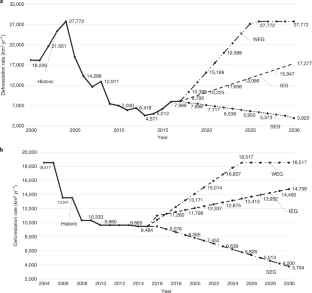
The alternative text for this image may have been generated using AI.
Fig. 2
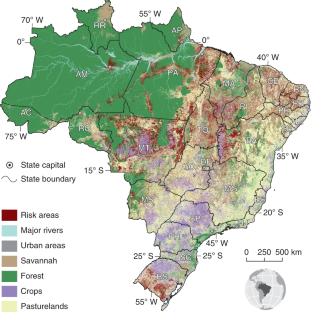
The alternative text for this image may have been generated using AI.
Fig. 3
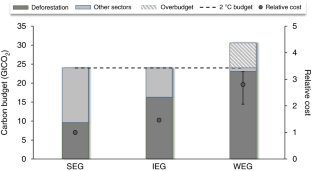
The alternative text for this image may have been generated using AI.
Fig. 4
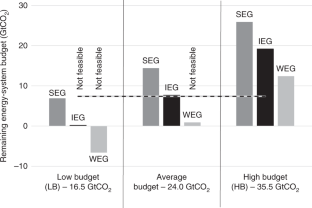
The alternative text for this image may have been generated using AI.
References
- Tollefson, J. Political upheaval threatens Brazil’s environmental protections. Nature 539, 147–148 (2016).
Article CAS Google Scholar - Tollefson, J. Brazil’s lawmakers renew push to weaken environmental rules. Nature 557, 17 (2018).
Article CAS Google Scholar - van Vuuren, D. et al. Alternative pathways to the 1.5 °C target reduce the need for negative emission technologies. Nat. Clim. Change 8, 391–397 (2018).
Article Google Scholar - Creutzig, V. et al. Towards demand-side solutions for mitigating climate change. Nat. Clim. Change 8, 268–271 (2018).
Article Google Scholar - Estimativas Anuais de Emissões de Gases de Efeito Estufa no Brasil 3rd edn (Brazil Ministério da Ciência, Tecnologia, Inovações e Comunicações, 2016); https://go.nature.com/2t0WWrO
- Soares Filho, B. S. et al. Cracking Brazil’s forest code. Science 344, 363–364 (2014).
Article CAS Google Scholar - Crouzeilles, R., Feltran-Barbieri, R., Ferreira, M. S. & Strassburg, B. B. N. Hard times for the Brazilian environment. Nat. Ecol. Evol. 1, 1213 (2017).
Article Google Scholar - Viola, E. & Franchini, M. Brazil and Climate Change: Beyond the Amazon (Routledge, New York, 2018).
- Fearnside, P. Brazilian politics threaten environmental policies. Sci. Policy Forum 353, 746–748 (2016).
CAS Google Scholar - Portaria no. 68, 14 January 2017; http://go.nature.com/2u4gJFm
- Medida Provisória no. 756, 19 December 2016; http://go.nature.com/2vhtste
- Law no. 13.465, 11 July 2017; http://go.nature.com/2f7CbYj
- Viola, E. & Franchini, M. Brazilian climate politics 2005–2012: ambivalence and paradox. WIRES Clim. Change 5, 677–688 (2014).
Article Google Scholar - PRODES – Monitoramento da Floresta Amazônica Brasileira por Satélite (Instituto Nacional de Pesquisas Espaciais database, 2017); http://www.obt.inpe.br/prodes/index.php
- Messner, D., Schellnhuber, J., Rahmstorf, S. & Klingenfeld, D. The budget approach: a framework for a global transformation toward a low-carbon economy. J. Renew. Sustain. Energy 2, 031003 (2010).
Article Google Scholar - Gignac, R. & Matthews, H. Allocating a 2 °C cumulative carbon budget to countries. Environ. Res. Lett. 10, 075004 (2015).
Article Google Scholar - Rocha, M. et al. Analysis of Equitable Mitigation Contribution of Countries (Climate Analytics, 2015); http://climateanalytics.org/files/climate_analytics_report_sept_2015.pdf
- Lucon, O., Romeiro, V. & Fransen, T. Bridging the Gap Between Energy and Climate Policies in Brazil —Policy Options to Reduce Energy-Related GHG Emissions (World Resources Institute, Washington DC, 2015).
- Kanitkar, T., Jayaraman, T., D’Souza, M. & Purkayastha, P. Carbon budgets for climate change mitigation: a GAMS-based emissions model. Curr. Sci. 104, 1200–1206 (2013).
Google Scholar - CD-LINKS Stocktaking/Fast-track Database (version 1.0) (CD-Links, 2016); https://go.nature.com/2HM208O
- Soares Filho, B. S., Rajão, R., Merry, F., Rodrigues, H., Davis, J., Lima, L., Macedo, M., Coe, M., Carneiro, A. & Santiago, L. Brazil’s Market for Trading Forest Certificates. Plos One 11, e0152311 (2016).
Article Google Scholar - Modelagem Setorial de Opções de Baixo Carbono para Agricultura, Florestas e Outros Usos do Solo (AFOLU) Technical Report (MCTIC, 2015); https://go.nature.com/2MpDIVJ
- ADVANCE wiki; http://themasites.pbl.nl/models/advance/index.php/ADVANCE_wiki
Acknowledgements
The data of the energy system model, compiled in the Supplementary Information, follow the format and template of an international effort on climate and energy systems modelling, the so-called CD-Links project (www.cdlinks.org), where the BLUES model used in this study is registered. A.K., A.S., A.F.P.L., E.V. and R.S. received support from the Brazilian Conselho Nacional de Desenvolvimento Científico e Tecnológico (CNPq). B.S.-F., J.L.D. and Ra.R. received support from the Climate and Land Use Alliance (CLUA), Fundação de Amparo à Pesquisa de Minas Gerais (FAPEMIG), CNPq and the Humboldt Foundation. P.R.R.R. and Re.R. received support from the Brazilian Coordenação de Aperfeiçoamento de Pessoal de Nível Superior (CAPES). The authors also thank B. Strassburg for some initial discussions on the subject of this study.
Author information
Authors and Affiliations
- COPPE, Universidade Federal do Rio de Janeiro, Rio de Janeiro, Brazil
Pedro R. R. Rochedo, Roberto Schaeffer, Alexandre Szklo, André F. P. Lucena, Alexandre Koberle & Regis Rathmann - Centro de Sensoriamento Remoto, UFMG, Belo Horizonte, MG, Brazil
Britaldo Soares-Filho & Juliana Leroy Davis - Instituto de Relações Internacionais, UNB, Brasília, DF, Brazil
Eduardo Viola - Departamento de Engenharia de Produção, UFMG, Belo Horizonte, MG, Brazil
Juliana Leroy Davis & Raoni Rajão
Authors
- Pedro R. R. Rochedo
- Britaldo Soares-Filho
- Roberto Schaeffer
- Eduardo Viola
- Alexandre Szklo
- André F. P. Lucena
- Alexandre Koberle
- Juliana Leroy Davis
- Raoni Rajão
- Regis Rathmann
Contributions
A.S., A.F.P.L. and R.S. performed the basic integrated modelling and conceived the methodological procedure. A.K. and P.R.R.R. were responsible for the energy system modelling and the final writing of the Supplementary Information. B.S.-F., J.L.D. and Ra.R. performed the land-use modelling and contributed to writing the manuscript and the Supplementary Information. E.V. developed the political analysis and contributed to writing the manuscript and the Supplementary Information. Re.R. was responsible for the review of the land-use results.
Corresponding author
Correspondence toRoberto Schaeffer.
Ethics declarations
Competing interests
The authors declare no competing interests.
Additional information
Publisher’s note: Springer Nature remains neutral with regard to jurisdictional claims in published maps and institutional affiliations.
Supplementary information
Rights and permissions
About this article
Cite this article
Rochedo, P.R.R., Soares-Filho, B., Schaeffer, R. et al. The threat of political bargaining to climate mitigation in Brazil.Nature Clim Change 8, 695–698 (2018). https://doi.org/10.1038/s41558-018-0213-y
- Received: 13 December 2017
- Accepted: 04 June 2018
- Published: 09 July 2018
- Version of record: 09 July 2018
- Issue date: August 2018
- DOI: https://doi.org/10.1038/s41558-018-0213-y