More Education, Less Administration: Reflections of Neuroimagers’ Attitudes to Ethics Through the Qualitative Looking Glass (original) (raw)
Abstract
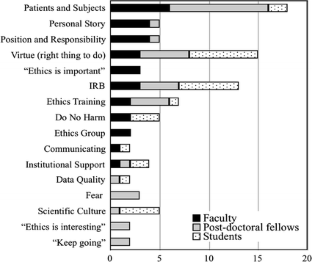
In follow-up to a large-scale ethics survey of neuroscientists whose research involves neuroimaging, brain stimulation and imaging genetics, we conducted focus groups and interviews to explore their sense of responsibility about integrating ethics into neuroimaging and readiness to adopt new ethics strategies as part of their research. Safety, trust and virtue were key motivators for incorporating ethics into neuroimaging research. Managing incidental findings emerged as a predominant daily challenge for faculty, while student reports focused on the malleability of neuroimaging data and scientific integrity. The most frequently cited barrier was time and administrative burden associated with the ethics review process. Lack of scholarly training in ethics also emerged as a major barrier. Participants constructively offered remedies to these challenges: development and dissemination of best practices and standardized ethics review for minimally invasive neuroimaging protocols. Students in particular, urged changes to curricula to include early, focused training in ethics.
Access this article
Subscribe and save
- Starting from 10 chapters or articles per month
- Access and download chapters and articles from more than 300k books and 2,500 journals
- Cancel anytime View plans
Buy Now
Price excludes VAT (USA)
Tax calculation will be finalised during checkout.
Instant access to the full article PDF.
Fig. 1

The alternative text for this image may have been generated using AI.
Fig. 2
The alternative text for this image may have been generated using AI.
Fig. 3

The alternative text for this image may have been generated using AI.
Fig. 4

The alternative text for this image may have been generated using AI.
References
- Beaulieu, A. (2002). Images are not the (only) truth: Brain mapping, visual knowledge, and iconoclasm. Science Technology Human Values, 27, 53–86.
Article Google Scholar - Bradley, E., Curry, L., & Devers, K. (2007). Qualitative data analysis for health services research: Developing taxonomy, themes, and theory. Health Services Research, 42(4), 1758–1772.
Article Google Scholar - Conti, F., & Corbellini, G. (2008). Italian neuroscientists are ready to start the debate. Nature, 451, 627.
Article Google Scholar - Deslauriers, C., Bell, E., Palmour, N., Pike, B., Doyon, J., & Racine, E. (2010). Perspectives of Canadian researchers on ethics review of neuroimaging research. Journal of Empirical Research on Human Research Ethics, 5(1), 49–66. doi:10.1525/jer.2010.5.1.49.
Article Google Scholar - Illes, J., Kirschen, M. P., Edwards, E., Stanford, L. R., Bandettini, P., Cho, M. K., et al. (2006). Ethics. Incidental findings in brain imaging research. Science, 311(5762), 783–784. doi:10.1126/science.1124665.
Article Google Scholar - Illes, J., Kirschen, M. P., & Gabrieli, J. D. (2003). From neuroimaging to neuroethics. Nature Neuroscience, 6(3), 205. doi:10.1038/nn0303-205.
Article Google Scholar - Illes, J., Moser, M. A., McCormick, J. B., Racine, E., Blakeslee, S., Caplan, A., et al. (2010a). Neurotalk: Improving the communication of neuroscience research. Nature Reviews. Neuroscience, 11(1), 61–69. doi:10.1038/nrn2773.
Article Google Scholar - Illes, J., Tairyan, K., Federico, C. A., Tabet, A., & Glover, G. H. (2010b). Reducing barriers to ethics in neuroscience. Frontiers in Human Neuroscience, 4. doi:10.3389/fnhum.2010.00167.
- Lavazza, A., & De Caro, M. (2010). Not so fast. On some bold neuroscientific claims concerning human agency. Neuroethics, 3(1), 23–41.
Article Google Scholar - Lindquist, M. A., Meng Loh, J., Atlas, L. Y., & Wager, T. D. (2009). Modeling the hemodynamic response function in fMRI: Efficiency, bias and mis-modeling. Neuroimage, 45(1 Suppl), S187–S198. doi:10.1016/j.neuroimage.2008.10.065.
Article Google Scholar - Logothetis, N. K. (2008). What we can do and what we cannot do with fMRI. Nature, 453, 869–878.
Article Google Scholar - Lombera, S., Fine, A., Grunau, R. E., & Illes, J. (2010). Ethics in neuroscience graduate training programs: Views and models from Canada. Mind, Brain, and Education, 4(1), 20–27.
Article Google Scholar - Mack, N., et al. (2005). Qualitative research methods: A data collector’s field guide. Research Triangle Park, NC: Family Health International.
Google Scholar - Sahakian, B. J., & Morein-Zamir, S. (2009). Neuroscientists need neuroethics teaching. Science, 325, 147.
Article Google Scholar - Vul, E., Harris, C., Winkielman, P., & Pashler, H. (2009). Puzzlingly high correlations in fMRI studies of emotion, personality, and social cognition. Perspectives on Psychological Science, 4(3), 274–290.
Article Google Scholar
Acknowledgments
Generously supported by National Institutes of Health/National Institutes of Mental Health (NIH/NIMH) R01 #9R01MH84282, Canadian Health Institutes of Health Research (CIHR/INMHA) #CNE 85117, Canadian Foundation for Innovation (CFI) and British Columbia Knowledge Development Fund (BCKDF) (JI, Principal Investigator). Judy Illes holds the Canada Research Chair in Neuroethics.
Conflict of interest
All authors declare that the research was conducted in the absence of any commercial or financial relationships that could be construed as a potential conflict of interest.
Author information
Authors and Affiliations
- National Core for Neuroethics, Division of Neurology, Department of Medicine, The University of British Columbia, 2211 Wesbrook Mall, Koerner S124, Vancouver, BC, V6T 2B5, Canada
A. A. Kehagia, K. Tairyan, C. Federico & J. Illes - Radiological Sciences Laboratory, Department of Radiology, Stanford University, Stanford, CA, USA
G. H. Glover
Authors
- A. A. Kehagia
- K. Tairyan
- C. Federico
- G. H. Glover
- J. Illes
Corresponding author
Correspondence toJ. Illes.
Rights and permissions
About this article
Cite this article
Kehagia, A.A., Tairyan, K., Federico, C. et al. More Education, Less Administration: Reflections of Neuroimagers’ Attitudes to Ethics Through the Qualitative Looking Glass.Sci Eng Ethics 18, 775–788 (2012). https://doi.org/10.1007/s11948-011-9282-2
- Received: 31 December 2010
- Accepted: 15 May 2011
- Published: 28 May 2011
- Issue date: December 2012
- DOI: https://doi.org/10.1007/s11948-011-9282-2