Maternal antibodies block malaria (original) (raw)
- Scientific Correspondence
- Published: 29 October 1998
Nature volume 395, pages 851–852 (1998) Cite this article
- 1947 Accesses
- 556 Citations
- 16 Altmetric
- Metrics details
Abstract
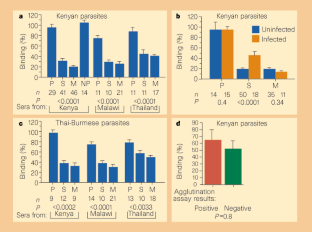
Women are at increased risk from malaria during pregnancy, and, for unknown reasons, this risk is greatest during the first pregnancy1. Plasmodium falciparum, the most virulent of the four malaria parasites of humans, adheres to a molecule called chondroitin sulphate A (CSA) on the surface of syncytiotrophoblasts (cells lining the intervillous space)2 and sequesters in the human placenta. Here we show that anti-adhesion antibodies, which limit the accumulation of parasites in the placenta, appear in pregnant women from Africa and Asia who have been pregnant on previous occasions (multigravidas), but not in those who are pregnant for the first time (primigravidas). Anti-adhesion antibodies against CSA-binding parasites are strain-independent and are associated with greatly reduced prevalence and density of infection. We conclude that malaria susceptibility in primigravidas is related to the lack of these anti-adhesion antibodies, and that an anti-adhesion vaccine for maternal malaria may be globally effective.
This is a preview of subscription content, access via your institution
Access options
Subscribe to this journal
Receive 52 print issues and online access
$199.00 per year
only $3.83 per issue
Buy this article
- Purchase on SpringerLink
- Instant access to the full article PDF.
USD 39.95
Prices may be subject to local taxes which are calculated during checkout
Additional access options:
Figure 1: Serum inhibition of malarial parasite binding to CSA, expressed as the percentage of binding in control serum.
References
- McGregor, I. A. Am. J. Trop. Med. Hyg. 33, 517–525 (1984).
Google Scholar - Fried, M. & Duffy, P. E. Science 272, 1502–1504 (1996).
Google Scholar - Nosten, F., ter Kuile, F., Maelankirri, L., Decludt, B. & White, N. J. Trans. R. Soc. Trop. Med. Hyg. 85, 424–429 (1991).
Google Scholar - Singh, B. et al. Clin. Exp. Immunol. 72, 145–150 (1988).
Google Scholar - Southwell, B. R. et al. Trans. R. Soc. Trop. Med. Hyg. 83, 464–469 (1989).
Google Scholar - Udeinya, I. J., Miller, L. H., McGregor, I. A. & Jensen, J. B. Nature 303, 429–431 (1983).
Article ADS CAS Google Scholar
Author information
Authors and Affiliations
- Department of Immunology, Walter Reed Army Institute of Research, 14th and Dahlia Street, Washington, 20307, DC, USA
Michal Fried & Patrick E. Duffy - Shoklo Malaria Research Unit, PO Box 46, Mae Sot, 63110, Thailand
François Nosten & Alan Brockman - Faculty of Tropical Medicine, Mahidol University, Bangkok, Thailand
François Nosten & Alan Brockman - Nuffield Department of Medicine, Centre for Tropical Medicine, John Radcliffe Hospital, Oxford, OX3 9DU, UK
François Nosten & Alan Brockman - Tropical Child Health Group, Liverpool School of Tropical Medicine, Pembroke Place, Liverpool, L3 5QA, UK
Bernard J. Brabin
Authors
- Michal Fried
- François Nosten
- Alan Brockman
- Bernard J. Brabin
- Patrick E. Duffy
Rights and permissions
About this article
Cite this article
Fried, M., Nosten, F., Brockman, A. et al. Maternal antibodies block malaria.Nature 395, 851–852 (1998). https://doi.org/10.1038/27570
- Issue date: 29 October 1998
- DOI: https://doi.org/10.1038/27570